
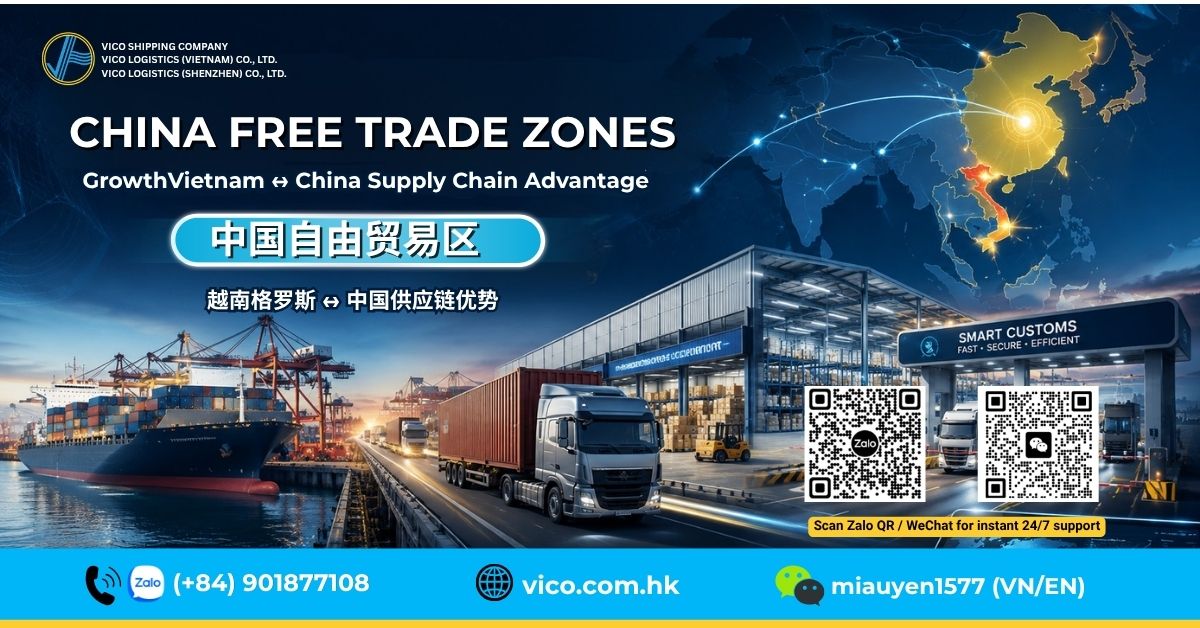
China's Free Trade Zones (FTZs) are reshaping regional supply chains and logistics. From Guangxi bordering Vietnam to Shanghai and Hainan, FTZs offer advantages in customs, bonded warehousing, and multimodal transport, helping businesses optimize import-export operations between Vietnam and China. China's FTZs allow goods to be stored, processed, and distributed under special customs supervision.
1. Introduction to Free Trade Zones (FTZs)
In the increasingly complex landscape of global trade, Free Trade Zones (FTZs) have emerged as an essential strategic tool. For bilateral trade between Vietnam and China—where cargo flows heavily via both sea and land borders—China's FTZs serve not only as gateways but also as commercial hubs designed to maximize speed and flexibility.
An FTZ is a designated area within a country where goods can be imported, stored, lightly processed, transformed, and re-exported under streamlined customs supervision and preferential policies. Crucially, tariffs, VAT, and specific licensing requirements are often suspended until the goods enter domestic circulation.
China has pioneered this model with 22 FTZs up to 2025, spanning from coastal gateways like Shanghai and Guangdong to inland hubs, notably the Guangxi FTZ, which shares a direct border with Vietnam. Properly leveraging these free trade zones enables Vietnamese enterprises to optimize cash flow, reduce lead times, and build a resilient supply chain prepared to mitigate any risks.
Get a Quote Now: https://vico.com.hk/#quotation
| No. | Province / City | Year Established | Area (sq km) | Officially Encouraged Industries & Activities |
|---|---|---|---|---|
| 1 | Shanghai | 2013 | 240 | Finance, Bonded Logistics, High-Tech |
| 2 | Guangdong | 2015 | 116 | High-end Manufacturing, Finance, Logistics |
| 3 | Tianjin | 2015 | 120 | Logistics, Finance, R&D, High-end Manufacturing |
| 4 | Fujian | 2015 | 118 | Tourism, Modern Services, Finance |
| 5 | Liaoning | 2017 | 120 | Logistics, High-Tech Manufacturing, E-commerce |
| 6 | Zhejiang | 2017 | 240 | Oil & Petrochemicals, Aerospace, International Trade |
| 7 | Henan | 2017 | 120 | Advanced Manufacturing, Modern Logistics, Trade |
| 8 | Hubei | 2017 | 120 | Smart Manufacturing, IT, High-end Equipment |
| 9 | Chongqing | 2017 | 120 | IT, Smart Equipment, Modern Services |
| 10 | Sichuan | 2017 | 120 | Logistics, Warehousing, Advanced Manufacturing |
| 11 | Shaanxi | 2017 | 120 | High-Tech, Logistics, Trade, Finance |
| 12 | Hainan | 2018 | 35,400 | High-Tech, Tourism, Services, Logistics, Healthcare |
| 13 | Shandong | 2019 | 120 | International Tourism, Culture, AI |
| 14 | Jiangsu | 2019 | 120 | High-Tech Industries, Tourism (Yachts, Sailing) |
| 15 | Guangxi | 2019 | 120 | Modern Finance, Smart Logistics, Trade |
| 16 | Hebei | 2019 | 120 | Biotech, Services, Digital Trade (Media, Gaming) |
| 17 | Yunnan | 2019 | 120 | Premium Goods, Aviation Logistics, Tourism |
| 18 | Heilongjiang | 2019 | 120 | New Materials, Equipment, Biotech |
| 19 | Hunan | 2020 | 120 | Manufacturing, E-commerce, Logistics |
| 20 | Anhui | 2020 | 120 | AI, High-Tech, New Energy |
| 21 | Beijing | 2020 | 120 | Tech Innovation, Trade, Biotech |
| 22 | Xinjiang | 2023 | 180 | Trade, Logistics, New Materials & Energy, Textiles |
| 23 | Jilin | 2024 | 118 | Smart Vehicles, Ice & Snow Economy, Tech Science |
Source: ciprocess
2. What is a Free Trade Zone and How Does It Work?
The fundamental concept of a free trade zone is an area designed to facilitate international trade.
Basic Definition: An FTZ allows foreign goods to enter, undergo logistics operations or light processing, and subsequently leave (re-export) or enter the domestic market. The core mechanism is "bonded first," meaning goods are considered to have "not entered" the customs territory for taxation purposes.
2.1 Operational Mechanism: Import – Storage – Processing – Re-export
-
Duty/VAT Suspension: The core benefit is the deferral of duties and VAT while goods remain within the zone. Taxes are only incurred when goods are moved out of the FTZ and into the Chinese domestic consumer market. This creates a cash-flow advantage for seasonal inventory storage or kitting/light assembly.
-
Streamlined Customs: FTZs prioritize paperless declarations, consolidated documentation, and single-window customs systems. This directly cuts down warehousing dwell time and shortens documentation processes for logistics operators.
2.2 Comparing FTZs with Vietnam's Export Processing Enterprises (EPEs)
Vietnam's model centers on Industrial Zones (IZs), Economic Zones (EZs), and Export Processing Zones (EPZs). Export Processing Enterprises (EPEs) enjoy input tax exemptions for export-oriented production and VAT exemptions. While functionally similar to FTZs regarding export manufacturing, China's pilot FTZs—particularly in Shanghai and Hainan—are more advanced. They focus on institutional experimentation (financial services, data flows) and transshipment/commercial services alongside traditional manufacturing.
3. Business Benefits Derived from Free Trade Zones
China's FTZs deliver customs efficiency, tax deferrals, and flexible inventory management.
3.1 Tax and Customs Incentives
The most obvious advantage is the deferral of duties and VAT while goods are inside the zone. This holds immense significance for multi-market distribution companies, allowing them to stage inventory in China (e.g., Qinzhou) and delay the import decision until the final Asian market destination is determined.
3.2 Logistics Flexibility
-
Faster Procedures: "Single-window" initiatives in Shanghai have drastically reduced customs clearance times. This provides a strategic edge for transshipment, trade processing, and cross-border e-commerce fulfillment.
-
Operational Flexibility: Value-added activities such as assembly, kitting, and labeling can be executed within the zone, capitalizing on tariff benefits prior to final distribution.
3.3 Boosting Cross-Border E-Commerce
China's FTZs have spearheaded the piloting of cross-border e-commerce models, heavily supported by bonded warehousing. This empowers consumer brands to test the Chinese market efficiently in terms of both taxation and procedures.
4. Key Free Trade Zones for Vietnam - China Trade
While China operates numerous FTZs, the following four zones exert the most profound direct or indirect impact on Vietnam-China supply chains:
4.1 Guangxi FTZ: The ASEAN Gateway
Serving as China's primary gateway connecting with ASEAN and Vietnamese trade, the Guangxi FTZ features three main areas:
-
Qinzhou Port (Beibu Gulf): The anchor of the New Western Land-Sea Corridor, linking inland Chinese provinces with the ASEAN market.
-
Chongzuo (Pingxiang/Youyi Guan): The hub for cross-border land cargo flows with Vietnam. Currently being upgraded into a smart border with 24/7 customs clearance, it has reduced average truck wait times to approximately 3.5 hours and doubled clearance volumes compared to 2019. This is a direct benefit for Vietnamese agricultural and electronic goods.
4.2 Shanghai FTZ
As the inaugural pilot zone (2013), Shanghai FTZ is China's flagship for financial trade, multimodal logistics (port/airport connectivity), and high-end e-commerce models. It is ideal for premium import-export processes and large-scale value-added services.
4.3 Hainan Free Trade Port (FTP)
Hainan represents an upgraded "FTZ-plus" model. Starting December 18, 2025, Hainan will transition to independent customs operations and implement a widespread zero-tariff mechanism. This presents a strategic opportunity for consolidating duty-free goods and importing consumer products.
4.4 Xinjiang FTZ
Established in November 2023, China's 22nd FTZ focuses on westbound rail and road logistics connecting to Central Asia and Europe. This zone is critical for Vietnam-originating cargo utilizing China as a transit point to reach the Eurasian continent via inland rail.
5. Why Free Trade Zones Are Crucial for Vietnam - China Logistics
FTZs, especially the Guangxi FTZ, are game-changers for bilateral logistics, optimizing the flow of goods between the two nations:
5.1 Enhancing Border Clearance (Huu Nghi Quan / Youyi Guan)
The upgrade of Youyi Guan (opposite Vietnam's Huu Nghi border gate in Lang Son) into China's first cross-border smart gate directly benefits Vietnam's transport sector. Reports indicate daily clearance volumes reaching around 3,300 trucks (double the 2019 figure), slashing average wait times by about 3.5 hours per truck.
5.2 Multimodal Flexibility and Storage Cost Optimization
Qinzhou Port (Beibu Gulf) is expanding automated container terminals and rail-sea feeders to connect inland China with ASEAN. This enables carriers to flexibly switch between road, sea, and rail based on congestion or costs. Bonded warehousing in Qinzhou allows businesses to defer taxes until a final market decision is made.
5.3 Supporting Vietnamese Enterprises in Market Expansion
The Vietnam-China logistics advantage is demonstrated through speed and processing capacity:
-
Agricultural Goods (Northbound): Accelerated clearance and flexible bonded staging at Chongzuo/Pingxiang prior to pushing into the Guangdong/Guangxi consumer markets.
-
Electronics (Southbound): Component cargo is consolidated at bonded zones in Shanghai or Qinzhou, followed by light assembly/labeling, and trucked via Youyi Guan to manufacturing hubs in Bac Ninh/Bac Giang.
6. New Policies and Development Trends Toward 2025
China's FTZs continue to expand trade capabilities through smart logistics infrastructure.
6.1 Hainan FTP Zero-Tariff Policy 2025
The completion of Hainan FTP's customs closure mechanism by December 18, 2025, is a major signal. The shift to a negative-list approach and the application of a broader zero-tariff scope generate unprecedented opportunities for consumer brands and bonded distribution.
6.2 Customs Digitalization Trends at the Border
The "smart border" development at Youyi Guan demonstrates a commitment to digitalization aimed at achieving 24/7 clearance. Furthermore, FTZs like Shanghai/Lingang and Hainan are piloting data export negative lists to enable logistics platforms to compliantly synchronize inventory and commercial documentation with international systems.
6.3 Comparing FTZ Models in ASEAN
While Singapore features traditional entrepôt-style FTZs (focused on transshipment/hubbing) and Vietnam's EPZs focus on export manufacturing, China's FTZs stand out due to:
-
Diversity and Scale: Encompassing border-centric FTZs like Guangxi and Xinjiang to support ASEAN and Eurasian land-sea corridors.
-
Institutional Experimentation: Integrating advanced financial, data, and service mechanisms alongside traditional bonded frameworks.
-
Core Focus: Emphasizing trade facilitation rather than strictly manufacturing.
7. How Vietnamese Enterprises Can Leverage Free Trade Zones
Practical applications for optimizing the Vietnam-China supply chain:
7.1 Applications for the Agricultural Sector
-
Flexible Warehousing: Fresh produce (fruits, seafood) from Vietnam can be consolidated in bonded zones at Chongzuo/Pingxiang (Guangxi FTZ). This permits businesses to defer duties until formal orders enter the domestic market, alleviating the pressure of immediate sales.
-
Utilizing Smart Borders: Leveraging smart-gate scheduling services ensures rapid clearance, preserving product quality.
7.2 Applications for the Electronics and Components Sector
-
Cargo Consolidation: Electronic components can be consolidated in bonded areas in Shanghai or Qinzhou, undergoing labeling and simple kitting before being reverse-shipped to Vietnamese manufacturing hubs via Youyi Guan.
7.3 Transshipment Trends for Vietnamese Goods to the EU
Vietnamese enterprises can utilize inland FTZs like Xinjiang (or Chongqing/Chengdu) as transshipment hubs. Goods from Vietnam can be shipped to these cities and then forwarded via rail to Central Asia/Europe, acting as an effective lead-time and cost-hedging strategy.
8. Risks and Mitigation Strategies When Using Free Trade Zones
While FTZs offer tariff "freedom," this does not equate to regulatory compliance "freedom."
8.1 Regulatory Compliance Risks
-
Issue: Product-specific controls, licenses, and standards (especially for agriculture and food) remain applicable, regardless of the goods being in an FTZ.
-
Mitigation: Develop detailed checklists based on HS Codes and specific FTZ regulations to avoid surprises when goods are released inland.
8.2 Policy Fluctuation Risks
-
Issue: FTZ negative lists and pilot programs are constantly evolving (e.g., new data export rules).
-
Mitigation: Closely monitor zone-specific circulars and adjust Standard Operating Procedures (SOPs) promptly.
8.3 Border Operational Congestion Risks
-
Issue: Despite significant clearance improvements, border traffic can still spike seasonally, causing bottlenecks.
-
Mitigation: Employ time-of-day slotting strategies and buffer staging within border-adjacent bonded zones to smooth out congestion peaks.
9. Conclusion: Free Trade Zones as an Essential Competitive Tool
VICO supports businesses in optimizing China-Vietnam logistics through FTZ strategies and cross-border operations.
For B2B exporters, free trade zones are competitive tools that extend far beyond the concept of "tax reduction." They deliver advantages in clearance times, market optionality, and advanced institutional frameworks.
The combination of flexible bonded mechanisms, single-window customs, and digitized land borders (typified by the Guangxi FTZ), coupled with the expansion of the Hainan FTP and new routes via the Xinjiang FTZ, is forging a wider and faster network for the Vietnam-China supply chain. If your 2025–2026 business plan involves expanding imports and exports via China, mastering and navigating these FTZs is a prerequisite for capturing competitive advantages and maintaining market leadership.
Frequently Asked Questions (FAQ) about Free Trade Zones
How does a Free Trade Zone differ from a Special Economic Zone (EZ) or an Export Processing Zone (EPZ)?
Although both EPZs and FTZs provide duty/VAT exemptions for exported goods, the main difference lies in their operational scope and institutional experimentation. Vietnam's EPZs focus on export-oriented manufacturing and processing. Conversely, China's pilot FTZs (like Shanghai and Hainan) not only offer tariff benefits but also serve as testing grounds for financial, data flow, and service reforms, with a strong emphasis on transshipment and commerce.
Do Vietnamese enterprises require a separate license to operate within a Chinese FTZ?
Vietnamese businesses (or their logistics partners) must register or partner with a legal entity already authorized to operate within the FTZ. Specific procedures for warehousing and light processing services must strictly comply with the unique customs regulations of each specific zone.
Which Vietnamese industries benefit most from Chinese Free Trade Zones?
- Agriculture/Fresh Produce: Benefits from accelerated clearance at the Guangxi FTZ and bonded staging capabilities to defer taxes, mitigating spoilage risks.
- Electronics & Components: Leverages FTZs (Shanghai, Qinzhou) for cargo consolidation, labeling, and expedited transit between manufacturing hubs in Vietnam and China.
- Consumer Goods/E-commerce: Stands to gain from the upcoming Hainan FTP (zero-tariff) to efficiently test China's duty-free retail market.
How will the Hainan Free Trade Port impact Vietnamese consumer goods exports?
When Hainan transitions to a zero-tariff mechanism (expected Dec 2025), it will create a massive, highly attractive domestic consumer market devoid of tariffs for numerous commodities. This unlocks opportunities for high-quality Vietnamese consumer goods (food, textiles, etc.) to enter China via this duty-free channel, especially if supply chains and warehousing can be established within the FTP.
What are the risks if a business heavily relies on Chinese FTZs?
The primary risk is policy fluidity and the distinction between being "tax-exempt" and "compliance-exempt." Negative lists and pilot rules (such as data regulations) can shift rapidly. Over-reliance on FTZs without a contingency strategy (like combining road and sea freight) can lead to disruptions in the event of operational bottlenecks or abrupt policy changes.
- Door to Door China to Vietnam: The Ultimate B2B Shipping Solution for 2026
- Choose the Right Manufacturing Model (OEM, ODM, OBM) for Your Import/Export Business
- Electronics Shipping: Mastering the Logistics of High Value Technology
- Cambodia Vietnam Transportation: Comprehensive Solutions for the Indochina Supply Chain
- Air Freight Cost Per Kg 2026: The Ultimate Guide to Understanding Rates and Optimizing Your B2B Shipments
Get a Logistics Quote in just 5 minutes
Professional international transportation and supply chain solutions tailored for your business.
Get a quote now ↗Quick Contact
🇻🇳 Ms Uyen
Hotline / Zalo
(+84) 901 877 108WeChat (VN/EN)
miauyen1577Scan to Contact
Zalo
🇨🇳 Ms Schyler
Office Hotline
(+852) 3759 9300WeChat ID
Schyler_skylarScan to Contact
VICO International Logistics — Your Trusted Logistics Partner in Indochina
Senior member of international logistics and trade associations: Eurocham, JCtrans, VICOFA, VITAS, and more.