


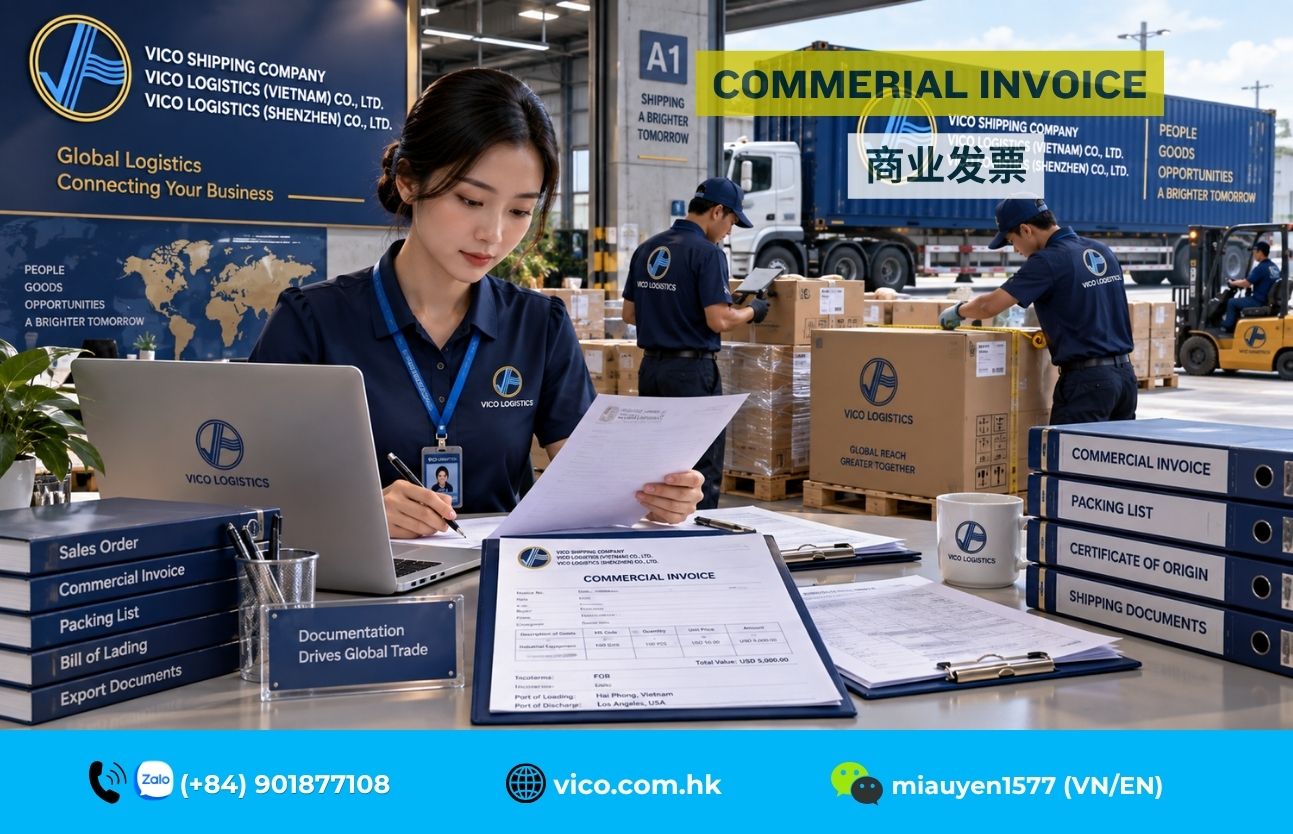
A Commercial Invoice is one of the most important documents in international trade. Whether you are exporting goods by sea, air, road, or rail, the information shown on the commercial invoice can directly affect customs clearance, import duties, shipment processing, and communication between the seller and buyer.
A small mistake — such as an incorrect product description, quantity, value, or Incoterm—can create questions during customs clearance and potentially delay a shipment.
For businesses involved in international shipping, understanding how to prepare a commercial invoice correctly is therefore essential.
1. What Is a Commercial Invoice?
A commercial invoice is a document issued by the seller or exporter to the buyer or importer for goods sold internationally.
It provides the commercial details of the transaction, including what is being sold, the quantity, value, currency, buyer and seller information, and other shipping-related information.
Unlike a simple domestic sales invoice, a commercial invoice is commonly used as part of the documentation required for international shipping and customs procedures.
Customs authorities may use the document to understand:
What goods are being imported or exported
Who is buying and selling the goods
The declared commercial value
The origin of the goods
The terms of sale
The basis for calculating applicable duties and taxes
The exact requirements can vary depending on the destination country, type of cargo, and customs regulations.
2. Why Is a Commercial Invoice Important in International Shipping?
The commercial invoice performs several important functions throughout an international shipment.
Customs clearance
Customs authorities review the invoice to identify the goods, transaction value, country of origin, and other information relevant to import or export procedures.
If information is incomplete or inconsistent, customs may request clarification or additional documentation.
Customs valuation
The declared value on the commercial invoice may be one of the key pieces of information considered when determining the customs value of imported goods.
This can affect the calculation of duties, VAT, or other import-related charges.
Buyer and seller record
The invoice also serves as a commercial record between the exporter and importer, showing the goods sold and their agreed value.
Freight and logistics documentation
Freight forwarders and customs brokers may refer to information from the commercial invoice when preparing shipment documents, customs declarations, and transportation instructions.
For this reason, consistency between documents is extremely important.
3. What Information Should a Commercial Invoice Include?
Although requirements differ between countries, a typical commercial invoice should contain the following information.
Seller / Exporter Information
Include the full legal details of the company selling the goods:
- Company name
- Address
- Country
- Telephone / Email
- Tax or business identification number, when applicable
Buyer / Importer Information
Provide the full details of the receiving company:
- Buyer / Importer name
- Address
- Country
- Contact information
If the importer of record is different from the buyer, additional information may be required.
Invoice Number
Each commercial invoice should have a unique reference number.
For example:
Invoice No.: VICO-EXP-2026-001
A clear numbering system makes documentation easier to track and reconcile.
Invoice Date
State the date the invoice was issued.
Product Description
The description should be clear enough for customs authorities to understand what the product actually is.
Instead of:
- Parts
use a more specific description such as:
Stainless steel machine components for industrial equipment
Instead of:
- Clothes
use:
Men's 100% cotton knitted T-shirts
Specific descriptions generally reduce ambiguity during customs review.
Quantity
Include the number of units being sold.
For example:
500 cartons
or
10,000 pieces
The quantity should match related shipping documents.
Unit Price
State the agreed price for each unit.
Example:
USD 5.00 / piece
Total Commercial Value
Calculate the total value of the goods.
For example:
10,000 pieces × USD 5.00
Total Value: USD 50,000
Currency
Always clearly identify the currency.
Examples include:
- USD
- EUR
- CNY
- VND
Writing only “50,000” without stating the currency can create unnecessary confusion.
HS Code
Where appropriate, include the relevant Harmonized System (HS) code used to classify the product for customs purposes.
Correct classification is important because the HS code can influence duties, restrictions, documentation requirements, and customs procedures.
Country of Origin
The country of origin identifies where the goods were manufactured or produced.
For example:
Country of Origin: Vietnam
The country of origin is not necessarily the same as the country from which the goods are shipped.
Incoterms
Clearly state the agreed Incoterm and named place.
For example:
FOB Hai Phong Port, Incoterms® 2020
or:
DDP Shanghai, Incoterms® 2020
This helps clarify how transportation costs, responsibilities, and risks are allocated between the seller and buyer.
Shipping Information
Depending on the shipment, the invoice may also include:
Mode of transport, port of loading, port of discharge, final destination, shipment reference or purchase order number.
Payment Terms
Examples include:
- T/T 30 days
- 100% payment before shipment
- Letter of Credit
- Payment terms should reflect the actual commercial agreement between seller and buyer.
4. How to Prepare a Commercial Invoice Step by Step
A practical process can reduce documentation errors.
Step 1 — Confirm seller and buyer information
Use the correct legal company names and addresses.
Avoid abbreviations unless they are officially part of the company's registered name.
Step 2 — Confirm the purchase order
Compare the invoice against the purchase order or sales contract.
Verify:
- Product
- Quantity
- Price
- Currency
- Payment terms
- Incoterm
Step 3 — Describe the goods accurately
Use clear commercial descriptions rather than internal product codes alone.
For example, an invoice showing only:
Model XZ-102
does not explain what the product actually is.
A better description might be:
Electric motor, Model XZ-102, 220V, for industrial machinery
Step 4 — Check quantity, unit price, and total value
Make sure the calculation is correct.
Quantity × Unit Price = Total Value
Also verify whether freight, insurance, or other costs need to be shown separately based on the transaction and destination requirements.
Step 5 — Confirm HS codes and origin
Incorrect HS classifications or origin information can create customs problems.
If classification is uncertain, businesses should confirm it with an experienced customs professional rather than guessing.
Step 6 — State the Incoterm correctly
Don't write only:
FOB
Instead, specify the named location:
FOB Cat Lai Port, Incoterms® 2020
The named place is an important part of the Incoterm.
Step 7 — Cross-check all shipping documents
Before submitting the documentation, compare the Commercial Invoice against:
- Packing List
- Bill of Lading / Air Waybill
- Certificate of Origin
- Customs Declaration
- Purchase Order
Important information such as quantity, cargo description, weight, consignee, and shipment details should be consistent where applicable.
5. Commercial Invoice Example
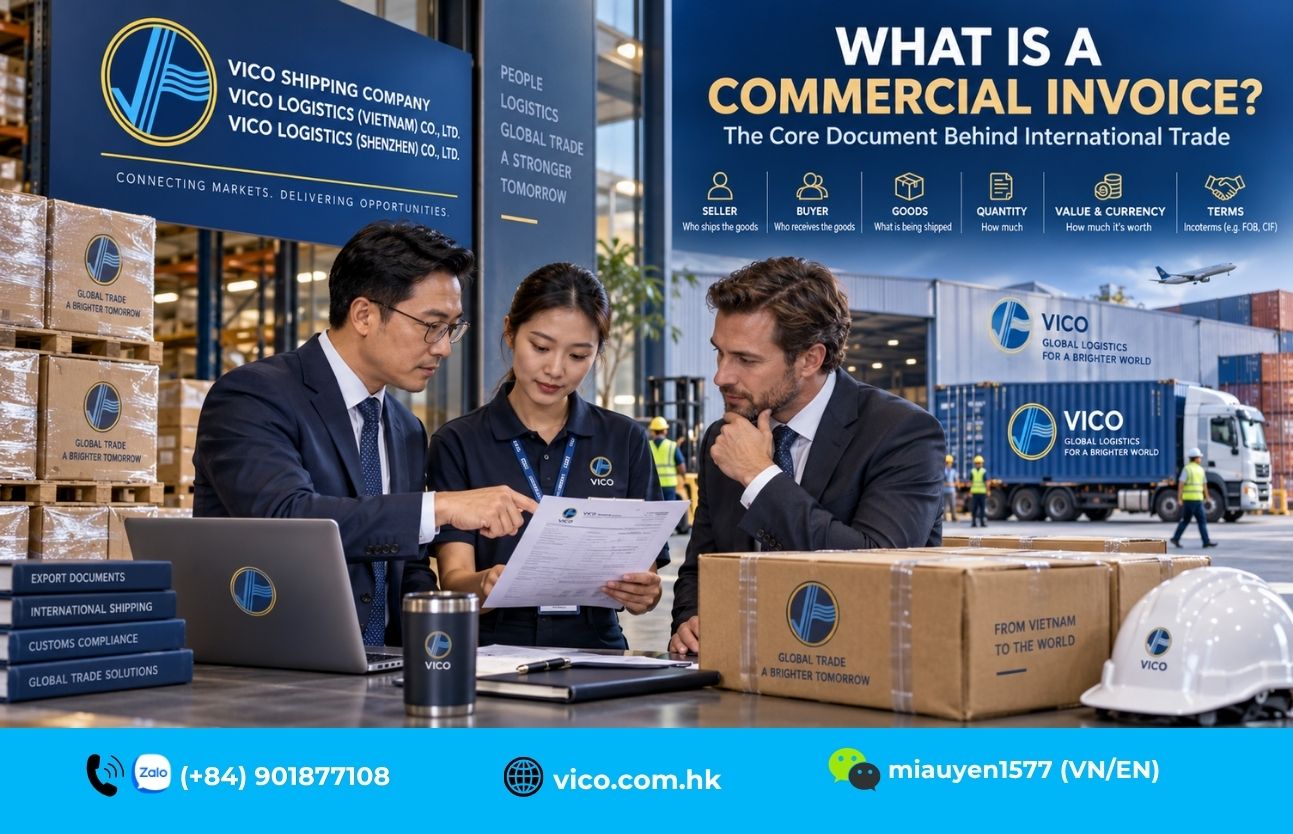
A simple commercial invoice could look like this:
COMMERCIAL INVOICE
Exporter:
ABC Coffee Export Co., Ltd.
Ho Chi Minh City, Vietnam
Importer:
XYZ Trading Co., Ltd.
Shanghai, China
Invoice No.: ABC-2026-018
Invoice Date: September 18, 2026
Product: Vietnamese roasted coffee beans, 1kg commercial bags
HS Code: [Applicable HS Code]
Quantity: 2,000 bags
Unit Price: USD 8.00
Total Value: USD 16,000
Country of Origin: Vietnam
Incoterm: CIF Shanghai, Incoterms® 2020
Currency: USD
Payment Terms: T/T
This is only a simplified example. Actual customs and documentation requirements may differ by market and commodity.
6. Commercial Invoice vs. Proforma Invoice
A Commercial Invoice and Proforma Invoice can contain similar information, but they serve different purposes.
A Proforma Invoice is generally issued before the final sale or shipment. It may be used to provide the buyer with an estimated price and transaction details.
A Commercial Invoice represents the actual commercial transaction and is commonly used during the shipment and customs clearance process.
In simple terms:
Proforma Invoice → before the final transaction
Commercial Invoice → actual shipment / commercial transaction
Businesses should not automatically substitute one for the other when customs requires a final commercial invoice.
7. Commercial Invoice vs. Packing List
These documents are related but serve different functions.
The Commercial Invoice focuses primarily on the commercial value and transaction.
It contains information such as:
- Product value
- Unit price
- Currency
- Buyer and seller
- Payment terms
- Incoterms
The Packing List focuses mainly on the physical shipment.
It typically contains:
- Number of cartons
- Package dimensions
- Net weight
- Gross weight
- Packing method
- Marks and numbers
A simple way to remember the difference is:
Commercial Invoice = What the goods are worth
Packing List = How the goods are physically packed
Both documents should describe the same shipment consistently.
8. Common Commercial Invoice Mistakes
Documentation errors can lead to additional questions, corrections, customs delays, and unexpected costs.
Some of the most common problems include:
Vague product descriptions
Writing “samples,” “parts,” or “accessories” may not provide enough information.
Incorrect HS codes
Incorrect product classification can affect customs duties and regulatory requirements.
Invoice value does not match the transaction
The declared commercial value should reflect the transaction and comply with applicable customs rules.
Incorrect currency
Always state whether the transaction is in USD, EUR, CNY, or another currency.
Inconsistent quantities
The number of units on the Commercial Invoice should correspond with the relevant shipping and packing documents.
Incorrect Incoterms
For example, the sales contract may state FOB while the invoice states CIF.
Incorrect country of origin
Shipping goods from Vietnam does not automatically mean the goods originate in Vietnam.
Documents do not match
Commercial Invoice, Packing List, B/L, AWB, C/O and customs declarations should not contain conflicting shipment information.
9. Commercial Invoice Checklist Before Shipping
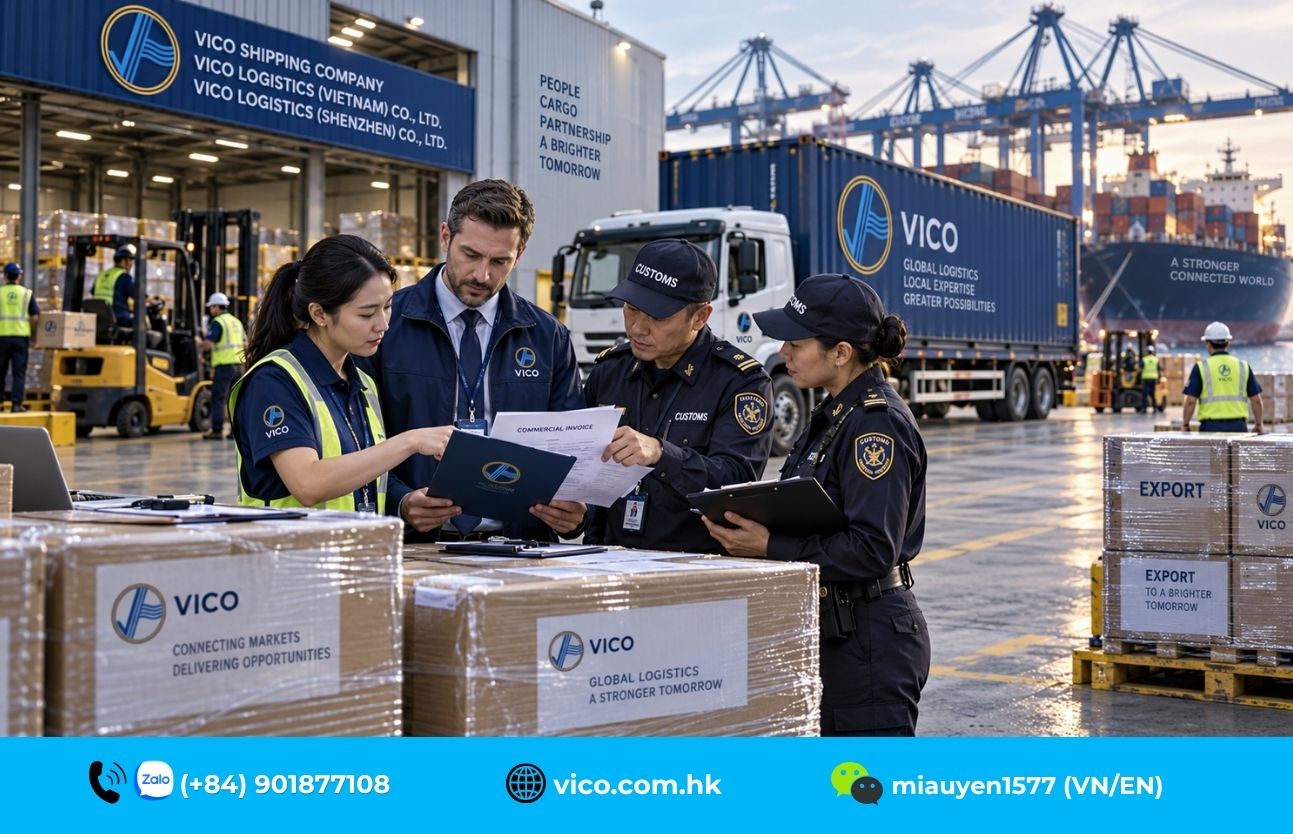
Before sending the invoice to your logistics or customs team, check:
✓ Exporter information correct
✓ Importer information correct
✓ Invoice number and date included
✓ Product descriptions clear
✓ Quantity correct
✓ Unit prices correct
✓ Total invoice value correct
✓ Currency stated
✓ HS code checked
✓ Country of origin checked
✓ Incoterm + named place included
✓ Payment terms correct
✓ Information matches Packing List
✓ Information matches transportation documents
✓ Any destination-specific requirements confirmed
Taking a few minutes to perform this check can prevent significantly more time being lost later in the shipment.
10. How VICO Logistics Can Support Your Shipment
Preparing accurate shipping documentation is only one part of a successful international shipment.
VICO Logistics supports businesses across international supply chains with solutions including:
- Freight forwarding
- Customs clearance coordination
- Cross-border transportation
- Ocean and air freight
- Warehousing and cargo handling
- Shipment consolidation
- Documentation coordination
For businesses shipping across Vietnam, China and the wider Indochina region, having an experienced logistics partner can help reduce documentation problems and improve coordination between the exporter, importer, carrier, warehouse, and customs parties.
Conclusion
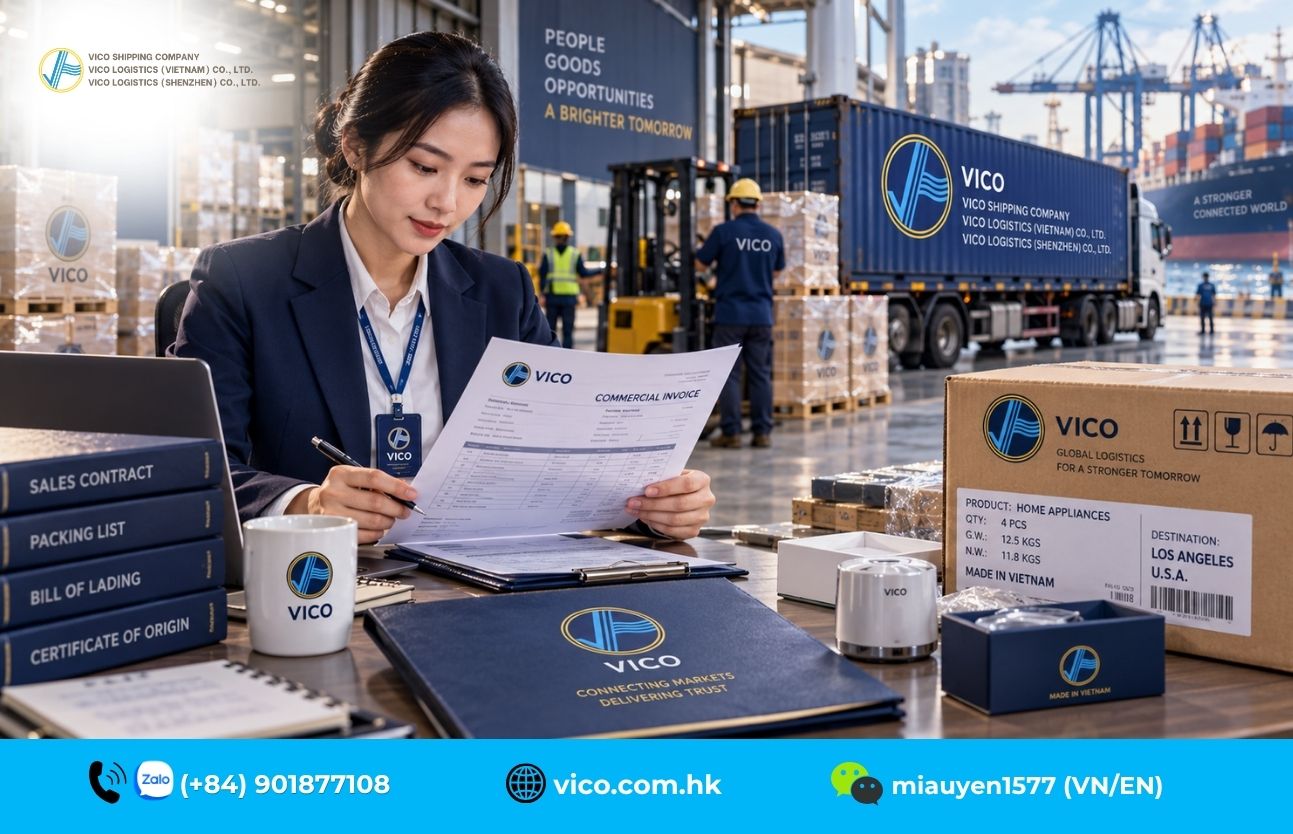
A Commercial Invoice may look like a simple sales document, but in international logistics it plays a much larger role.
Customs authorities, importers, exporters, freight forwarders and other parties may rely on its information throughout the shipment.
The key is accuracy and consistency.
Make sure the commercial invoice clearly describes the goods, shows the correct transaction value, specifies the currency and Incoterm, and matches the information appearing across the rest of the shipping documentation.
Good documentation does not just support compliance—it helps create a smoother supply chain from seller to customs to final delivery.
Need support with your international shipment?
VICO Logistics can help coordinate freight forwarding, customs clearance and logistics documentation for your cross-border shipments.