
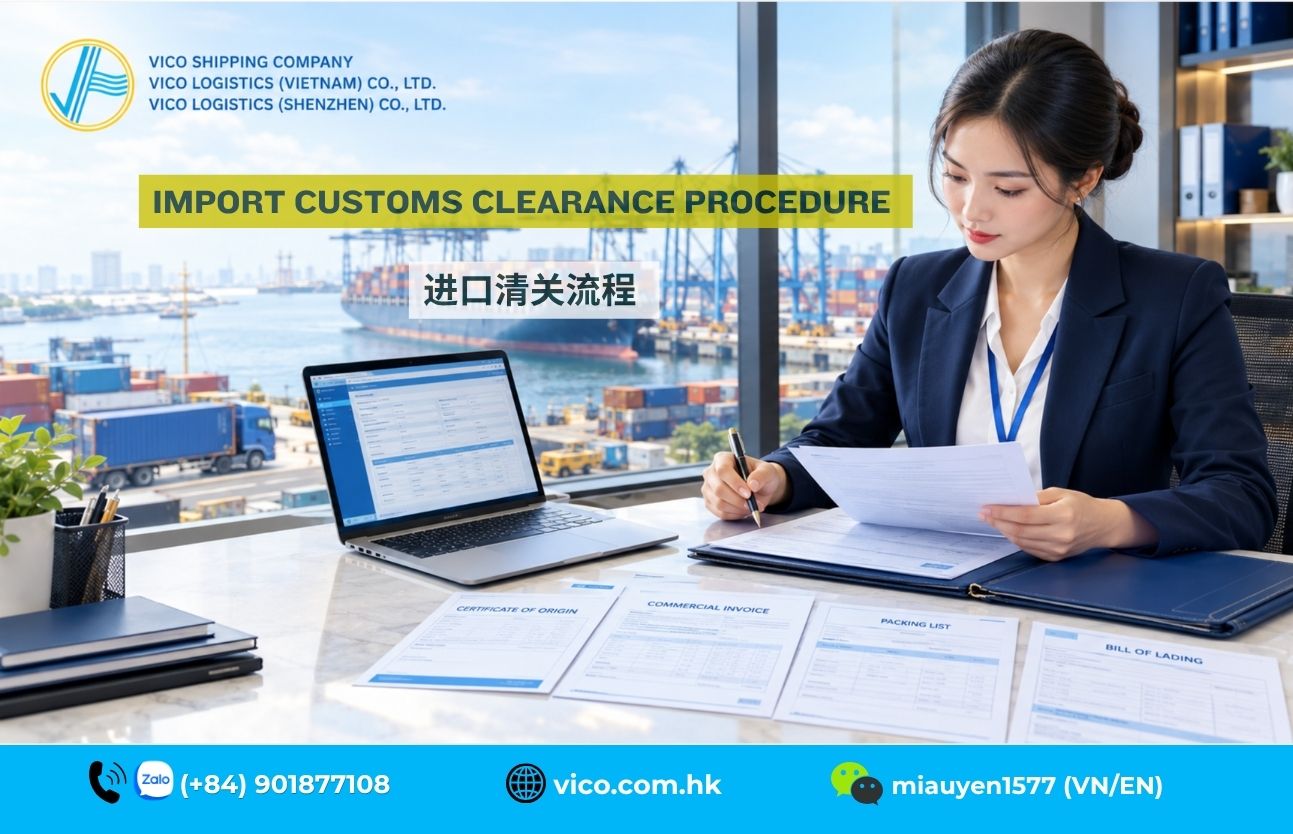
Customs clearance is a critical stage in the goods import process, directly impacting delivery schedules, logistics costs, and business operation plans. If documents are incomplete, HS codes are inaccurate, or goods fail to meet import conditions, the processing time can be prolonged, resulting in additional expenses.
What are the steps involved in the import customs clearance process? What documents should businesses prepare, what types of taxes must be paid, and how can delays at the port be minimized?
In this article, VICO Logistics provides a detailed, step-by-step guide to importing goods through customs in Vietnam, while sharing practical considerations to help businesses proactively manage documentation, time, and costs.
1. What is Import Customs Clearance?
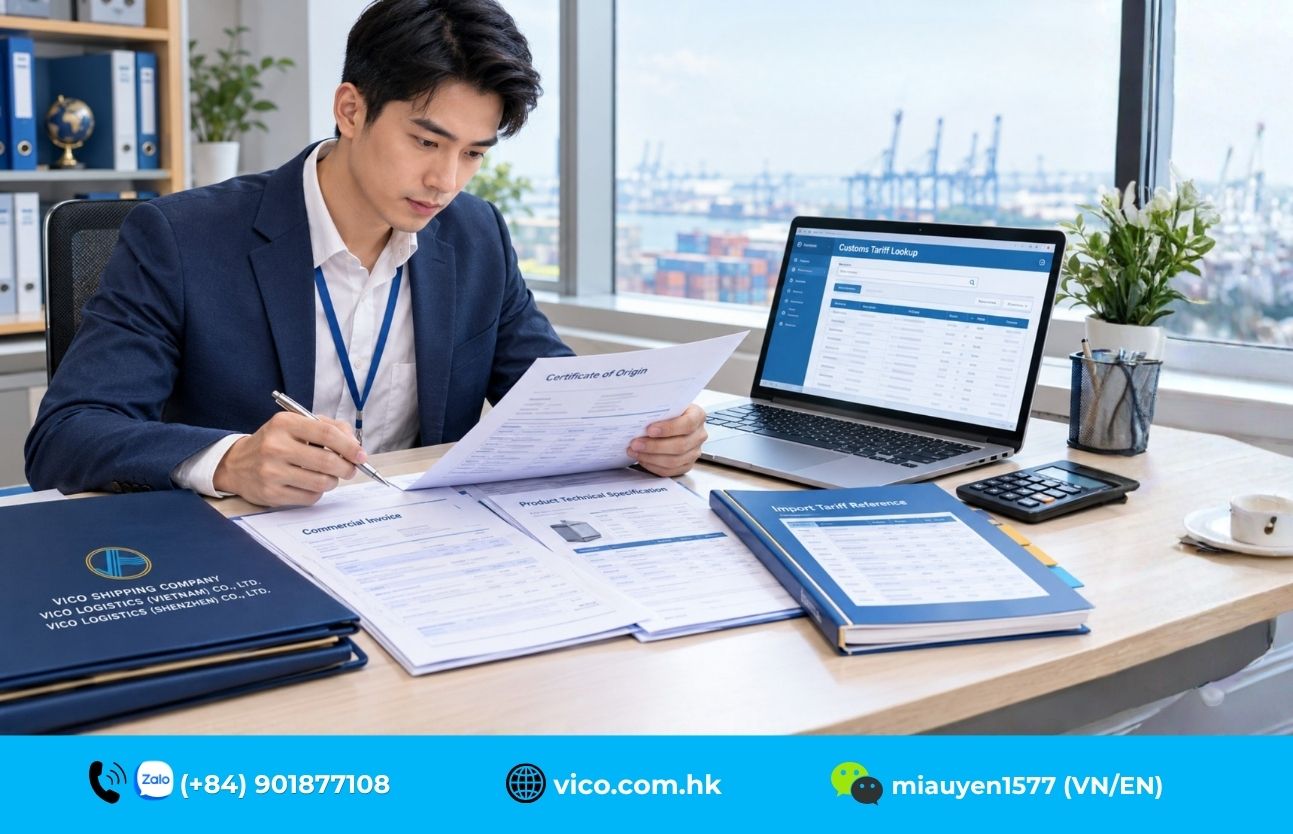
Import customs clearance is the process of completing all necessary customs procedures to legally allow goods to be imported according to regulations. Depending on the type of goods, this process may include customs declaration, document verification, physical inspection of goods, specialized inspections, and fulfillment of tax obligations.
Customs clearance does not mean that the goods have already been delivered to the importer's warehouse. After meeting the release conditions stipulated by regulations, the business must still complete delivery procedures, settle related costs, and arrange transportation of the goods to the designated receiving location.
Why is following the correct clearance process necessary?
Executing the correct procedure helps businesses:
-
Minimize errors in declaration and document preparation.
-
Accurately determine HS codes, import policies, and tax liabilities.
-
Actively coordinate with shipping lines, forwarding agents, and specialized management agencies.
-
Reduce the risk of delivery delays, container detention (DEM), or storage (DET) fees.
-
Better control the total cost of bringing goods into the warehouse.
For regular importers, establishing a document review process before goods are shipped is much more effective than starting the process only when the goods arrive at the port.
2. What Documents Are Included in Import Customs Clearance?
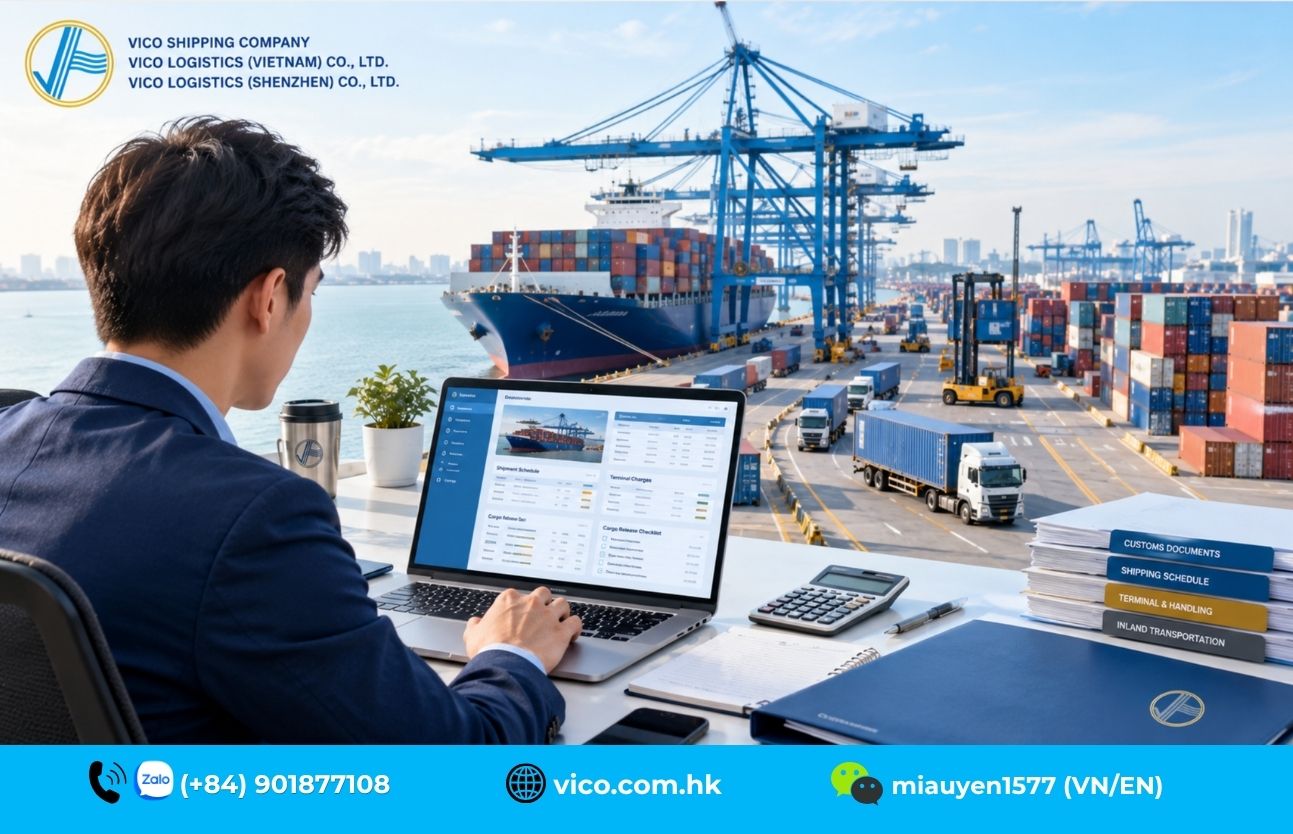
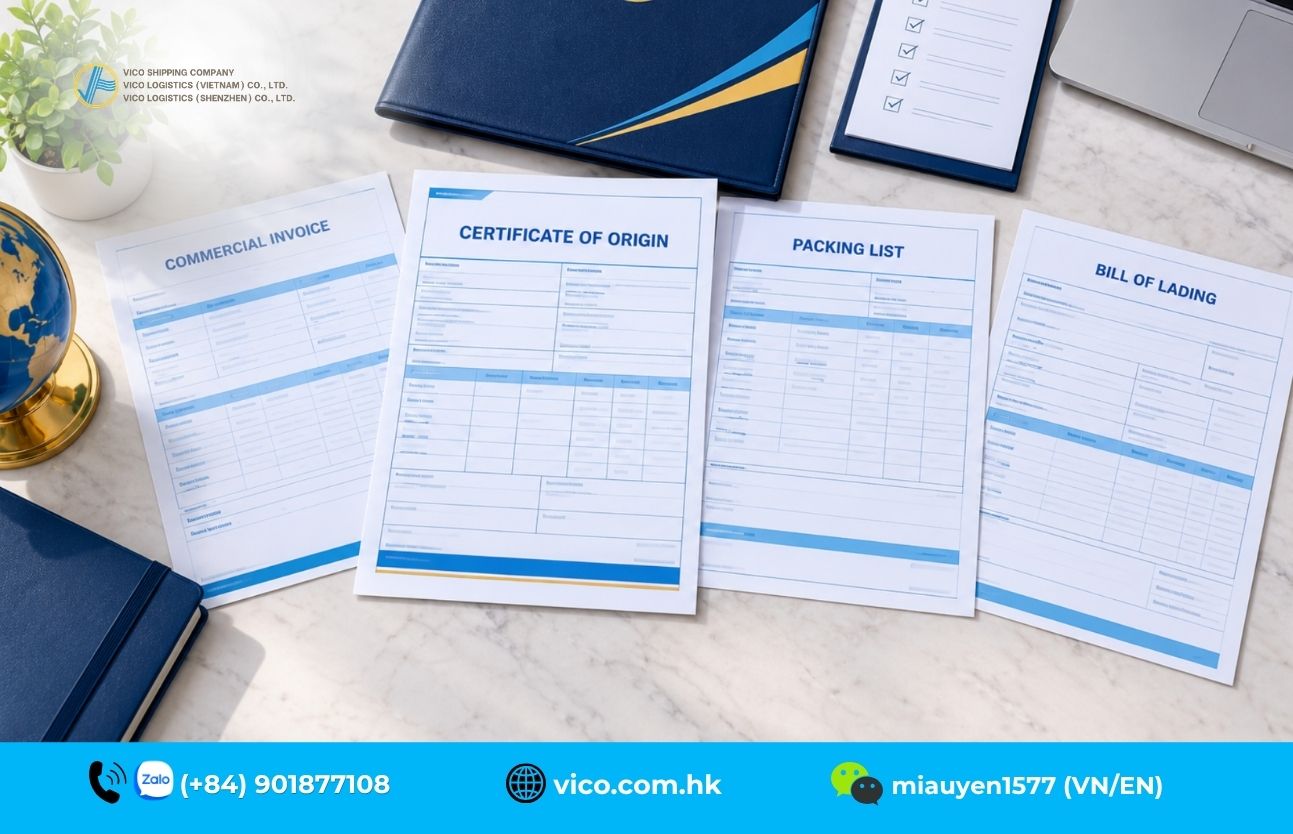
Customs dossiers are determined by the type of goods, import method, and relevant regulations. Not every shipment requires the exact same set of documents.
Below are the documents businesses typically need to prepare and cross-check.
|
Document
|
Purpose
|
|
Customs Declaration Form
|
Declare goods information and shipment-related contents
|
|
Commercial Invoice
|
Indicate transaction details, goods description, and invoice value
|
|
Packing List
|
Indicate package counts, weight, packaging specifications, and related details
|
|
Bill of Lading (B/L) or equivalent transport document
|
Indicate transportation and cargo handling details
|
|
Sales Contract
|
Cross-check transaction terms when necessary
|
|
Certificate of Origin (C/O)
|
Origin document used to determine origin and consider tariff preferences if eligible
|
|
Import License or specialized inspection results
|
Applicable to goods under corresponding management scopes
|
|
Other required documents
|
Depending on the goods type, import method, and specialized regulations
|
According to Article 24 of the Customs Law, the customs dossier includes the customs declaration or alternative documents as prescribed, along with relevant documents. The specific components must be based on each individual import case; do not assume that every document listed in the table is mandatory for all shipments.
Document Check Checklist Prior to Declaration
Before transmitting the customs declaration, businesses should verify the following information:
-
Name and address of the seller and buyer.
-
Goods name, product description, model, brand, and technical characteristics if applicable.
-
Quantity, unit of measurement, weight, and number of packages.
-
Unit price, total value, payment currency, and delivery terms.
-
Bill of lading number, transport vehicle details, and relevant ports.
-
Goods origin and the suitability of the C/O if utilized.
-
Estimated HS code, import policies, and necessary licenses.
-
Consistency across the commercial invoice, packing list, transport documents, and other certificates.
Note: A document may be formally complete yet lack consistency in content. For instance, overly generic product descriptions on an invoice can make it difficult for businesses to determine HS codes or justify product characteristics when requested.
3. The 7-Step Import Customs Clearance Process
Step 1: Check Import Policies and Goods Conditions
Before goods are shipped to Vietnam, businesses must verify whether the goods are permitted for import and whether they fall under special management categories.
Key items to check include:
-
Do the goods belong to the prohibited or restricted import lists?
-
Is an import license, specialized inspection registration, quarantine, quality inspection, or other management procedure required?
-
Are there specific requirements regarding product labeling, safety, technical standards, or specific import conditions?
-
Can the goods benefit from tariff preferences under any trade agreements?
-
What documents need to be prepared and at what timeline should each procedure be executed?
Identifying import policies early allows businesses to proactively prepare dossiers and avoid scenarios where goods arrive at the port without meeting the necessary processing conditions.
Example: A shipment of machinery and a shipment of foodstuffs may have different documentation, specialized inspection, and import condition requirements. Therefore, do not apply a uniform document process to all product types.
Step 2: Prepare and Cross-Check Import Documents
After identifying import policies, the business collects documents from the supplier, carrier, or related parties.
Import-export personnel must verify consistency among the Commercial Invoice, Packing List, Bill of Lading, Contract, and C/O (if applicable).
Discrepancies that must be resolved prior to declaration include:
-
Inconsistent goods names or descriptions.
-
Discrepancies in quantity, weight, or units of measurement.
-
Incorrect buyer or seller information.
-
Unclear delivery terms and cost components.
-
C/O mismatched with the goods, documents, or applied rules of origin.
If errors are discovered, businesses must coordinate with the document issuer to handle them properly under regulations, rather than altering documents arbitrarily outside their authority.
Step 3: Determine HS Codes, Taxes, and Customs Value
This step significantly impacts tax liabilities and declaration accuracy.
-
Determining HS Codes: HS codes are determined based on the nature, composition, intended use, structure, technical characteristics, and relevant classification rules. Do not rely solely on trade names or HS codes suggested by foreign suppliers. When classification is unclear, businesses should gather catalogues, technical documents, images, or samples where applicable to support evaluation.
-
Determining Customs Value: Customs value is established according to valuation methods and principles. Invoice values cannot automatically be used as-is in all cases without considering related factors. Businesses must review delivery terms, freight costs, insurance, and relevant adjustments under regulations.
-
Estimating Import Duties: Depending on the goods, tax liabilities may include:
-
Import duties.
-
Value Added Tax (VAT) on imports.
-
Special Consumption Tax or other taxes if applicable.
-
Tax rates and assessment bases depend on the product, HS code, origin, tax policies, and applicable conditions at the time of import. If using a C/O to request special preferential tax rates, verify the corresponding trade agreement, rules of origin, qualifying criteria, and documentation requirements. Holding a C/O does not automatically guarantee tax exemption or lower rates.
Step 4: Submit and Transmit Electronic Customs Declarations
Once sufficient information and documents are ready, the declarant submits the declaration via the electronic system per current regulations.
Information typically reviewed includes:
-
Importer and exporter details.
-
Goods description, HS code, and origin.
-
Quantity, weight, unit of measurement, and declared value.
-
Transport details, ports, and related data.
-
Tax amounts and management policies applied to the goods.
Upon transmission, the system processes and returns results accordingly. Declarants must review feedback, fulfill subsequent requests, and perform amendments or supplemental declarations based on valid grounds and correct procedures.
Key Takeaway: Electronic declaration does not mean every shipment clears automatically. Customs authorities may review documents or request physical inspections on a case-by-case basis.
Step 5: Conduct Customs Inspections and Specialized Inspections When Applicable
Depending on the declaration outcome and shipment characteristics, businesses may need to undergo one or more inspection procedures.
-
Document Inspection: Customs officials review declared details and supporting documents. If ambiguities or discrepancies arise, businesses must supply documents, clarifications, or adjustments per valid requests.
-
Physical Inspection of Goods: Goods may be inspected according to forms and scopes decided by competent authorities. Businesses must cooperate in arranging goods, workforce, and documents as guided.
-
Specialized Inspection: For items subject to specialized management, businesses must complete corresponding procedures mandated by the authorized governing agency.
To minimize delays, businesses should pre-identify inspection requirements, preparation timelines, and inter-party coordination. Actual timeframes depend on product categories, document status, and agency processing outcomes.
Step 6: Pay Taxes and Complete Related Obligations
Upon determining financial obligations, businesses settle taxes as prescribed or apply appropriate mechanisms if eligible.
Prior to payment, cross-check:
-
HS codes and applicable tax rates.
-
Taxable value and related adjustments.
-
Import duties, VAT, and any emerging taxes.
-
Eligibility conditions for tariff preferences.
-
Tax obligation status and remaining system requirements.
Aside from taxes, businesses should budget for related logistics fees, such as document fees, port handling fees, forwarding fees, container detention, storage charges, or other costs depending on the transportation mode and service contracts.
These costs are not all taxes or customs fees; differentiating them clearly helps control expenses and reconcile invoices from individual service providers.
Step 7: Receive Clearance Results and Arrange Delivery
When goods satisfy release or customs clearance conditions under regulations, businesses proceed with delivery steps.
Practical steps typically include:
-
Checking declaration status and remaining pending requirements.
-
Completing cargo release procedures with the shipping line, carrier, or port.
-
Settling related fees per contracts.
-
Booking domestic transport and confirming pickup schedules.
-
Inspecting cargo quantity and condition upon receipt, and archiving documentation.
-
Reconciling actual expenses against projected budgets.
Customs clearance is a milestone, but not the entirety of the import process. To prevent hiccups, businesses must synchronize customs declaration, vessel schedules, port procedures, and warehouse delivery plans.
4. How Long Does Import Customs Clearance Take?
There is no fixed timeframe applicable to all import shipments. Actual duration depends on product characteristics, document completeness, routing results, specialized inspection requirements, tax obligations, and the processing status of involved parties.
Factors affecting clearance duration include:
-
Completeness and consistency of documentation.
-
Whether HS codes, values, or origins require additional explanations.
-
Whether goods are subject to licensing or specialized inspections.
-
Whether a physical inspection of goods is required.
-
Whether the business has fulfilled all necessary obligations.
-
Working schedules, pickup slots, and coordination capacity of participating entities.
It is vital to distinguish between customs processing time and total lead time from port arrival to warehouse delivery. Total receiving time may also include waiting for unloading, document processing, delivery order (D/L) issuance, truck arrangement, and inland transport.
To plan accurately, businesses should evaluate shipment-by-shipment rather than relying on a generalized figure.
5. Taxes and Fees During Import Customs Clearance
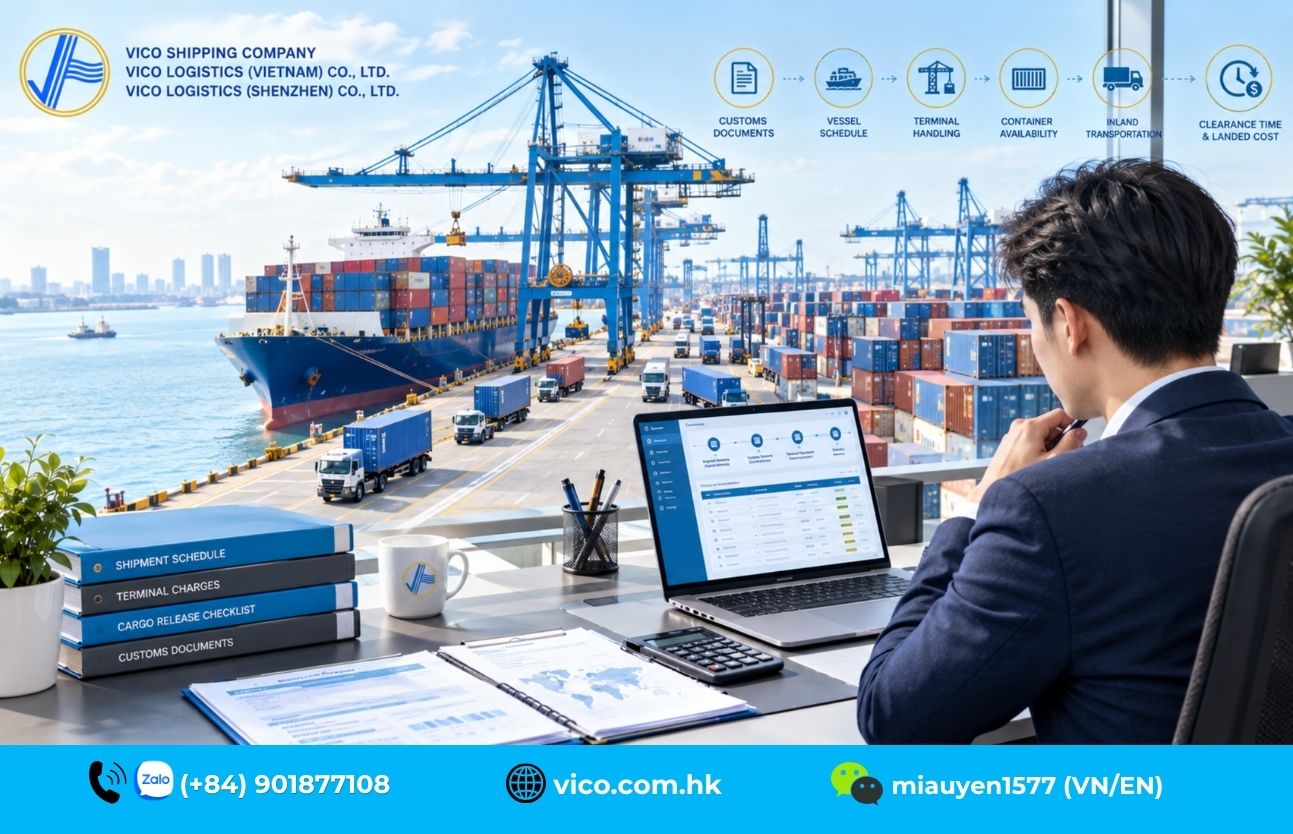
To effectively control import expenses, businesses must establish an overall budget rather than only considering purchase prices or import duties.
|
Cost Group
|
Elements to Review
|
|
Import Duties
|
Depends on HS code, origin, and applicable tax rates
|
|
Import VAT
|
Depends on taxable items, assessment basis, and corresponding rates
|
|
Other Taxes
|
May arise depending on product type and tax policies
|
|
International Freight
|
Depends on route, transport mode, cargo type, and delivery terms
|
|
Port and Shipping Line Fees
|
Varies by contract, port, carrier, and actual services
|
|
Customs Brokerage Fees
|
Depends on scope of work and service agreements
|
|
Specialized Inspection Fees
|
Incurred when items fall under regulatory scopes
|
|
Container Detention / Storage Fees
|
May arise when exceeding free time or per applicable terms
|
|
Inland Transportation
|
Depends on delivery location, vehicle type, and handling requirements
|
How to Reduce the Risk of Cost Overruns?
Businesses can proactively maintain control by:
-
Verifying import policies prior to placing orders.
-
Checking documents before shipments depart.
-
Grounding HS codes and tax liabilities on solid foundations.
-
Monitoring free time limits for container retention/storage and shipping line conditions.
-
Proactively arranging pickup schedules, transport vehicles, and locations.
-
Requesting service quotations that clearly outline work scopes, inclusions, and exclusions.
Not all expenses can be eliminated, but early planning will help businesses stay proactive when estimating cost-of-goods-sold and delivery timelines.
6. Common Errors Causing Import Clearance Delays
-
Incorrect or Missing Document Information: Inconsistent details regarding product names, quantities, weights, buyers, sellers, or bills of lading can trigger requests for clarification or adjustments.
-
Prevention: Use a standardized checklist to cross-check documents prior to declaration.
-
-
Inaccurate HS Code Determination: Incorrect HS codes can distort tax rates, item policies, and regulatory compliance requirements.
-
Prevention: Base codes on actual characteristics, technical documents, and classification rules; do not copy HS codes simply because products share similar trade names.
-
-
Overlooking Licenses or Specialized Procedures: Some businesses audit paperwork only after cargo reaches the port, increasing operational bottlenecks.
-
Prevention: Verify import conditions during the procurement planning stage and prior to shipment.
-
-
C/O Not Meeting Preference Conditions: C/O documents may fail to comply with rules of origin, qualifying criteria, document criteria, or relevant agreement mandates.
-
Prevention: Verify origin criteria prior to dispatch and collaborate with suppliers to prepare appropriate paperwork.
-
-
Underestimating Port Time and Costs: Even with baseline documents ready, businesses can incur fees if cargo release procedures or transport arrangements lag.
-
Prevention: Track vessel schedules, free time limits, declaration statuses, and pickup plans on a unified tracking dashboard.
-
7. Best Practices for Smooth Clearance and Cost Control
An efficient import process should begin before cargo is loaded onto transit vehicles.
Before Cargo Departs
-
Review import policies and licensing requirements.
-
Determine expected HS codes, origins, and tax liabilities.
-
Standardize the document package expected from suppliers.
-
Clarify delivery terms and cost scopes.
-
Define responsibilities for sellers, buyers, and forwarding partners.
Before Cargo Arrives at Port
-
Cross-check Commercial Invoices, Packing Lists, and Bills of Lading.
-
Verify C/Os if planning to claim tariff preferences.
-
Prepare declaration data and required paperwork.
-
Monitor specialized inspection progress if applicable.
-
Plan cargo retrieval, trucks, and warehouse distribution.
After Clearance Completion
-
Confirm processing status and release conditions.
-
Archive certificates, declarations, and tax records.
-
Reconcile actual expenses against initial quotations.
-
Log emerging issues to refine processes for upcoming shipments.
For regular importers, standardizing checklists and allocating clear responsibilities among procurement, accounting, import-export, and logistics teams helps reduce reliance on single individuals and enhances overall supply chain control.
8. When Should Businesses Use Customs Declaration Services?
Businesses can consider utilizing customs brokerage services when:
-
Importing for the first time or lacking specialized in-house personnel.
-
Goods involve specialized management requirements or complex paperwork.
-
Assistance is needed to audit HS codes, import policies, and document packages.
-
Integrating customs declaration with international freight and domestic trucking is necessary.
-
Managing multiple milestones, costs, and tasks across multiple third parties is required.
An experienced logistics provider can assist with document audits, collaborative filing, status tracking, and delivery arrangement within agreed service scopes. However, importing businesses must still supply accurate information and fulfill their regulatory duties.
How VICO Logistics Supports Businesses
Aligned with partnering businesses across international supply chains, VICO Logistics can be reached to discuss transport requirements, customs clearance coordination, and import delivery planning tailored to specific routes and service scopes.
When submitting consultation requests, businesses should prepare the following details:
-
Product name, utility, and technical parameters.
-
Export country and expected import location.
-
Quantity, weight, volume, or container type.
-
Contractual delivery terms.
-
Document status and expected arrival window.
-
Required support scope: transport, customs clearance, document audit, or inland delivery.
The clearer the information, the easier it is to assess preliminary job scopes and associated costs.
Contact VICO Logistics to discuss logistics solutions and import procedures tailored to your shipment. Quotations and service scopes will be confirmed based on actual operational details.
9. Frequently Asked Questions About Import Customs Clearance
What are the steps in import customs clearance?
The general process includes checking import policies, preparing documents, determining HS codes and tax liabilities, filing customs declarations, performing inspections when required, fulfilling financial obligations, and receiving clearance results to organize delivery. Specific steps may vary by product type and import scenario.
What documents are required for import customs clearance?
The dossier may include customs declarations, commercial invoices, packing lists, transport documents, and relevant certificates per regulations. Depending on the item, contracts, C/Os, licenses, or specialized inspection results may be needed.
How long does import customs clearance take?
Timing depends on documentation, goods categories, declaration processing outcomes, physical inspections, and related procedures. Businesses should separately evaluate customs processing time and total warehouse delivery lead times.
Does holding a C/O mean import duty exemption
No. A C/O is a document certifying goods origin, which can support the consideration of preferential tax rates if all associated conditions are met. Holding a C/O does not automatically equate to tax exemption.
Can businesses handle customs clearance themselves?
Yes, businesses can handle filings independently if they meet conditions and follow regulations. When lacking experience or handling complex shipments, partnering with a qualified service provider is recommended.
What costs can arise during customs clearance?
Aside from taxes and financial obligations, businesses may incur document fees, port charges, carrier fees, service fees, specialized inspection fees, container detention/storage fees, and inland freight depending on the case.
Conclusion
The import customs clearance process involves much more than simply transmitting customs declarations. To receive goods on schedule and control expenditures, businesses must synchronize efforts from checking import policies, preparing documentation, determining HS codes and taxes, to managing port delivery procedures.
Proactively reviewing paperwork before shipments depart, forecasting costs, and tracking progress across all parties will mitigate errors and delays.
If your business needs to discuss international transport options, import procedures, or receiving plans, contact VICO Logistics to review your specific requirements and define the appropriate support scope.
Would you like to explore specific logistics plans or documentation checklists tailored to a particular shipping route or commodity type for your upcoming shipments?
- Factory Coffee: The Global Coffee Harvest Calendar
- What's So Good About Vietnam Manufacturers
- Electronics Shipping: Mastering The Logistics Of High-Value Technology
- Door To Door Cambodia Shipping: The Ultimate Logistics Solution For 2026
- Trucking Cambodia - Vietnam: Fast & Reliable Cross-Border Solutions 2026
Get a Logistics Quote in just 5 minutes
Professional international transportation and supply chain solutions tailored for your business.
Get a quote now ↗Quick Contact
🇻🇳 Ms Uyen
Hotline / Zalo
(+84) 901 877 108WeChat (VN/EN)
miauyen1577Scan to Contact
Zalo
🇨🇳 Ms Schyler
Office Hotline
(+852) 3759 9300WeChat ID
Schyler_skylarScan to Contact
VICO International Logistics — Your Trusted Logistics Partner in Indochina
Senior member of international logistics and trade associations: Eurocham, JCtrans, VICOFA, VITAS, and more.