
Table of Contents
|
How Free Trade Zones Drive Cost Savings and Efficiency in Vietnam–China Trade
1. Introduction: Why Free Trade Zones (FTZs) Matter for Vietnam–China Trade
As Vietnam–China cross-border trade accelerates, companies are no longer competing on speed alone—they’re competing on efficiency, cash flow, and compliance. Free Trade Zones (FTZs) have become powerful levers to achieve all three.
An FTZ is a designated area where goods can be imported, processed, and re-exported without being subject to normal customs procedures or import duties. Taxes and duties are only applied when goods enter the domestic market.
In Vietnam, the concept is evolving under Resolution 136/2024, which introduces pilot FTZ regimes—moving beyond Export Processing Zones (EPZs) and bonded warehouses to fully integrated trade ecosystems. These pilots aim to enhance Vietnam’s role in regional logistics and attract international investment.
In China, FTZs are more mature. With 22 pilot zones and the Hainan Free Trade Port, the country has integrated trade facilitation with financial liberalization and digital customs management.
For businesses operating along the Vietnam–China corridor, understanding and leveraging FTZs is now essential—not optional. And this is exactly where VICO Logistics stands out: combining bonded warehousing, cross-border transport, and smart customs clearance to help clients maximize FTZ advantages with minimal complexity.
Photo: Vietnam Customs
>> Vietnam's exports to China: A roadmap for success
2. How Free Trade Zones Cut Costs and Unlock Cash Flow
2.1 Duty & VAT Suspension or Deferral
One of the most direct financial advantages of FTZs is duty and VAT suspension until goods are moved into the domestic market. This system allows companies to defer tax payments, improving liquidity and reducing financial pressure—especially for importers handling seasonal or large-volume inventory.
In Vietnam, the new FTZ model is expected to mirror this mechanism, letting businesses import materials into the FTZ duty-free, with taxes only applied when entering the domestic market. This builds upon Vietnam’s existing non-tariff areas and bonded warehouse system, which have provided similar relief.
>> How Multifunctional Bonded Warehouses in Vietnam Can Enhance Your Textile Business
Example:
- A Vietnamese electronics manufacturer stores imported components in a bonded facility managed by VICO Logistics at the border. Duties are applied only when finished products are released for domestic sale—freeing up as much as 15–20% in working capital.
- VICO helps clients structure storage and clearance schedules strategically to delay duty payments and smooth out cash flow cycles.
2.2 Tariff Exemptions & Re-Export Incentives
FTZs also offer tariff exemptions for goods that are processed and re-exported. When intermediate materials are imported into an FTZ, transformed, and then shipped abroad, companies often avoid import duties entirely.
This system is particularly valuable for electronics, textiles, and agricultural products, which dominate Vietnam–China trade.
China’s FTZs already implement “processing under bonded regime” programs, allowing companies to import, process, and export without incurring domestic import taxes.
VICO designs these bonded logistics flows for customers, ensuring only the true “value-added” portion of goods is taxed (if at all).
2.3 Bonded Warehousing and Light Processing
Bonded warehousing allows goods to be stored duty-free within FTZs, providing flexibility for inventory management and light processing (such as repackaging, labeling, and assembly) before goods are distributed.
Vietnam’s bonded warehouses—previously limited to export manufacturing—are now being integrated into broader FTZ frameworks under Resolution 136. Meanwhile, China’s FTZs like Shanghai and Guangxi have elevated bonded logistics into regional distribution centers for e-commerce and manufacturing supply chains.
VICO operates bonded warehouse networks across key FTZs in both Vietnam and China. Clients can stage goods closer to markets, manage seasonal stock, and minimize total logistics costs by avoiding premature duty payments.
>> Bonded Warehouses in Vietnam: What They Are and Where to Find Them
3. How Free Trade Zones Simplify & Accelerate Logistics
3.1 Streamlined Customs and Smart Border Management
FTZs aren’t just about tax incentives—they are also about logistics acceleration. Modern FTZs employ single-window customs systems, digital declarations, and 24/7 clearance operations.
For example, the Guangxi–Pingxiang Youyi Guan FTZ near the Vietnam border now uses AI inspection and smart logistics systems, cutting clearance times by half and doubling truck throughput.
VICO Logistics integrates directly with these border systems, managing pre-clearance documentation and scheduling optimized truck routes to minimize wait times.
3.2 Multimodal Connectivity and Trade Corridors
Most FTZs are strategically located at major logistics hubs—ports, airports, and border crossings—allowing seamless multimodal connections between road, rail, and sea.
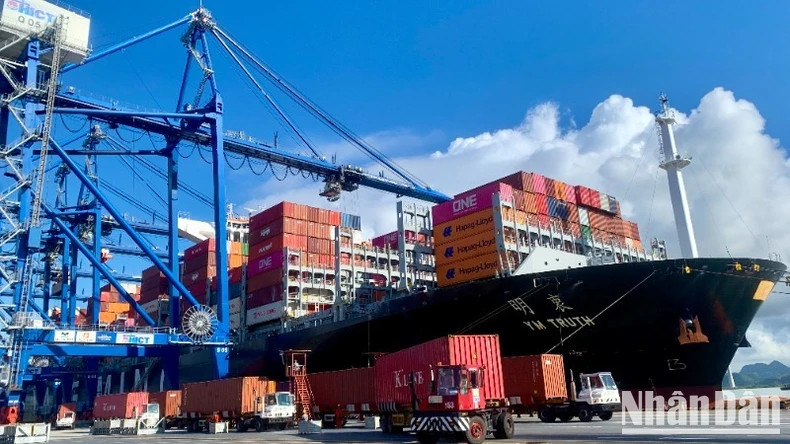
Photo: Nhandan newspaper
Examples include:
- Qinzhou Port (Guangxi FTZ): Part of the “New International Land-Sea Trade Corridor,” linking China’s inland regions to Vietnam and ASEAN.
- Hai Phong and Da Nang (Vietnam): Future FTZ hubs combining seaport, rail, and highway access.
- Hainan Free Trade Port: Offers unique maritime logistics benefits and digital trade facilitation.
VICO Logistics designs hybrid transport routes that pass through these FTZs, balancing time and cost by combining trucking, rail, and sea freight.
3.3 Reverse Logistics and EPR Compliance
FTZs also streamline reverse logistics under Extended Producer Responsibility (EPR) frameworks. Defective goods, returns, and recyclable packaging can move through FTZs for repair, recycling, or re-export—all under duty suspension.
This is especially valuable for electronics, FMCG, and packaging-intensive industries. VICO supports clients in building sustainable logistics loops that meet EPR rules while controlling costs.
4. Vietnam vs. China (and Regional FTZ Models)
Jurisdiction | FTZ / Free Trade Model | Strengths | Constraints | How VICO Leverages |
Vietnam (pilot) | Transition from EPZs to FTZs under Resolution 136 | Duty deferral, pilot incentives | Developing customs systems | Guides clients through pilot adoption and cross-border flow setup |
China | Mature network + Hainan Free Trade Port | Digital customs, financial liberalization | Regulatory complexity | Routes optimized across multiple zones |
Regional (SG/MY) | Transshipment-centric FTZs | High efficiency, established hubs | Limited manufacturing | Integrated into hybrid China–Vietnam supply chains |
China’s FTZs
China's FTZs integrate trade facilitation with advanced logistics and financial systems. Vietnam’s pilot FTZs, while newer, represent an important step toward full trade liberalization and competitiveness within ASEAN.
VICO’s experience operating across both markets enables clients to leverage each system’s advantages while managing compliance risk.
5. Use Cases in Vietnam–China Trade
Agriculture & Seafood: Vietnamese exporters use Guangxi FTZ bonded cold storage (via VICO) to defer duties and reduce spoilage during transshipment.
Electronics & Components: Components stored in Qinzhou FTZ are assembled and redistributed by VICO without multiple tariff layers.
Consumer Goods & Retail: Global brands use Hainan Free Trade Port for duty-free warehousing and e-commerce distribution.
Reverse Logistics: Returned electronics or packaging materials are reprocessed under bonded status through VICO-managed FTZ facilities.
6. How VICO Logistics Converts FTZ Value into Client Advantage
- Duty Management & Cash Flow Optimization: Strategic tax planning to delay or reduce duties.
- Customs Expertise: Integrated clearance processes through digital FTZ systems.
- Multimodal Route Design: Combining sea, rail, and road to minimize costs.
- Regulatory Compliance: Up-to-date with Vietnam and China FTZ regulations, including EPR.
- Strategic Distribution: Using FTZs as regional hubs for ASEAN and Chinese markets.
7. Conclusion: FTZs as Strategic Tools — Not Just Incentives
Free Trade Zones are not just policy experiments—they’re strategic infrastructure shaping the future of regional trade. They reduce costs, streamline customs, and improve logistics agility across the Vietnam–China corridor.
The real advantage lies in execution, and VICO Logistics transforms FTZ complexity into measurable savings, faster delivery, and sustainable growth.
If your business aims to optimize cross-border trade and leverage the full potential of Free Trade Zones in Vietnam and China—VICO is your trusted logistics partner.
Learn more the same topic articles at
China Free Trade Zones: Benefits, Key Locations, and Logistics Advantages for Vietnam–China Trade
Future of Logistics Da Nang: Free Trade Zone & Vietnam IFC Opportunities for Investors
-------
VICO Logistics – Your Indochina Expert
Premium member of Eurocham, JCtrans, VICOFA, VITAS... associations
Owned offices: Hong Kong (headquarters), China (Shenzhen, Shanghai), Vietnam (Ho Chi Minh, Da Nang, Hai Phong).
Youtube - Linkedin - Fanpage
Follow us for more valuable information
Book now: https://vico.com.hk/#quotation
| Contact us:
|