


_h878lIhHc.jpg)
An Air Waybill is an air freight document used to acknowledge the receipt of goods for transport, record shipment details, and serve as evidence of the contract of carriage by air.
Beyond transport, the AWB provides essential information for businesses to track shipment journeys, prepare customs procedures, and coordinate cargo delivery at the destination airport.
However, in practice, many people still confuse MAWB and HAWB, struggle with reading the fields on the waybill, or do not know which tracking number to use for shipment status.
In this article, VICO Logistics provides a detailed explanation of the Air Waybill, how to read and check air waybills, and guides businesses on how to avoid common mistakes during import and export operations.
1. What is an Air Waybill (AWB)?

The Air Waybill (AWB), known in Vietnamese as vận đơn hàng không, is a transport document for air cargo that confirms the carrier's receipt of goods and serves as evidence of the contract of carriage between the parties involved.
The AWB typically displays crucial information such as the shipper, consignee, airport of departure, airport of destination, commodity description, number of pieces, weight, and freight charges.
According to Article 57 of the Law on Vietnamese Civil Aviation No. 130/2025/QH15, effective from July 1, 2026, the transportation of goods by air requires an air waybill. The law also establishes the AWB as a transport document and proof of the conclusion of the contract, receipt of goods, and contract conditions.
1.1. Characteristics of an Air Waybill
One of the most important characteristics of an AWB is that it is not a document of title and is not negotiable by endorsement, unlike certain types of bills of lading in maritime transport.
This means holding an AWB does not automatically grant the holder ownership or the right to claim the goods. The carrier delivers the goods to the party entitled to receive them under the contract and related regulations, after fulfilling the necessary requirements.
Main characteristics of an AWB include:
-
Serves as a document for air cargo transport.
-
Acts as evidence of the contract of carriage and receipt of goods.
-
Is not a transferable document of title.
-
Displays cargo details, participating parties, and transport routes.
-
Can be used to track shipment status.
-
Can exist in paper or electronic format (e-AWB).
1.2. What are the Functions of an Air Waybill?
The AWB fulfills multiple functions during international cargo transport:
-
Acknowledgment of Receipt of Goods: When the carrier accepts goods for carriage, the AWB acts as evidence of receipt according to the stated details and conditions. However, it does not automatically prove that all information declared by the shipper has been fully verified and confirmed by the airline.
-
Evidence of Contract of Carriage: The AWB records information regarding the transport agreement, involved parties, and applicable conditions.
-
Journey Management Support: Using the AWB number, businesses can look up shipping information updated by the airline or freight forwarder.
-
Import/Export Procedure Support: AWB information is utilized during the preparation and cross-checking of transport documents, customs declarations, and the processing of cargo files as required.
-
Cargo Delivery Coordination: At the destination airport, the AWB is a vital source of information for carriers, warehouses, and forwarding agents to identify shipments and coordinate delivery procedures.
1.3. Who Issues the Air Waybill?
Depending on the transport arrangement, an AWB can be issued by an airline, an authorized agent, or a freight forwarder. Specifically:
-
Airlines typically issue a Master Air Waybill (MAWB).
-
Freight forwarders typically issue a House Air Waybill (HAWB).
-
When booking directly with an airline, the shipper and consignee on the MAWB may be the actual commercial parties.
Example: A business in Vietnam exports 300 kg of electronic components to Singapore through a freight forwarder. The forwarder can issue an HAWB to the exporting business. Simultaneously, the airline issues an MAWB reflecting the transport relationship between the airline and the party booking the cargo space. Both documents relate to the same shipment but serve different roles.
2. Distinguishing MAWB and HAWB in Air Transport
MAWB and HAWB are two common types of waybills encountered when businesses ship internationally via freight forwarders. Understanding the differences helps businesses identify the correct waybill number for tracking, reporting, and coordinating delivery.
2.1. What is an MAWB?
A Master Air Waybill (MAWB) is issued by an airline or an airline-authorized agent. It records the transport of goods under a contract between the airline and the shipper listed on the waybill. In consolidation operations, the shipper on the MAWB is typically a freight forwarder or consolidator. A single MAWB can cover multiple shipments from different customers when consolidated under a suitable transport plan.
2.2. What is an HAWB?
A House Air Waybill (HAWB) is usually issued by a freight forwarder to their customer. It records shipment details and the transport relationship between the forwarder and the customer based on their agreement. In consolidation operations, each customer's shipment can be managed by a separate HAWB.
2.3. Comparison Table: MAWB vs. HAWB
|
Criteria
|
Master Air Waybill (MAWB)
|
House Air Waybill (HAWB)
|
|
Full Name
|
Master Air Waybill
|
House Air Waybill
|
|
Issuer
|
Airline or authorized agent
|
Freight forwarder
|
|
Contract Scope
|
Shipment under contract with the airline
|
Shipment under contract with the forwarder
|
|
Consolidation Role
|
May cover multiple HAWBs
|
Typically tied to an individual customer's shipment
|
|
Waybill Number
|
Usually follows the IATA 11-digit structure
|
Follows the forwarder's internal system rules
|
|
Tracking Platform
|
Typically via the airline's system
|
Typically via the forwarder's system
|
The above relationships align with the MAWB/HAWB transport model referenced by the Vietnam Logistics Business Association (VLA) in industry publications.
2.4. Practical Example of MAWB and HAWB
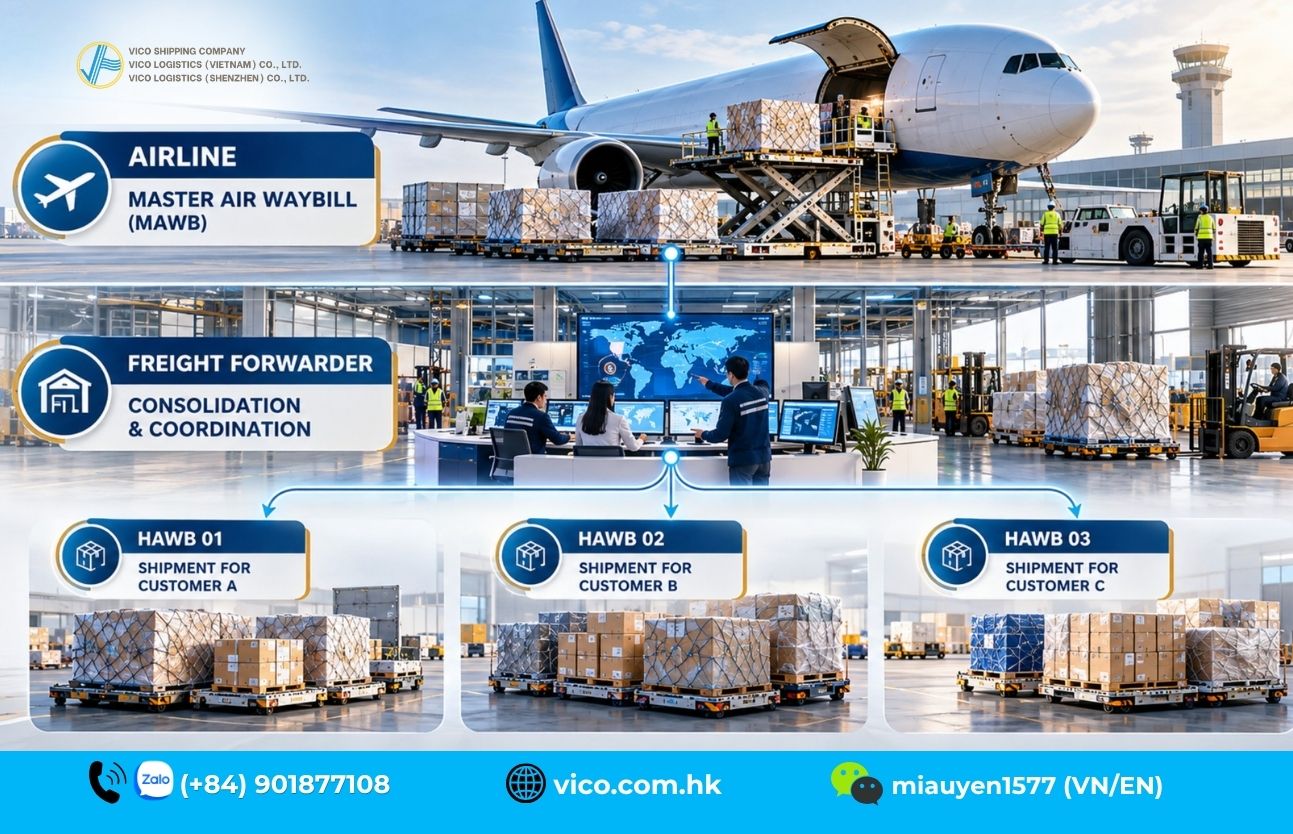
Suppose three Vietnamese enterprises export goods to Singapore through a single freight forwarder:
-
Airline → Issues MAWB (Master Waybill)
-
Freight Forwarder → Manages consolidated cargo and issues individual HAWBs:
-
HAWB 01 → Company A (Components)
-
HAWB 02 → Company B (Garments)
-
HAWB 03 → Company C (Spare Parts)
-
Because the forwarder issues three separate HAWBs to manage individual parcels while the airline issues a single MAWB for the consolidated cargo, businesses should use the MAWB when tracking flight and transport status updates provided by the airline. When clarifying details regarding an individual parcel, businesses can use the HAWB to communicate with the forwarder.
3. What Information Does an Air Waybill Contain?
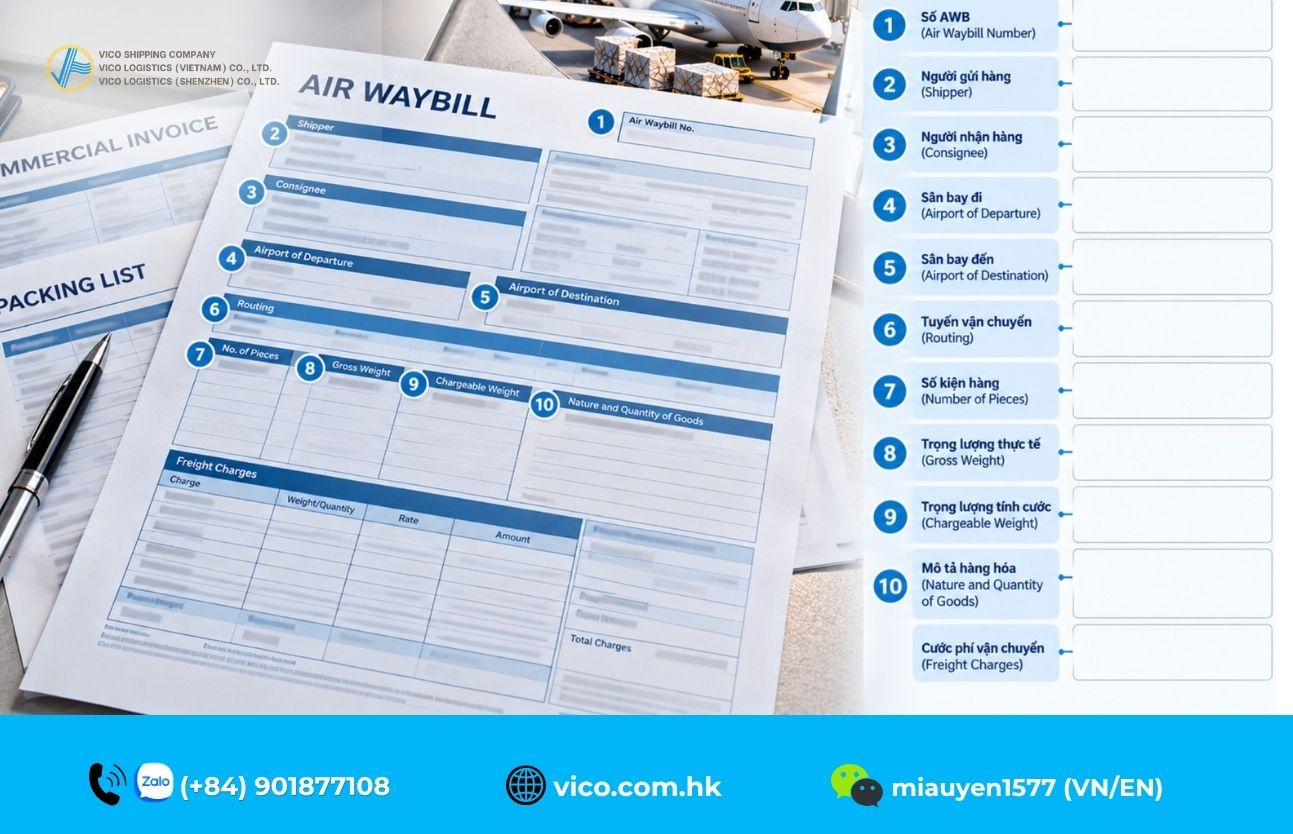
A primary need for anyone handling an AWB is understanding the data fields presented on the waybill. Standard AWB forms feature multiple data fields covering parties, itineraries, cargo characteristics, and freight rates.
3.1. Key Information Fields on an AWB
|
English Field
|
What to Verify
|
|
AWB Number
|
Correct waybill code
|
|
Shipper
|
Correct name and address
|
|
Consignee
|
Correct recipient information
|
|
Issuing Carrier's Agent
|
Correct issuing entity
|
|
Airport of Departure
|
Correct departure airport
|
|
Airport of Destination
|
Correct arrival airport
|
|
Routing and Destination
|
Expected routing
|
|
Flight/Date
|
Estimated schedule (if noted)
|
|
No. of Pieces
|
Matches packing information
|
|
Gross Weight
|
Correct actual weight
|
|
Chargeable Weight
|
Correct billing basis
|
|
Rate / Charge
|
Matches quotations
|
|
Nature and Quantity of Goods
|
Accurate cargo description
|
|
Prepaid / Collect
|
Matches agreed terms
|
Note: Not all AWB forms layout fields identically. The IATA AWB guidance documentation provides reference structures for these information fields.
3.2. How to Read the 11-Digit AWB Number
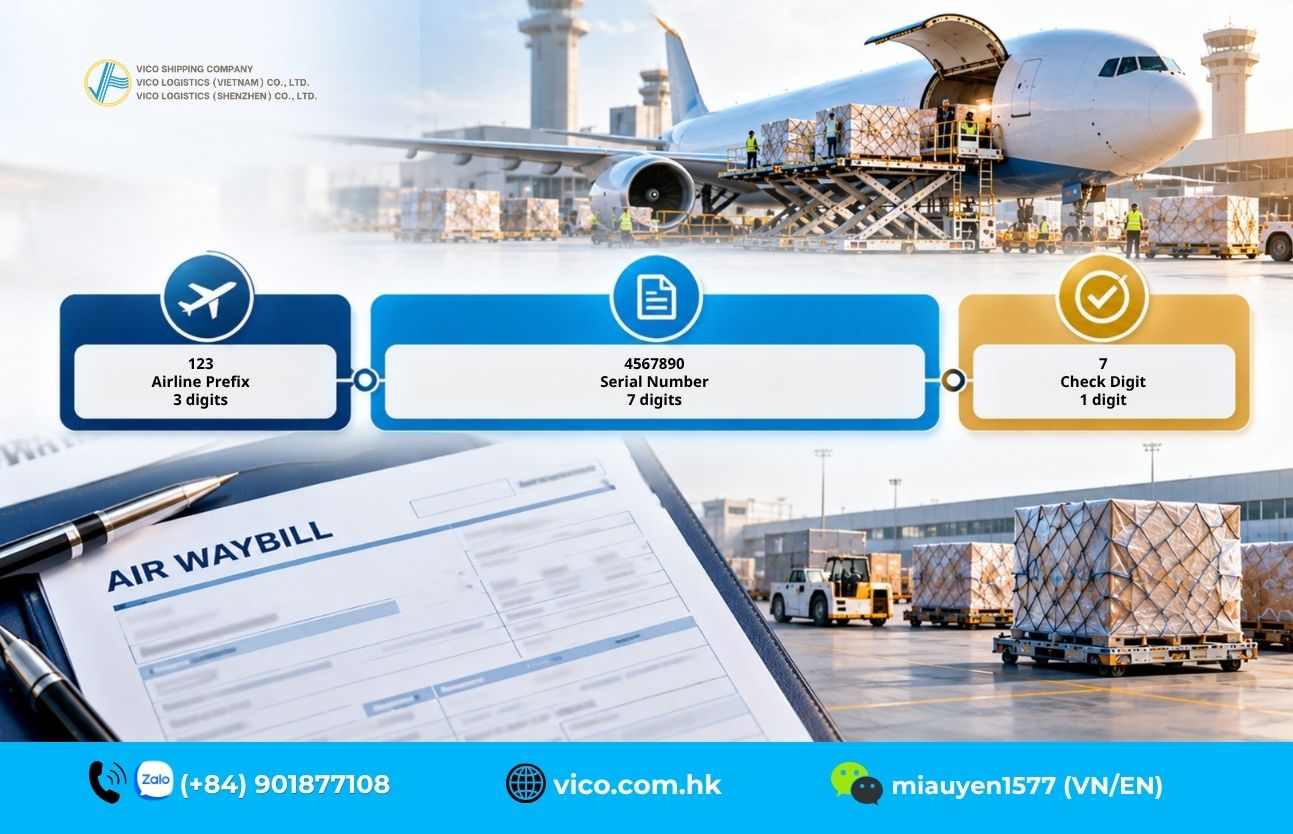
A standard airline MAWB number consists of 11 digits, divided into three components:
-
First 3 digits: Airline identification code.
-
Next 7 digits: Serial sequence number.
-
Last 1 digit: Check digit (calculated via the Modulus 7 method).
Example (IATA format reference): 777-12345675 (This is a sample format and cannot be used to track real cargo).
Do not assume all HAWB or express tracking numbers must follow an 11-digit structure, as private systems may use custom formats.
3.3. Example of Reading an AWB for a Shipment
Suppose a Vietnamese business exports 20 cartons of machinery spare parts to Singapore:
-
Shipper: ABC Manufacturing Co., Ltd.
-
Consignee: XYZ Trading Pte. Ltd.
-
Airport of Departure: SGN – Ho Chi Minh City
-
Airport of Destination: SIN – Singapore
-
No. of Pieces: 20
-
Gross Weight: 250 kg
-
Chargeable Weight: 300 kg
-
Nature of Goods: Machinery Spare Parts
-
Freight Terms: Prepaid
Key verification questions when reviewing an AWB:
-
Are the shipper and consignee names accurate?
-
Is the destination airport correct per the booking?
-
Do the piece counts match the packing list?
-
Is the chargeable weight consistent with measured data?
-
Are the freight payment terms correct?
If errors are found, contact the forwarder or issuer before the waybill is finalized and used in subsequent operational steps.
4. How to Track an Air Waybill to Monitor Shipments
Once goods are dispatched, businesses naturally want to know their location, departure status, and estimated arrival time. The AWB serves as a primary reference code for this purpose.
4.1. Tracking via MAWB
-
Obtain the MAWB number from the airline or forwarder.
-
Identify the issuing airline based on the waybill details.
-
Access the airline's official Cargo Tracking webpage.
-
Enter the MAWB number according to the system format.
-
Check the transport status and update timestamps.
Note: Data may not appear immediately upon issuance, as updates depend on operational processing times and cargo reception milestones.
4.2. Tracking via HAWB
If holding an HAWB, businesses can contact their forwarder or use the forwarder's tracking portal if available. In some cases, HAWBs cannot be tracked directly on airline websites; businesses should then request the corresponding MAWB from their forwarder.
4.3. Common Transport Status Codes
|
Status Code
|
Common Meaning
|
|
BKD
|
Booking Confirmed
|
|
RCS
|
Goods Received from Shipper / Accepted for Carriage
|
|
MAN
|
Manifested (Recorded on flight manifest)
|
|
DEP
|
Flight Departed
|
|
ARR
|
Flight Arrived
|
|
RCF
|
Cargo Received from Flight
|
|
NFD
|
Notice of Arrival / Ready for Delivery sent to consignee
|
|
DLV
|
Delivery Completed
|
Note: Actual definitions and update triggers can vary across systems. An "Arrived" flight status does not mean goods are customs-cleared or immediately ready for pickup.
4.4. Why Does an AWB Tracking Search Return No Data?
-
The AWB number was entered incorrectly.
-
An HAWB number was entered into a system that only supports MAWBs.
-
The cargo has not yet been fully processed or logged by the airline.
-
Shipping data updates are delayed.
-
The system of the airline or forwarder is experiencing lag.
-
The shipment moves across multiple legs with schedule revisions.
If this happens, double-check the waybill number and contact the transport provider to confirm details before concluding that cargo is lost.
5. How Do Air Waybills (AWB) and Bills of Lading (B/L) Differ?
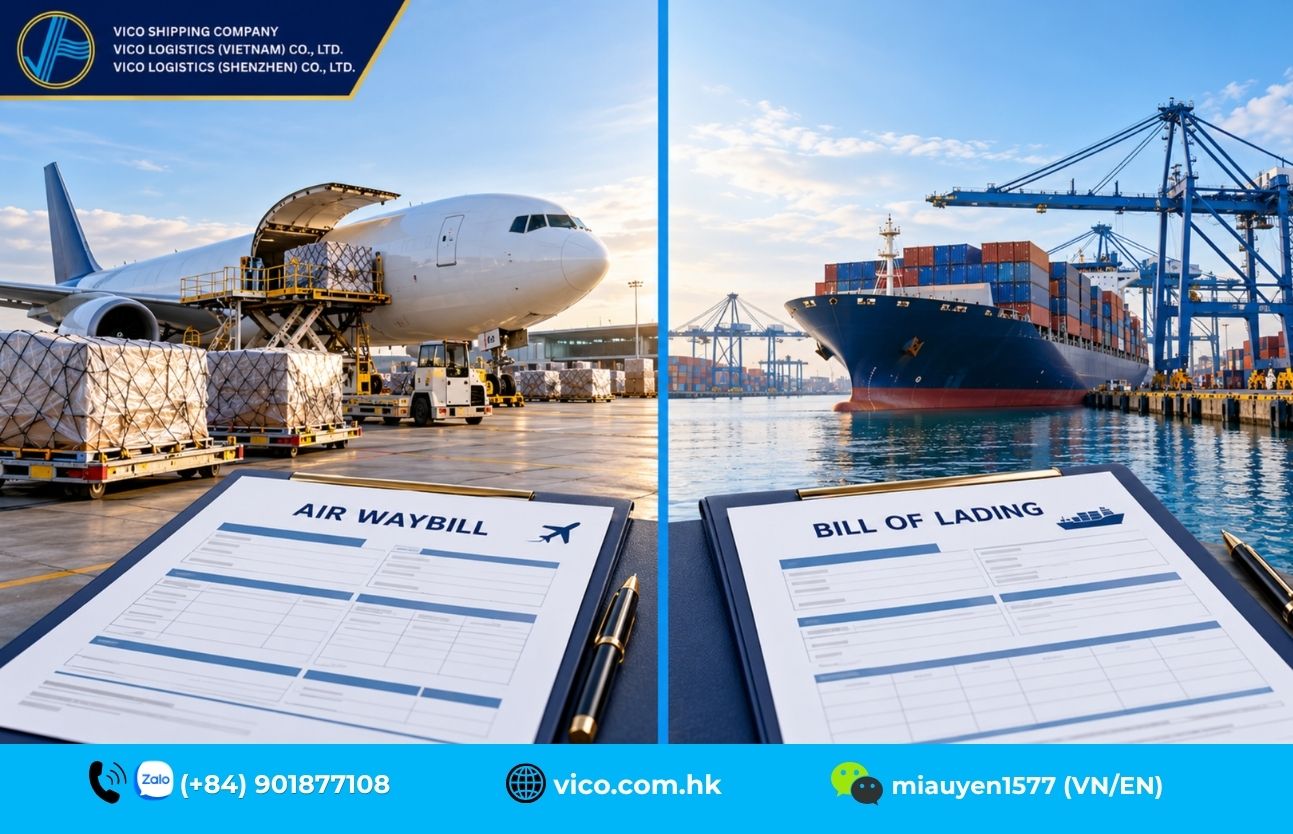
A common question in import/export is whether an AWB and a Bill of Lading (B/L) are identical. Both are transport documents used across different transport modes, featuring key legal distinctions.
5.1. Comparison Table: AWB vs. B/L
|
Criteria
|
Air Waybill (AWB)
|
Bill of Lading (B/L)
|
|
Transport Mode
|
Air
|
Sea
|
|
Evidence of Contract
|
Yes
|
Yes
|
|
Receipt of Goods
|
Yes
|
Yes
|
|
Document of Title / Transferable
|
No
|
Yes (depending on B/L type)
|
|
Endorsement Capability
|
Not via order-bill mechanisms
|
Possible with order B/Ls
|
|
Delivery Mechanism
|
Based on entitled receiver and governing rules
|
Dependent on B/L type and release procedures
|
|
Electronic Format
|
e-AWB
|
e-B/L available
|
|
Typical Cargo
|
High-value, urgent, time-sensitive goods
|
Bulk cargo, containers, non-urgent goods
|
5.2. Why is an AWB Not a Document of Title?
Because an AWB is non-negotiable, delivery does not rely on endorsing and handing over original hard-copy documents like certain maritime order bills of lading. Instead, the carrier delivers goods to the legally verified receiver under contract terms and relevant regulations.
Practical Example: An enterprise in Singapore imports 100 kg of electronics into Vietnam by air. Upon arrival at Tan Son Nhat Airport, the importer does not need to endorse an original AWB via maritime order-bill protocols. However, the recipient must still complete necessary customs declarations, prove authorization to receive, pay applicable fees, and follow airport cargo terminal procedures.
6. The Air Waybill Issuing Process in Import/Export
Understanding the AWB issuance workflow helps businesses know what to prepare and verify at each milestone:
-
Submit Booking Request: Provide route, commodity name, piece count, weight, dimensions, timeline, and special handling instructions.
-
Confirm Booking: The forwarder or airline confirms space allocation, schedules, and conditions.
-
Prepare Documentation Info: Provide Shipper, Consignee, Commercial Invoice, Packing List, and cargo specifications.
-
Draft AWB Preparation: The issuer prepares a draft to verify shipment details.
-
Review and Confirm: Parties cross-check the recipient, airports, description, pieces, weight, and rate terms.
-
Cargo Acceptance & AWB Finalization: Once cargo is processed at the warehouse, data and documentation are finalized.
-
Tracking & Delivery: Use the AWB number to monitor progress, handle destination clearance, and coordinate delivery.
6.1. What is a Draft AWB?
A Draft AWB is a preliminary waybill prepared for parties to verify details prior to issuance. Information is pulled from Shipping Instructions, Invoices, Packing Lists, and booking data. If discrepancies arise, notify the issuer promptly.
6.2. When is an AWB Issued?
AWB numbers and drafts can be prepared prior to airline cargo drop-off. Final completion of the AWB depends on operational workflows, electronic data clearance, and transport agreements. Having an AWB number does not automatically mean the cargo is already loaded onto an aircraft.
7. How Chargeable Weight is Calculated on an Air Waybill
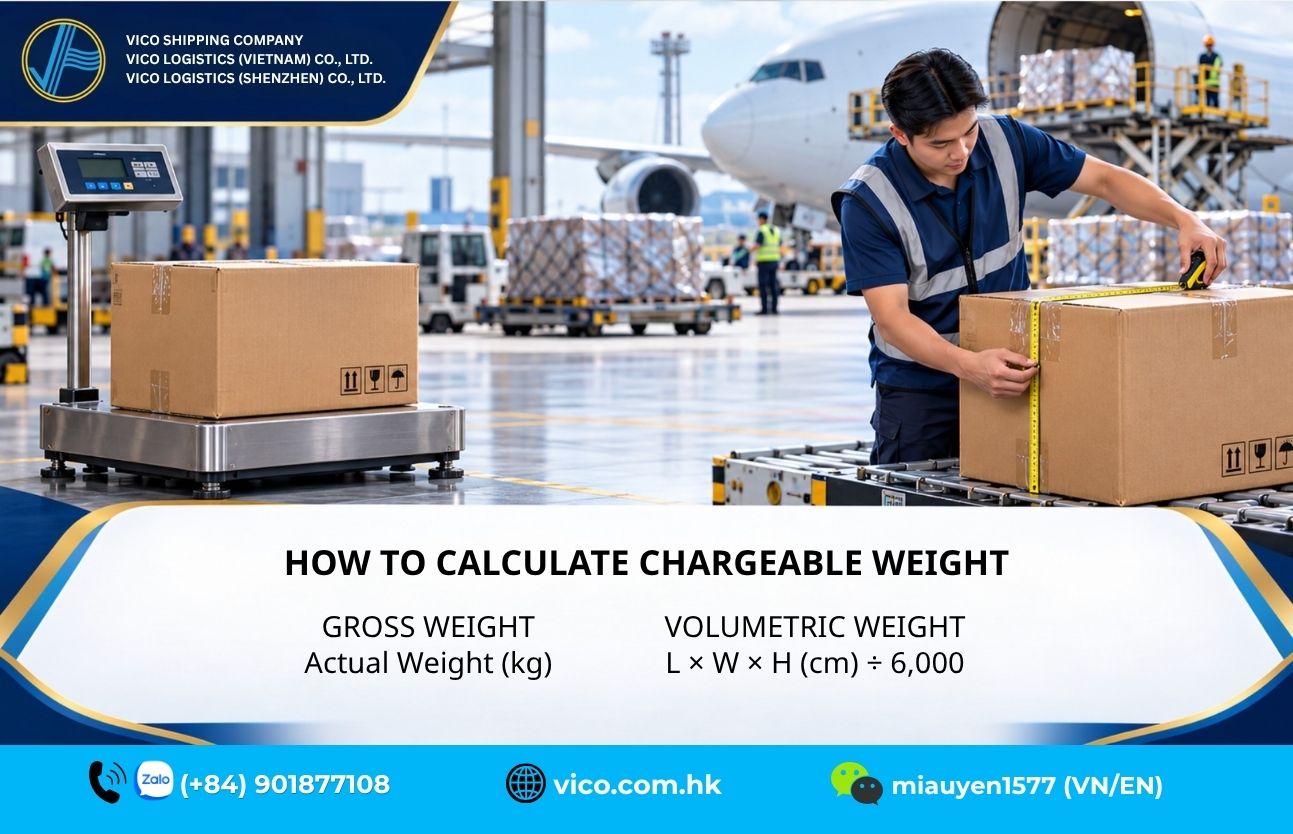
When checking an AWB or air freight quotation, businesses often encounter two weight values: Gross Weight (actual weight) and Chargeable Weight (billable weight).
7.1. Gross Weight vs. Volumetric Weight
-
Gross Weight: Total actual physical weight of the cargo, including packaging.
-
Volumetric Weight: Weight calculated based on cargo dimensions. Because aircraft have strict volume and weight limits, bulky yet lightweight shipments are billed based on space occupied.
Common Air Freight Volumetric Formula:
(The divisor of 6,000 is standard in air cargo calculations, though specific carriers may apply alternate tariffs per IATA guidelines).
7.2. Determining Chargeable Weight
The Chargeable Weight is the metric used to calculate freight charges. Carriers compare actual Gross Weight against Volumetric Weight, select the higher value, and apply rounding rules or tariff minimums.
Calculation Example:
-
10 cartons of cargo.
-
Dimensions per carton: $60 \times 50 \times 40\text{ cm}$.
-
Actual Gross Weight: $120\text{ kg}$.
-
Volumetric weight per carton: $\frac{60 \times 50 \times 40}{6000} = 20\text{ kg}$.
-
Total Volumetric Weight: $20\text{ kg} \times 10 = 200\text{ kg}$.
-
Result: Gross Weight ($120\text{ kg}$) < Volumetric Weight ($200\text{ kg}$) $\rightarrow$ Chargeable Weight = $200\text{ kg}$.
Providing exact dimensions and weights at the quotation stage helps businesses prevent unexpected cost spikes.
8. Checklist for Reviewing a Draft AWB
Reviewing a Draft AWB is a vital step to minimize documentation errors. Before confirmation, import/export staff should cross-check shipment records:
-
[ ] Correct Shipper name and address
-
[ ] Correct Consignee name and address
-
[ ] Correct departure and destination airports
-
[ ] Accurate routing and flight details (if indicated)
-
[ ] Accurate commodity description and nature of goods
-
[ ] Correct piece count (Pieces)
-
[ ] Correct Gross Weight
-
[ ] Correct Chargeable Weight and calculation basis
-
[ ] Correct Freight Prepaid/Collect terms
-
[ ] Special handling requirements noted (if applicable)
-
[ ] Consistency with Commercial Invoice and Packing List
-
[ ] Notification and pickup preferences confirmed
Key documents to cross-reference against:
-
Commercial Invoice: Check party names, goods descriptions, and transaction data.
-
Packing List: Verify piece count, weight, packaging specifications, and identifiers.
-
Shipping Instructions: Confirm details requested by the shipper.
-
Booking Confirmation: Verify airports and routing plans.
9. Common AWB Errors and How to Handle Them
|
Error
|
Potential Impact
|
Corrective Action
|
|
Incorrect Consignee
|
Delivery delays or verification issues
|
Contact issuer to amend via standard procedures
|
|
Wrong Destination Airport
|
Misrouted shipments
|
Verify 3-letter airport codes before confirming
|
|
Incorrect Piece Count / Weight
|
Discrepancies in billing or operations
|
Cross-check packing lists and warehouse receipts
|
|
Wrong Chargeable Weight
|
Cost variances
|
Review dimensions and volumetric formulas
|
|
MAWB / HAWB Confusion
|
Tracking search failures
|
Verify waybill type and use appropriate tracking portals
|
|
Incorrect Freight Terms
|
Payment disputes
|
Cross-check booking notes and quotations
|
If errors are caught after departure, adjustments depend heavily on airline and forwarder approvals.
10. What is an e-AWB (Electronic Air Waybill)?
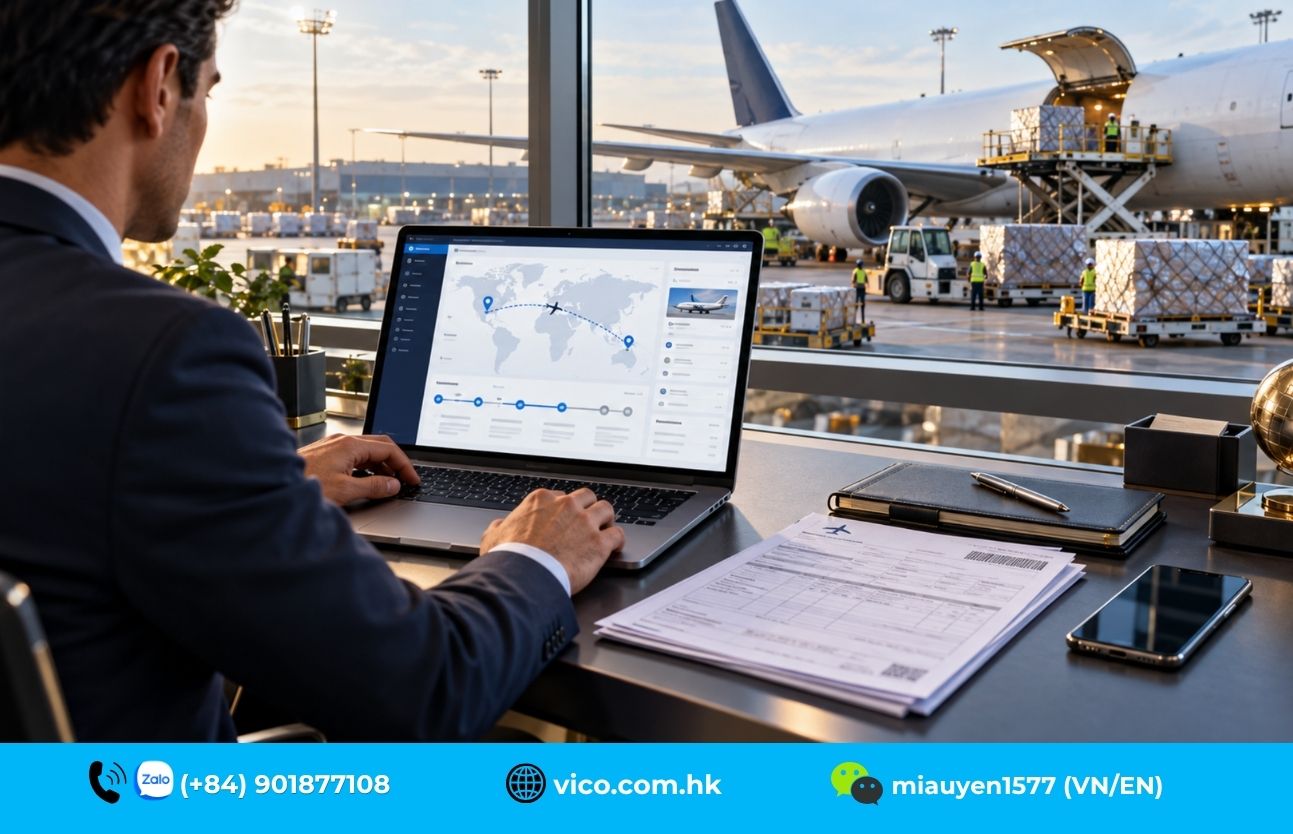
An e-AWB (Electronic Air Waybill) is the digital equivalent of a paper air waybill, replacing traditional paper workflows with electronic data transmission under compliant regulatory frameworks established by IATA.
10.1. Benefits of e-AWB
-
Reduced Paper Handling: Minimizes printing, physical transport, and archive storage requirements.
-
Data Efficiency: Enables seamless, fast data exchange between stakeholders.
-
Fewer Manual Errors: Eliminates redundant data re-entry.
-
Enhanced Tracking: Simplifies lifecycle updates across supply chains.
10.2. Does e-AWB Fully Replace Paper AWB?
Not in every circumstance. Adoption depends on trade lanes, system capabilities, bilateral agreements, and local regulatory laws. Businesses should always confirm documentation requirements directly with their carrier or forwarder for each specific shipment.
11. Frequently Asked Questions (FAQ)
-
What does AWB stand for?
AWB stands for Air Waybill. In some documents, "Airway Bill" is also used interchangeably.
-
Is an AWB a negotiable document?
No. Unlike order-based ocean bills of lading, an AWB cannot be transferred via endorsement to pass title of goods.
-
How many digits are in an AWB number?
A standard IATA MAWB features 11 digits (3 airline prefix digits + 7 serial digits + 1 check digit). HAWBs may follow internal company formats.
-
Does having an AWB mean my cargo is airborne?
Not necessarily. AWB numbers can be generated prior to physical cargo drop-off or flight departure. Tracking status updates are required to confirm real-time milestones.
-
Can an AWB be used for customs clearance?
Yes. AWB data is widely used in air import/export customs declarations and clearance packages.
-
What is the difference between Freight Prepaid and Freight Collect?
Prepaid indicates freight charges are settled at origin; Collect indicates charges are payable at destination. Ultimate cost responsibility still rests on agreed commercial Incoterms.
12. How VICO Logistics Supports International Air Freight
For shipments requiring rapid transit, high value, or strict delivery windows, air freight provides an ideal solution. However, velocity depends on seamless booking coordination, cargo preparation, waybill verification, and destination handover.
-
Transport Method Advisory: Helping businesses evaluate cargo profiles, volumetric constraints, and logistics costs to select ideal transport options.
-
Documentation Support: Reviewing AWBs early to minimize discrepancies across parties.
-
End-to-End Coordination: Combining air uplift, local trucking, and customs brokerage into streamlined touchpoints.
Do you have an upcoming international air shipment? Contact VICO Logistics today to discuss your cargo requirements, documentation needs, and secure tailored air freight solutions matching your business goals.
- Factory Coffee: The Global Coffee Harvest Calendar
- What's So Good About Vietnam Manufacturers
- Electronics Shipping: Mastering The Logistics Of High-Value Technology
- Door To Door Cambodia Shipping: The Ultimate Logistics Solution For 2026
- Trucking Cambodia - Vietnam: Fast & Reliable Cross-Border Solutions 2026
- Commercial Invoice: What It Is and How to Prepare It
- What Is a Packing List? How to Prepare a Proper Packing List for Import and Export Shipments
Get a Logistics Quote in just 5 minutes
Professional international transportation and supply chain solutions tailored for your business.
Get a quote now ↗Quick Contact
🇻🇳 Ms Uyen
Hotline / Zalo
(+84) 901 877 108WeChat (VN/EN)
miauyen1577Scan to Contact
Zalo
🇨🇳 Ms Schyler
Office Hotline
(+852) 3759 9300WeChat ID
Schyler_skylarScan to Contact
VICO International Logistics — Your Trusted Logistics Partner in Indochina
Senior member of international logistics and trade associations: Eurocham, JCtrans, VICOFA, VITAS, and more.