


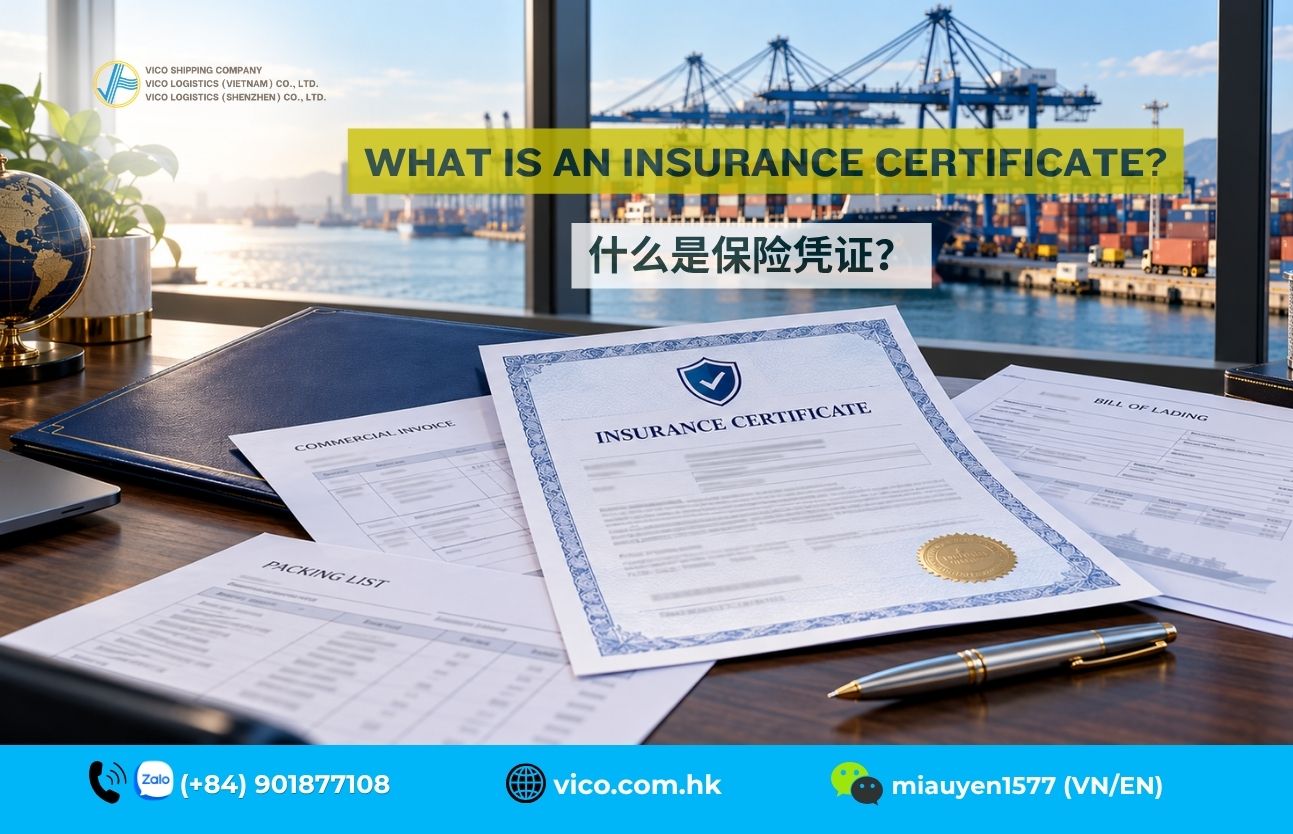
In import and export activities, goods can encounter risks during transit such as loss, damage, accidents, or unexpected incidents. To mitigate financial losses, many businesses choose to purchase cargo insurance and use an Insurance Certificate as a crucial document in their transactions.
What exactly is an Insurance Certificate? Who issues it, when is it needed, and how can businesses inspect it to avoid errors?
This article by VICO Logistics provides a detailed explanation, complete with examples and checklists to help businesses understand how to effectively use insurance documents in import and export.
1. What is an Insurance Certificate?

An Insurance Certificate is a document issued by an insurance company or an authorized agent confirming that a specific shipment has been insured under the agreed terms and scope of coverage.
The document typically displays shipment details, the insured party, the sum insured, the transport route, insurance conditions, and other necessary information for processing claims.
In import and export, an Insurance Certificate is also commonly referred to as a cargo insurance certificate.
The Role of an Insurance Certificate in Import and Export
An Insurance Certificate serves three main roles:
-
Confirmation of cargo insurance: Indicates that the shipment is insured under specific conditions and scope.
-
Support for international payment: Can be a required document to present to banks when paying via Letter of Credit (L/C).
-
Support for claims processing: Provides insurance details when goods suffer loss or damage within the covered scope.
Example: A Vietnamese enterprise imports electronic equipment from China. During transit, the goods are damaged due to an unexpected incident.
If the shipment has appropriate insurance, the enterprise or the party entitled to claim can use the Insurance Certificate along with related documents to request the insurance company to review the loss.
However, having an Insurance Certificate does not mean every loss will be compensated. Actual benefits depend on the insurance conditions, the cause of the loss, and exclusion clauses.
Who Issues an Insurance Certificate?
An Insurance Certificate is typically issued by:
-
Insurance companies.
-
Authorized agents or representative entities legally appointed by an insurance company.
-
Specialized insurance providers offering international transport insurance products.
The exporting enterprise, importing enterprise, or the party tasked with purchasing insurance will provide shipment details to apply for insurance. Once the application and conditions are approved, the document is issued as agreed.
2. When is an Insurance Certificate Used?
Not every import and export shipment requires an Insurance Certificate. The necessity of purchasing insurance and presenting the document depends on trade terms, sales contracts, payment requirements, and applicable regulations.
When Importing and Exporting under CIF and CIP
In Incoterms 2020, CIF and CIP are two trade terms requiring the seller to arrange cargo insurance for the buyer at a minimum coverage level.
|
Condition
|
Insurance Obligation under Incoterms 2020
|
|
CIF – Cost, Insurance and Freight
|
Seller procures minimum insurance equivalent to ICC (C), unless otherwise agreed
|
|
CIP – Carriage and Insurance Paid To
|
Seller procures minimum insurance equivalent to ICC (A), unless otherwise agreed
|
CIF applies to sea and inland waterway transport, while CIP can be used for any mode of transport.
Key points to note: Even though the seller pays for freight and insurance under CIF or CIP, risk transfers from the seller to the buyer at the delivery point specified in each term. Do not confuse the destination payment location with the point of risk transfer.
Under the Institute Cargo Clauses (ICC), the default insurance levels for CIF and CIP differ, so businesses must verify the applicable conditions rather than assuming both offer the same level of protection.
When Importing and Exporting under FOB, EXW, or DAP
For terms such as FOB, EXW, or DAP, Incoterms do not impose a general obligation on the seller to purchase cargo insurance for the buyer. However, the buyer or seller can still proactively arrange insurance based on their respective responsibilities and risks.
Example: A Vietnamese enterprise imports machinery from China under FOB Shanghai. The buyer bears the risk according to FOB regulations from the moment goods are loaded onto the vessel at the port of shipment. Therefore, the buyer may consider purchasing insurance to protect the goods during transit from Shanghai to Vietnam.
When Paying via Letter of Credit (L/C)
A Letter of Credit (L/C) is a payment method where the bank handles payment based on the terms and documents stipulated in the credit letter. If the L/C requires an Insurance Certificate, the exporter must ensure the insurance document complies with relevant clauses.
Key details to pay special attention to include:
-
Issuing entity and valid signature.
-
Date of document and effective time of insurance.
-
Sum insured and currency.
-
Insurance conditions.
-
Number of original copies required.
-
Other requirements specified in the L/C.
According to Article 28 of UCP 600, banks have specific rules regarding the acceptance of insurance documents. For example, the date of the document generally must not be later than the date of shipment, unless the document indicates that the insurance coverage is effective no later than the date of shipment.
Note: A document may confirm valid insurance yet still fail to meet all L/C requirements. Businesses should cross-check before presenting documents to the bank.
3. What Information Does an Insurance Certificate Contain?
The format of an Insurance Certificate may vary depending on the insurer. However, the document typically includes the following vital information:
|
English Field
|
|
Certificate No.
|
|
Insurer
|
|
Insured
|
|
Beneficiary / Loss Payee
|
|
Description of Goods
|
|
Voyage / Conveyance
|
|
From / To
|
|
Sum Insured
|
|
Insurance Conditions
|
|
Date of Issue
|
|
Claims Agent
|
|
Signature
|
Illustrative Example of an Insurance Certificate
        INSURANCE CERTIFICATE

Certificate No.      : IC-2026-001

Insured              : ABC Import Co., Ltd.

Description of Goods : Electronic Components

Route                : Shanghai → Ho Chi Minh City

Invoice Value        : USD 50,000

Sum Insured          : USD 55,000

Conditions           : Institute Cargo Clauses (A)

Issue Date           : 12 October 2026

(Example for educational purposes only)
Scenario: Suppose an importing enterprise buys electronic components worth USD 50,000 and agrees on a sum insured equal to 110% of the invoice value. The illustrated sum insured is USD 55,000.
The receiver must check whether the information on the document matches the sales contract, commercial invoice, bill of lading, and actual insurance requirements.
Special Note: The sum insured is not a guaranteed payout in the event of a loss. Actual compensation depends on the value of the damage, liability limits, deductibles, and insurance terms.
4. Difference Between an Insurance Certificate and an Insurance Policy
The terms Insurance Certificate and Insurance Policy often appear in import-export document sets but are not identical.
|
Criteria
|
Insurance Certificate (Giấy chứng nhận bảo hiểm)
|
Insurance Policy (Đơn bảo hiểm)
|
|
Purpose
|
Confirms the insurance coverage granted for a specific shipment
|
Represents the insurance contract or full terms and conditions
|
|
Content
|
Summarizes insurance details for a specific shipment
|
Presents full terms, benefits, and obligations
|
|
Usage Form
|
Usually issued for shipments under an open cover policy
|
Can be issued for a separate shipment or represent a policy agreement
|
|
In L/C Payment
|
Accepted if meeting relevant requirements
|
Can replace an Insurance Certificate under UCP 600
|
A notable point under UCP 600 Article 28 is that an Insurance Policy can replace an Insurance Certificate, but it should not be automatically assumed that an Insurance Certificate can always replace an Insurance Policy if the L/C demands a specific document type.
Example: An exporting enterprise shipping goods multiple times a year may use an open cover insurance contract. For each shipment, they declare details and receive a corresponding Insurance Certificate. Conversely, when buying insurance for an isolated shipment, they may receive an Insurance Policy or another approved document format.
Businesses should confirm the required document type before issuance, especially for L/C transactions.
5. Cargo Insurance Conditions: ICC (A), ICC (B), ICC (C)

One of the most critical pieces of information on an Insurance Certificate is the insurance condition. In international cargo transport, the three common sets of conditions are Institute Cargo Clauses (A), (B), and (C).
Institute Cargo Clauses (A) – ICC (A)
-
ICC (A) provides the broadest standard coverage among the three sets.
-
It covers all risks of unexpected physical loss or damage to goods, except for specifically excluded cases.
-
ICC (A) is suitable for high-value goods, goods vulnerable to external impacts, or shipments undergoing multiple handling stages, depending on risk assessment.
-
However, the common term "All Risks" does not mean every single risk is covered.
Institute Cargo Clauses (B) – ICC (B)
-
ICC (B) covers risks specifically listed in the clause, with a broader scope than ICC (C).
-
Covered risks include fire, explosion, vessel accidents, and certain losses related to natural disasters or water ingress, depending on application terms.
Institute Cargo Clauses (C) – ICC (C)
-
ICC (C) has the narrowest standard coverage scope.
-
It primarily focuses on major listed risks such as fire, explosion, major transport vessel accidents, and other specifically defined events.
Overview Comparison Table
|
Criteria
|
ICC (A)
|
ICC (B)
|
ICC (C)
|
|
Scope
|
Broadest
|
Medium
|
Most Restrictive
|
|
Principle
|
Physical risk coverage, except exclusions
|
Enumerated risks
|
Enumerated risks
|
|
Fire, Explosion
|
Yes
|
Yes
|
Yes
|
|
Certain Natural Disasters
|
Yes (per terms)
|
Yes (per terms)
|
Limited
|
|
Ordinary Theft Risks
|
May be covered
|
Not default
|
Not default
|
Actual coverage depends on the clause version, endorsements, supplementary conditions, and exclusions. Before purchasing insurance, businesses should review commodity characteristics, routes, transport modes, transshipments, and potential risk levels.
6. How to Calculate Insured Value and Premium
What is 110% Insured Value?
In many import-export transactions, the sum insured is required to be 110% of the goods' value on a CIF or CIP basis. Under Incoterms 2020, CIF and CIP insurance obligations typically mandate a minimum coverage of 110% of the contract value. UCP 600 also establishes rules for determining insurance coverage in L/C payments.
Example: A shipment has a CIF value of USD 50,000:
Thus, the expected sum insured is USD 55,000.
How to Calculate Cargo Insurance Premium
A simple estimation formula is:
Assumptions:
-
CIF Value: USD 50,000
-
Sum Insured: USD 55,000
-
Assumed Premium Rate: 0.15%
Calculated Premium:
Note: USD 82.5 is an illustrative calculation, not an official insurance quotation. Actual premiums depend on cargo type, insurance conditions, transit routes, deductibles, insurers, supplementary terms, and applicable taxes/fees.
7. Procedure for Obtaining an Insurance Certificate
The process for obtaining an insurance certificate generally follows these steps:
-
Prepare Shipment Information: Gather the Commercial Invoice, cargo details, quantity, value, departure point, destination, and transport schedule.
-
Select Insurance Conditions: Determine whether ICC (A), (B), (C), or other conditions fit the contract and risk profile.
-
Submit Insurance Application: Provide necessary information to the insurance company or authorized agent.
-
Confirm Conditions and Premium: Review the sum insured, coverage scope, deductibles, effective date, and premium rate.
-
Receive Insurance Document: Obtain the Insurance Certificate or other insurance document after approval.
-
Pre-use Inspection: Cross-check the document against the shipment document set and contract/L/C requirements.
Businesses should arrange insurance before the transport phase requiring coverage begins. Do not wait until an incident occurs to verify validity.
8. Insurance Certificate Pre-Delivery Checklist

This is a vital step to minimize errors in your import-export document set. Before sending documents to customers or banks, review the following items:
-
Insured name is accurate
-
Insurer information and valid signature are present
-
Description of goods matches the Invoice
-
Transport route and insurance locations are correct
-
Sum insured meets contract or L/C requirements
-
Insurance currency is appropriate
-
Insurance conditions match requirements
-
Insurance becomes effective at the correct time
-
Bill of lading number or related transport info is accurate (if shown)
-
Beneficiary and assignment requirements are proper (if applicable)
-
Number of original documents fulfills requirements
-
Claims and contact information are clear
Cross-checking: To reduce error risks, the Insurance Certificate should be cross-referenced with:
-
Commercial Invoice
-
Packing List
-
Bill of Lading or Air Waybill
-
Sales Contract
-
Letter of Credit (L/C), if applicable
9. Common Errors on Insurance Certificates
9.1. Incorrect Insured Information
Discrepancies in the company name, insured party, or beneficiary compared to the contract can cause processing difficulties.
Solution: Check with the insurer and request adjustments if necessary.
9.2. Insufficient Sum Insured
If the sum insured is lower than the contract or L/C requirement, payment issues or coverage gaps may arise.
Solution: Cross-check invoice values, CIF/CIP terms, and requested insurance amounts.
9.3. Incorrect Effective Date
If the damage occurs outside the insurance validity period, compensation may be denied.
Solution: Verify start dates, shipping schedules, and covered transit durations.
9.4. Choosing Inappropriate Insurance Conditions
Assuming the certificate covers all risks when it only covers restricted conditions leads to vulnerabilities.
Solution: Check ICC (A), (B), (C) and exclusions, especially for high-value or fragile goods.
9.5. Document Inconsistencies
Mismatches in goods descriptions, quantities, routes, or bill of lading details create discrepancies during document checking.
Solution: Perform a cross-check of the entire dossier before submission.
10. What to Do When Goods Are Damaged?
When goods are damaged or lost during transit, businesses must act promptly to protect their rights:
-
Record the Current Status: Take photos, shoot videos, and draft a loss report.
-
Notify Relevant Parties: Contact the insurer, carrier, and responsible entities.
-
Mitigate Further Loss: Take reasonable steps to preserve the remaining cargo.
-
Coordinate Surveys: Arrange inspections or surveys as instructed by the insurer.
-
Prepare Claim Documents: Gather the Insurance Certificate, Invoice, Packing List, Bill of Lading, survey report, and evidence.
-
Track Resolution Progress: Supplement documents as requested and monitor progress.
Timely notification and evidence retention are essential to preserve the right to claim.
11. Frequently Asked Questions (FAQ)
-
Is an Insurance Certificate mandatory in import-export?
Not all shipments require one. Requirements stem from contracts, Incoterms, L/Cs, or transaction regulations.
-
Is an Insurance Certificate a Bill of Lading?
No. An Insurance Certificate confirms insurance details, while a Bill of Lading is a transport document confirming receipt of goods for carriage.
-
Is it a Certificate of Origin (C/O)?
No. An Insurance Certificate covers insurance, whereas a C/O certifies goods origin.
-
Who buys insurance under CIF terms?
The seller, according to Incoterms 2020 minimum requirements, unless agreed otherwise.
-
Can an Insurance Policy replace an Insurance Certificate?
Under UCP 600 Article 28, an Insurance Policy can replace a Certificate, but the reverse is not automatically true unless specified by the L/C.
-
Does having an Insurance Certificate guarantee compensation?
No. Compensation is only provided if the loss falls within the covered scope and meets policy terms.
12. How VICO Logistics Supports Businesses
In import and export, an Insurance Certificate is only one part of the logistics document set. To minimize errors, businesses need seamless communication between carriers, document teams, buyers/sellers, banks, and insurers.
With international logistics solutions, VICO Logistics can act as an advisory hub to coordinate transport, documentation, and customs procedures tailored to each shipment.
Are you preparing a shipment and unsure if your document set is compliant?
Contact VICO Logistics with your transport route, cargo type, Incoterms, and document requirements to receive professional logistics advice!
- Factory Coffee: The Global Coffee Harvest Calendar
- What's So Good About Vietnam Manufacturers
- Electronics Shipping: Mastering The Logistics Of High-Value Technology
- Door To Door Cambodia Shipping: The Ultimate Logistics Solution For 2026
- Trucking Cambodia - Vietnam: Fast & Reliable Cross-Border Solutions 2026
- Commercial Invoice: What It Is and How to Prepare It
- What Is a Packing List? How to Prepare a Proper Packing List for Import and Export Shipments
Get a Logistics Quote in just 5 minutes
Professional international transportation and supply chain solutions tailored for your business.
Get a quote now ↗Quick Contact
🇻🇳 Ms Uyen
Hotline / Zalo
(+84) 901 877 108WeChat (VN/EN)
miauyen1577Scan to Contact
Zalo
🇨🇳 Ms Schyler
Office Hotline
(+852) 3759 9300WeChat ID
Schyler_skylarScan to Contact
VICO International Logistics — Your Trusted Logistics Partner in Indochina
Senior member of international logistics and trade associations: Eurocham, JCtrans, VICOFA, VITAS, and more.