

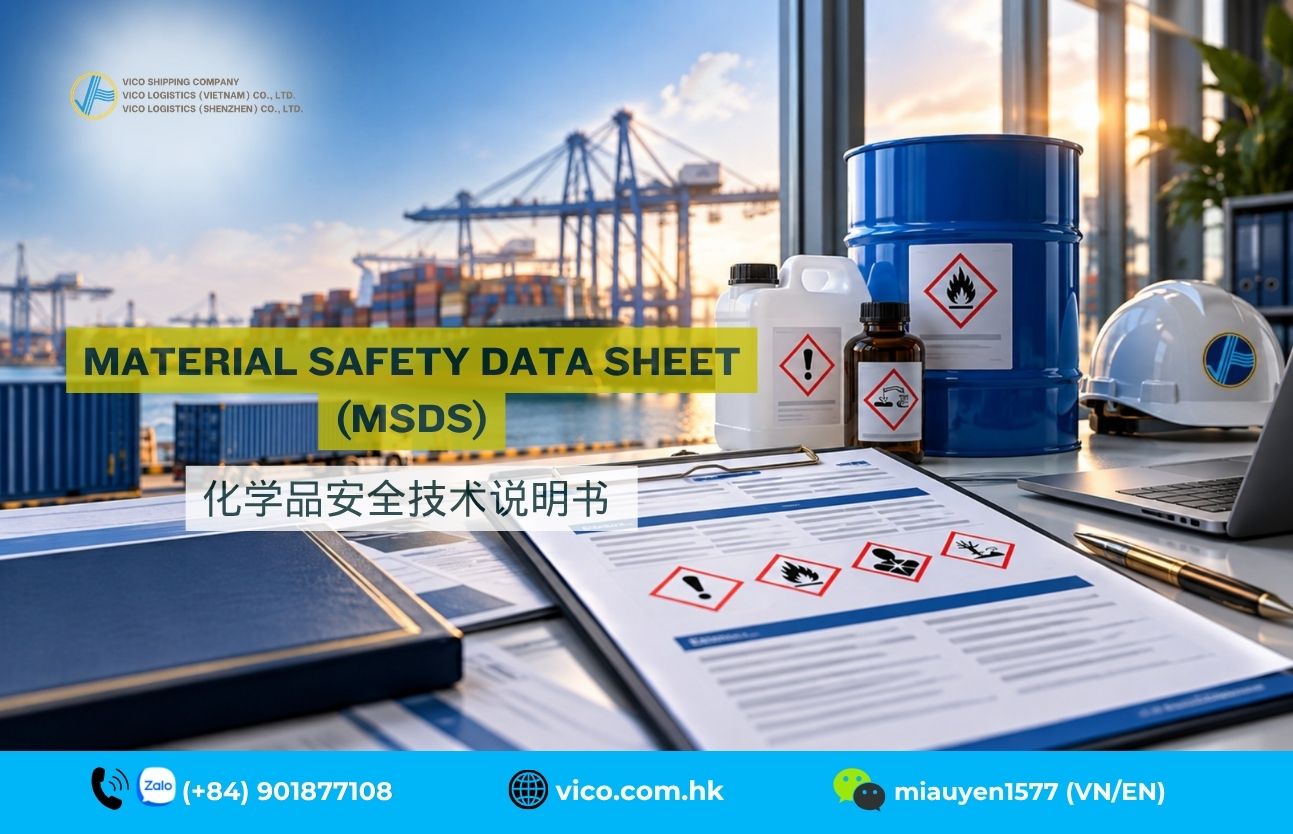
In import-export operations, especially for shipments containing chemicals or goods with hazardous properties, businesses may be required to provide an MSDS or SDS before transportation.
So what are MSDS and SDS? Are the two documents different? When do businesses need to provide an SDS, and how can they verify the information before shipping?
This article answers these questions and helps businesses identify the key information in a chemical safety data sheet, so they can reduce errors when preparing shipments.
1. What Are MSDS and SDS?
What is an MSDS?
An MSDS (Material Safety Data Sheet) is a chemical safety document that provides information on the properties, hazard levels, and safety measures related to a chemical or chemical mixture.
The information in an MSDS helps users identify risks that may arise during storage, use, handling, or transportation.
Common contents of an MSDS include:
- Chemical name and manufacturer information.
- Composition and physical and chemical properties.
- Health and environmental hazards.
- First-aid and incident response measures.
- Guidance on storage, handling, and transportation.
What is an SDS?
An SDS (Safety Data Sheet) is a chemical safety document. It is the term now widely used in many international chemical safety management systems.
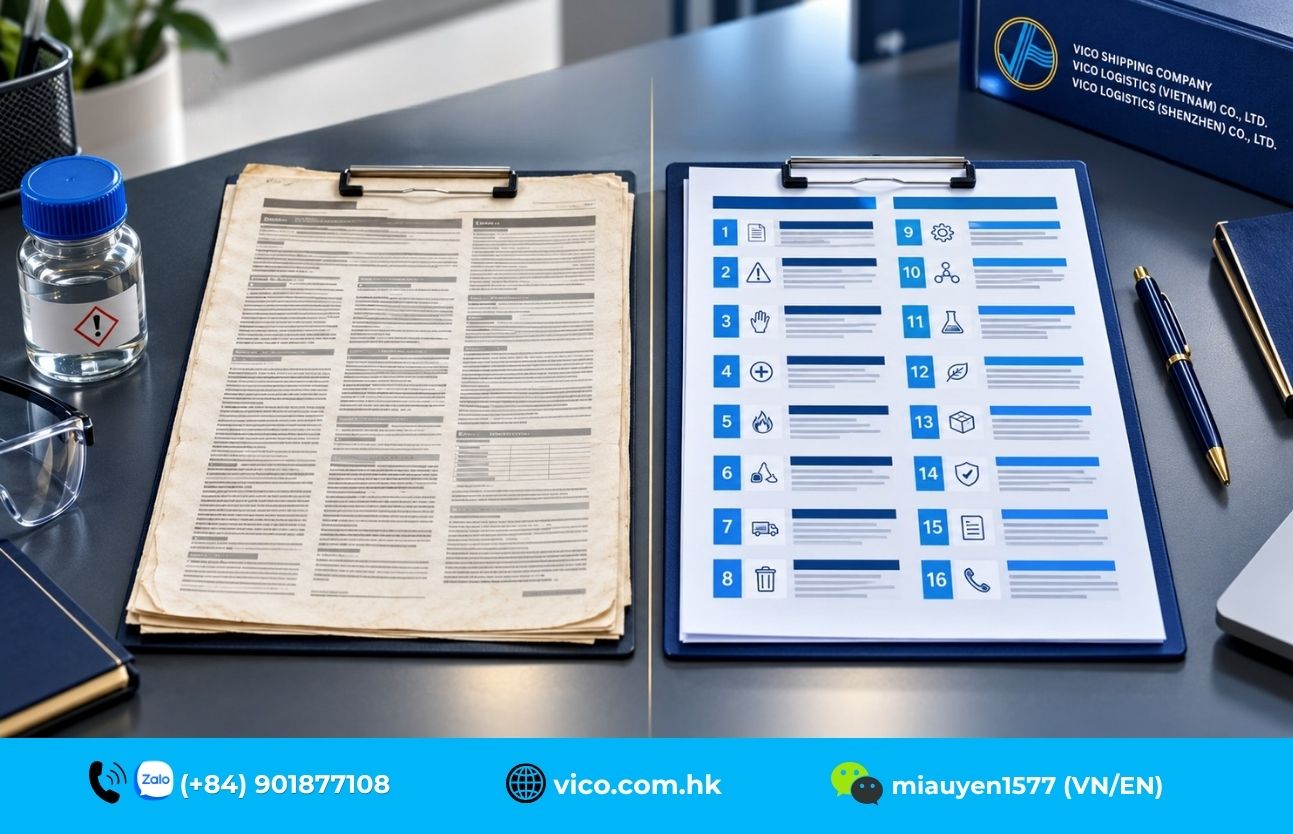
An SDS follows a 16-section structure, making it easier for readers to find, cross-reference, and use safety information.
According to OSHA, SDS is the modern term replacing MSDS in the U.S. Hazard Communication system, with a standardized 16-section format.
Example: A business importing industrial paint may need an SDS to review the product’s hazards, storage information, and classification for transportation purposes.
An SDS does not replace professional assessment or a check of the regulations that apply to a specific shipment.
2. What Is the Difference Between MSDS and SDS?
MSDS and SDS share the same basic purpose: providing information on the hazards and safety measures related to chemicals.
The main differences lie in terminology and in how standardized the format is.
|
Criteria
|
MSDS
|
SDS
|
|---|---|---|
|
Full name
|
Material Safety Data Sheet
|
Safety Data Sheet
|
|
Vietnamese name
|
Bảng chỉ dẫn an toàn hóa chất
|
Phiếu an toàn hóa chất
|
|
Terminology
|
Traditional term
|
Term now widely used
|
|
Structure
|
May vary under older systems
|
Standardized 16 sections under GHS
|
|
Purpose
|
Communicate safety information
|
Communicate safety information
|
|
Application
|
Manufacturing, warehousing, transportation
|
Manufacturing, warehousing, transportation
|
GHS stands for the Globally Harmonized System of Classification and Labelling of Chemicals.
This system helps standardize how chemical hazards are classified and communicated.
Important note for businesses: Whether a document is titled MSDS or SDS is not the only factor that determines whether it is suitable. What matters more is that the information is accurate, complete, and meets the requirements of the relevant market, sector, or mode of transport.
3. What Role Does an SDS Play in Import-Export?
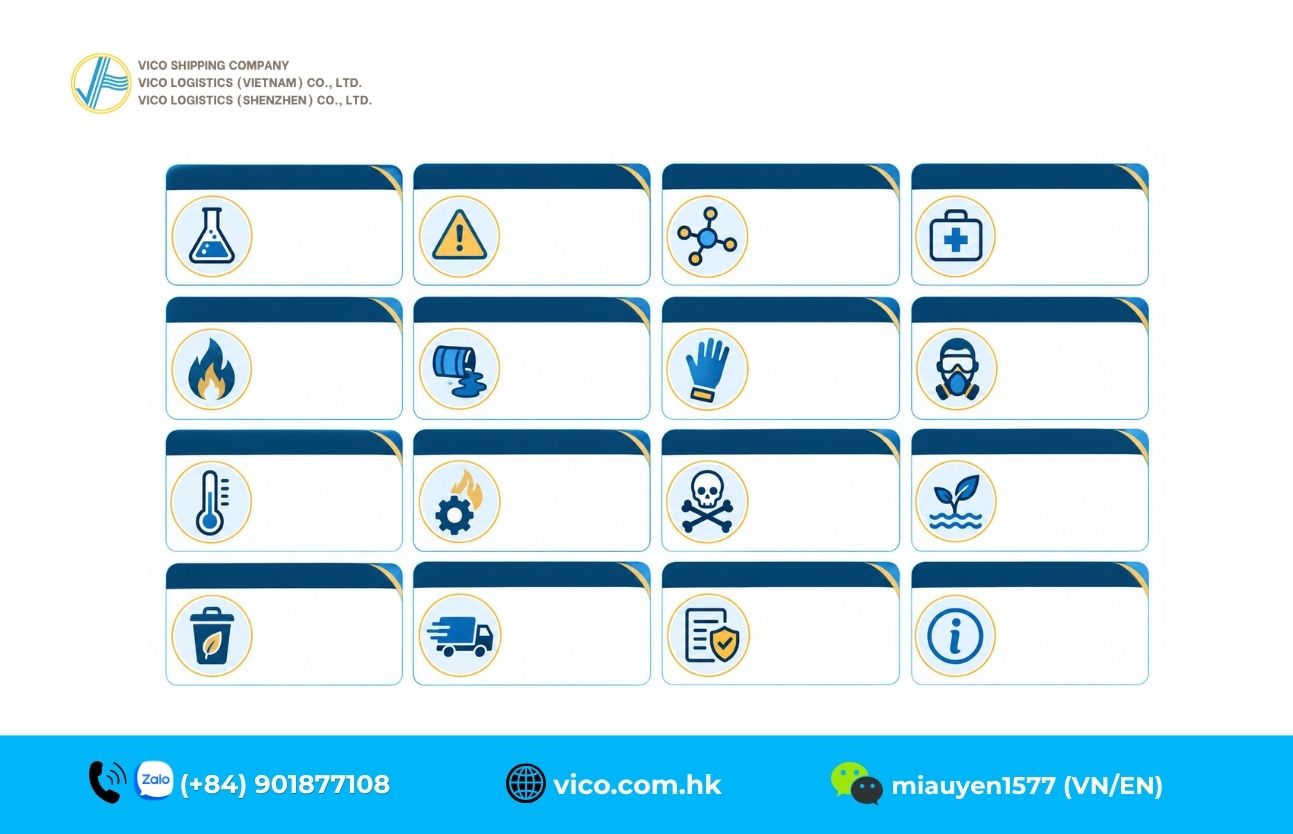
In logistics, an SDS is an important source of information that helps businesses and related parties assess the risks associated with goods.
3.1. Helps Identify Hazardous Properties
An SDS provides information that helps determine which hazardous properties a product has, such as fire risk, chemical reactivity, corrosiveness, or health effects.
This information supports the review and classification of goods.
However, an SDS should not be used as the sole basis for concluding whether goods are classified as dangerous goods for transport.
3.2. Helps Assess Transportation Conditions
Some types of goods must be reviewed under specific transport regulations.
Information in the SDS helps logistics providers make a preliminary assessment of:
- The declared hazardous properties of the goods.
- Whether the product matches the information declared.
- Warnings to note during transportation.
- The need for additional verification with the manufacturer or a qualified body.
According to IATA, the information in an SDS is not always sufficient or accurate for determining transport classification. When in doubt, it should be clarified with the manufacturer, distributor, or a qualified entity.
3.3. Supports Warehouse Management and Safety
For businesses with warehouses, an SDS helps staff understand the risks associated with a product and look up safety guidance published by the supplier.
It is also an important reference for safety training and for developing incident response procedures at the facility.
3.4. Reduces Risks Caused by Incomplete Information
When information about goods is unclear, businesses may have to supply additional documents, explain product characteristics, or undergo a professional assessment before shipping can proceed.
Preparing an appropriate SDS early gives all parties a better basis for verification and coordination.
4. What Does an SDS Contain?
An SDS that follows the GHS structure typically has 16 main sections.
In Vietnam, Article 5 of Circular 01/2026/TT-BCT also specifies 16 basic content groups for a Chemical Safety Data Sheet, with the template provided in Appendix I.
|
Section
|
Content
|
Plain-Language Meaning
|
|---|---|---|
|
1
|
Chemical and supplier identification
|
Identifies the product and the parties involved
|
|
2
|
Hazard identification
|
Shows hazard warnings
|
|
3
|
Composition/information on ingredients
|
Information on chemical composition
|
|
4
|
First-aid measures
|
Response information in case of exposure
|
|
5
|
Firefighting measures
|
Warnings and measures related to fire
|
|
6
|
Accidental release measures
|
Information on handling unexpected incidents
|
|
7
|
Handling and storage
|
Safety requirements for handling and warehousing
|
|
8
|
Exposure controls/personal protection
|
Information on controlling risks
|
|
9
|
Physical and chemical properties
|
Physical and chemical characteristics
|
|
10
|
Stability and reactivity
|
Conditions that may cause reactions
|
|
11
|
Toxicological information
|
Health effect risks
|
|
12
|
Ecological information
|
Environmental risks
|
|
13
|
Disposal considerations
|
Requirements for waste treatment
|
|
14
|
Transport information
|
Classification information for transportation
|
|
15
|
Regulatory information
|
Regulations relevant to the product
|
|
16
|
Other information
|
Preparation date, revision date, and additional information
|
Section 14 – Transport Information: What Should Businesses Pay Attention To?
For import-export and logistics professionals, Section 14 is often one of the parts that deserves the closest review.
Depending on the product and the document, this section may include:
UN Number: A code used in the dangerous goods transport system to identify substances or groups of goods under regulations.
Proper Shipping Name: The name used to identify goods in the dangerous goods transport system, where applicable.
Transport Hazard Class: Information on the hazard class of the goods under the relevant transport regulations.
Packing Group: Packing group classification, where applicable under regulations.
Environmental Hazards: Information on environmental risks relevant to transportation.
Notes When Reading Section 14
The information in an SDS may need to be re-verified against the specific mode of transport and the corresponding set of regulations. Do not rely on a single line such as “Not regulated” to conclude that the goods will be accepted for transport in every case.
IATA emphasizes that the classification, marking, packing, labeling, and documentation of dangerous goods transported by air must comply with the applicable transport regulations.
5. Which Products Commonly Require an MSDS/SDS Check?
Not every product requires an SDS in every case.
However, businesses should pay particular attention to product groups that may contain chemicals or have hazardous properties.
5.1. Paints, Printing Inks, and Industrial Adhesives
Some products in this group may contain ingredients that need to be assessed for fire risk, toxicity, or other hazardous properties.
Transport status cannot be determined from a product’s trade name alone.
5.2. Solvents and Industrial Chemicals
These products may require information on composition, hazard classification, and related requirements before they are accepted for transport.
5.3. Detergents and Industrial Cleaning Products
Not every detergent is a dangerous good. The assessment depends on the product formulation, its hazardous properties, and the applicable regulations.
5.4. Batteries and Battery-Powered Devices
Some products containing batteries are subject to specific transport requirements, depending on the battery technology, product characteristics, and mode of transport.
For these products, an SDS is not always a mandatory document or sufficient to meet the carrier’s requirements. Other product documentation or appropriate evidence of testing or assessment may be needed.
5.5. Cosmetics and Products with Chemical Ingredients
Some products may require clarification of ingredients or hazardous properties at the request of the logistics provider.
However, it cannot be assumed that all cosmetics require an SDS or are classified as dangerous goods.
Rule to remember: Whether an SDS is needed depends on the characteristics of the goods, their intended use, legal regulations, and the requirements of the parties involved in transportation.
6. Is an MSDS/SDS Mandatory for Import-Export?
This is a question many businesses ask when preparing shipping documents.
Two issues need to be distinguished:
First: Obligations regarding chemical safety data sheets.
In Vietnam, businesses need to consider their chemical information obligations under the Law on Chemicals No. 69/2025/QH15, Decree 26/2026/NĐ-CP, and related guiding documents.
Circular 01/2026/TT-BCT sets out the content and template of the Chemical Safety Data Sheet.
Second: Document requirements for transportation.
Shipping lines, airlines, freight forwarders, or other parties may request safety information to assess whether they can accept a shipment.
This requirement does not mean that every import-export shipment must submit an SDS as a mandatory customs document.
Businesses need to determine separately:
- Whether the product falls within the scope that requires a Chemical Safety Data Sheet to be prepared and provided under the applicable law.
- Whether the shipment is classified as dangerous goods under the intended mode of transport.
- Which documents the carrier requires.
- Whether there are other declaration, licensing, or specialized inspection obligations.
- These issues may be related, but they do not substitute for one another.
7. Who Is Responsible for Preparing and Providing the SDS?
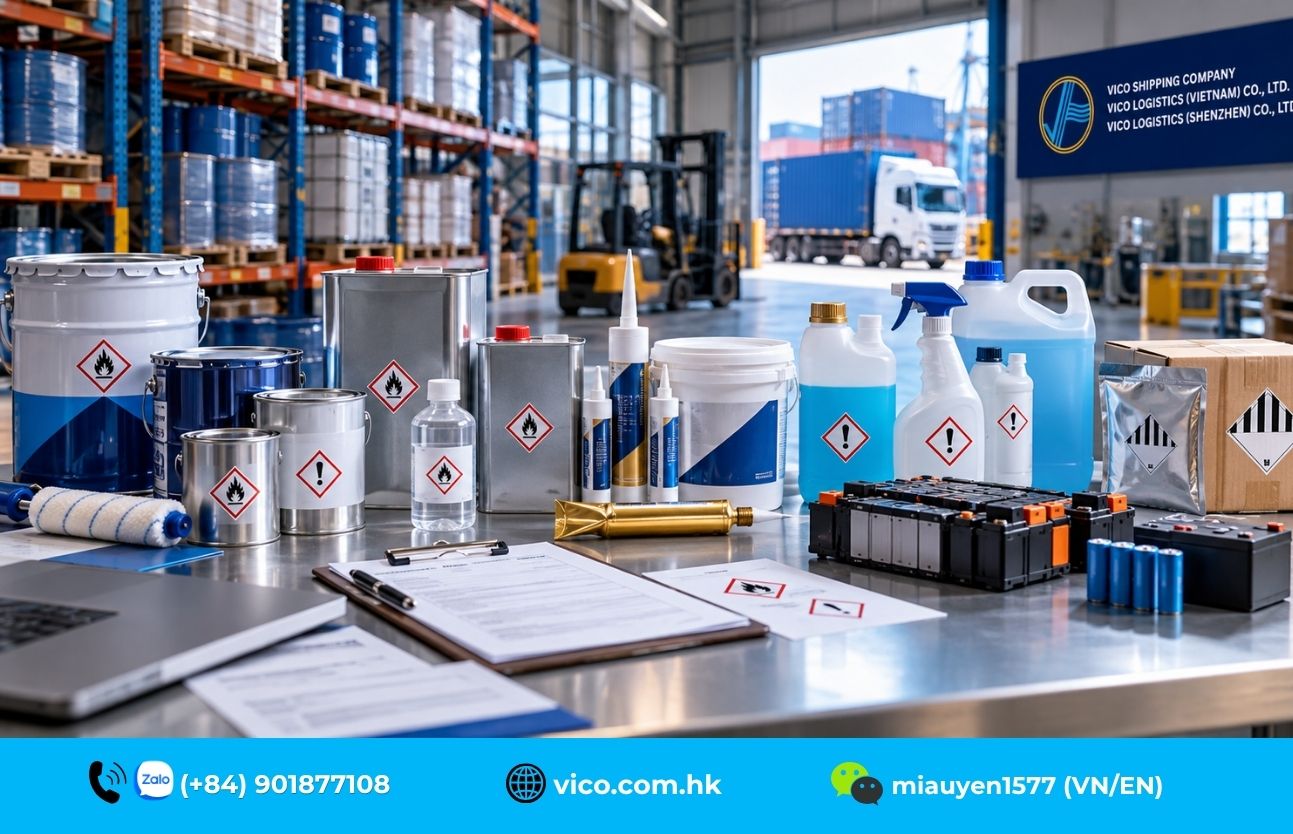
Responsibility for the chemical safety data sheet depends on the role of each organization or individual and on the applicable regulations.
In practice, the parties typically involved include:
Manufacturer: The party that holds information on the product’s composition, properties, and characteristics.
Importer: May have obligations regarding classification, chemical information, and providing documents under the regulations of the import market.
Distributor or supplier: May act as the point of contact that passes safety documents from the manufacturer on to customers.
Logistics provider: Uses the information provided to support assessment, coordination, and review of transport requirements, but does not automatically assume the classification responsibility of the shipper or of the party with the relevant obligations.
If you do not yet have an SDS, you should contact the manufacturer or supplier to request a document appropriate to the specific product.
Do not use the SDS of a different product just because the product name or application appears similar.
8. How to Check an SDS Before Shipping Import-Export Goods
Before providing an SDS to a logistics provider, businesses can carry out a preliminary check to spot missing or inconsistent information.
- SDS Verification Checklist for Businesses
- Product name matches the actual goods
- Manufacturer or supplier information is clear
- The SDS contains all sections required by the applicable template
- Hazard warnings are clearly presented
- Section 14 information has been verified
- Preparation or revision date has been verified
- Language and version meet requirements
- Document requirements have been confirmed with the carrier
This checklist only supports an initial information review. It does not replace a dangerous goods classification assessment or a legal compliance check by a specialist.
9. Common SDS Errors and How to Avoid Them
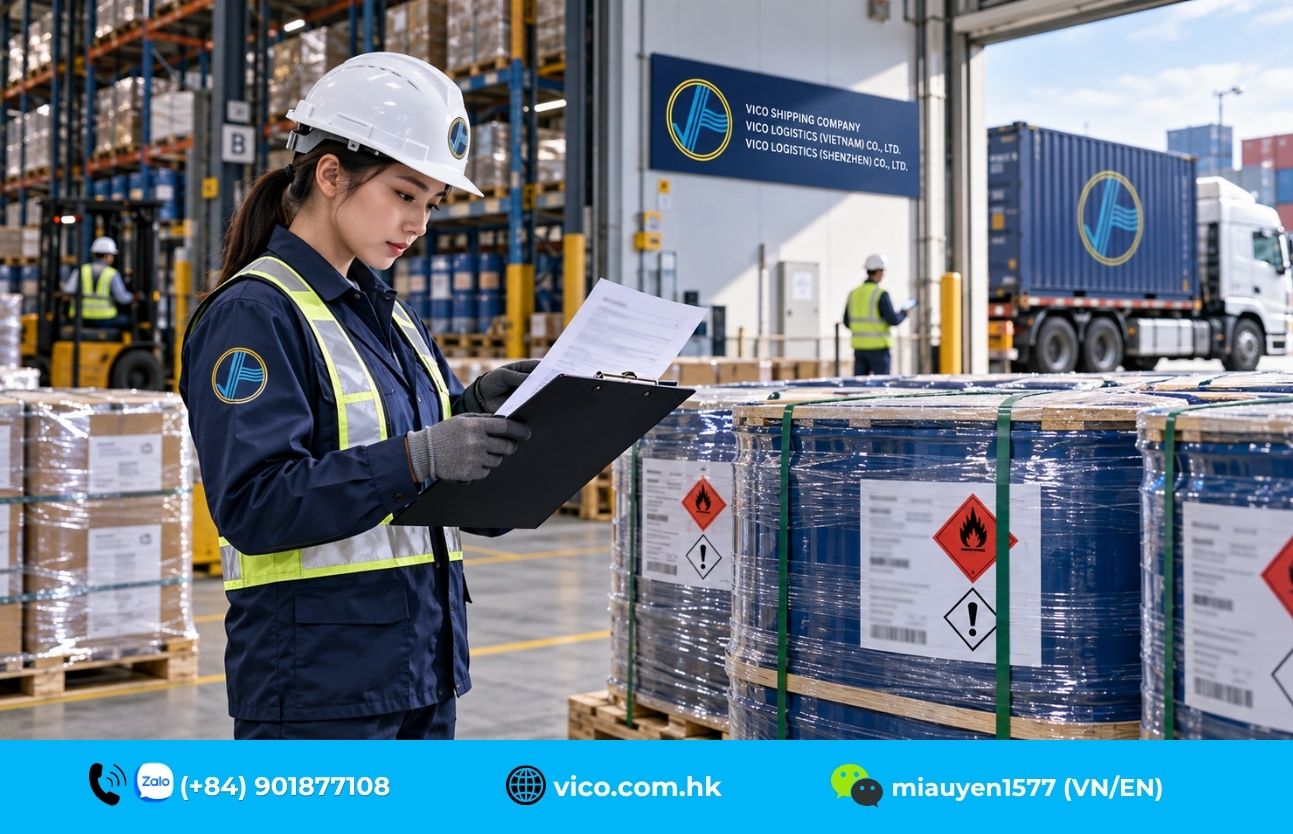
9.1. Product Name Mismatch
The product name on the SDS may differ from the goods description on the Commercial Invoice or Packing List.
This can lead to requests for clarification about the goods.
Businesses should cross-check the trade name, product code, and identifying information against the manufacturer’s documents.
9.2. Using the Wrong Product’s Document
Another common mistake is using the SDS of a product with a similar name or application but a different composition.
Products in the same category may have different hazardous properties and different transport classifications.
Therefore, make sure the document corresponds to the exact product being shipped.
9.3. Missing or Unclear Transport Information
The information in Section 14 is sometimes incomplete or insufficient to determine the transport classification.
When something is unclear, businesses should ask the manufacturer or a qualified body for confirmation rather than guess.
9.4. Using an Old SDS Without Checking
A document prepared some time ago does not automatically become invalid just because a certain period has passed.
However, businesses need to check whether the product, hazard information, regulations, or the receiving party’s requirements have changed.
9.5. Assuming an SDS Alone Is Enough for Transportation
This is a misunderstanding to avoid.
An SDS is a source of safety information. It is not a transport permit, a customs clearance certificate, or proof that the goods will be accepted under every mode of transport.
Transportation also depends on classification, route, type of vehicle, applicable regulations, and the requirements of the parties involved.
10. Frequently Asked Questions About MSDS/SDS
Are MSDS and SDS the same thing?
The two terms share the same purpose of communicating chemical safety information. SDS is the term widely used today, with a standardized 16-section structure in GHS-aligned systems.
Must an SDS be in Vietnamese?
Language requirements depend on the law of the place where it is applied and the purpose for which the document is used. For activities in Vietnam, businesses should check the current regulations on Chemical Safety Data Sheets; documents from foreign suppliers may need to be supplemented or translated appropriately.
Is an MSDS/SDS a quality certificate?
No. An SDS focuses on safety information and hazardous properties. It does not replace a Certificate of Analysis (COA), a quality certificate, or other documents.
If I have an SDS, will the goods definitely be shipped?
No. An SDS provides information for assessment, but whether the goods are accepted depends on transport regulations and the conditions applicable to the shipment.
Can an MSDS replace customs documents?
No. An SDS does not replace a customs declaration, commercial invoice, packing list, or any relevant specialized licenses and documents.
Where can businesses request an SDS?
The appropriate source is usually the manufacturer or the supplier responsible for the product. Businesses should request a document that corresponds to the exact product name and the version in use.
11. How VICO Logistics Supports Businesses in Preparing for Shipment
When importing or exporting products that contain chemicals or have hazardous properties, preparing accurate goods information is an important step in reducing potential issues.
VICO Logistics can serve as a point of contact for businesses to discuss shipping needs, shipment information, and requirements that must be verified with the relevant parties.
Depending on the type of goods, the shipping route, and the actual scope of services, the consultation may focus on product information, the documents to prepare, and suitable logistics solutions.
Need to ship goods with an SDS/MSDS?
Contact VICO Logistics and provide your product information, intended shipping route, and any existing documents to discuss the next steps.
- Factory Coffee: The Global Coffee Harvest Calendar
- What's So Good About Vietnam Manufacturers
- Electronics Shipping: Mastering The Logistics Of High-Value Technology
- Door To Door Cambodia Shipping: The Ultimate Logistics Solution For 2026
- Trucking Cambodia - Vietnam: Fast & Reliable Cross-Border Solutions 2026
- Commercial Invoice: What It Is and How to Prepare It
- What Is a Packing List? How to Prepare a Proper Packing List for Import and Export Shipments
Get a Logistics Quote in just 5 minutes
Professional international transportation and supply chain solutions tailored for your business.
Get a quote now ↗Quick Contact
🇻🇳 Ms Uyen
Hotline / Zalo
(+84) 901 877 108WeChat (VN/EN)
miauyen1577Scan to Contact
Zalo
🇨🇳 Ms Schyler
Office Hotline
(+852) 3759 9300WeChat ID
Schyler_skylarScan to Contact
VICO International Logistics — Your Trusted Logistics Partner in Indochina
Senior member of international logistics and trade associations: Eurocham, JCtrans, VICOFA, VITAS, and more.