


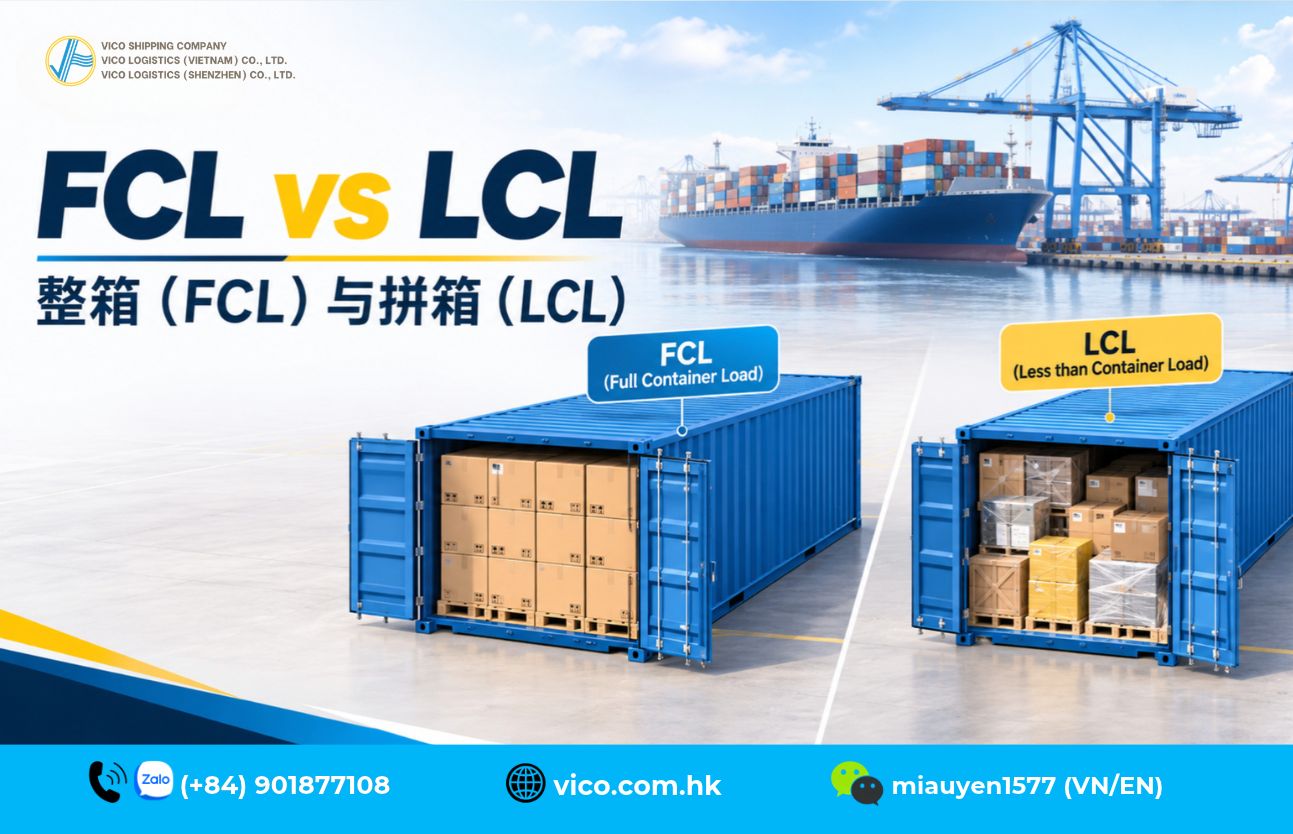
When shipping goods internationally by sea, one of the first decisions a business must make is whether to choose FCL or LCL shipping.
FCL (Full Container Load) allows a single shipper to use an entire container exclusively, whereas LCL (Less than Container Load) consolidates shipments from multiple shippers into the same container. Both methods help businesses move cargo across borders, but they differ in pricing structures, handling processes, transit times, and cargo requirements.
So, which option is better for your business? Should you book a full 20ft or 40ft container, or only pay for the space your cargo occupies?
This guide explains the key differences between FCL and LCL, compares their costs and transit times, and helps you select the most suitable shipping method for your cargo.
1. What is FCL Shipping?
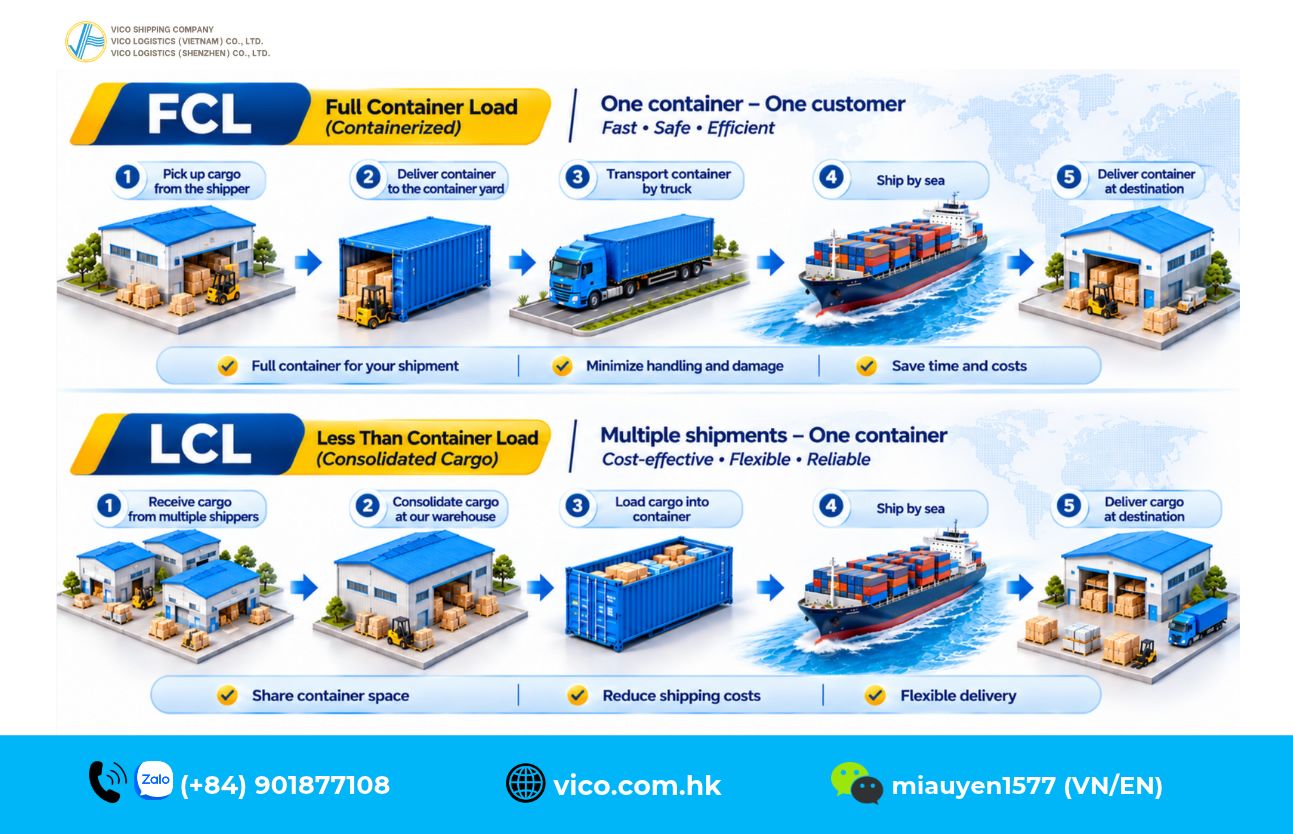
FCL (Full Container Load) is an ocean freight shipping method in which a single shipper books an entire container exclusively for their own cargo.
The container can be a 20ft, 40ft, or 40ft High Cube (HC), depending on the cargo volume, weight, and equipment requirements.
Although the term stands for "Full Container Load," your cargo does not necessarily have to fill every inch of space inside. You can still book an FCL container even if the load does not completely fill it.
1.1. How Does FCL Shipping Work?
A typical FCL shipment follows these steps:
- The shipper prepares the goods at their factory or warehouse.
- An empty container is dispatched to the loading location.
- The cargo is loaded inside the container.
- The container is sealed and transported to the port of loading.
- The container is loaded onto the vessel and shipped to the destination port.
- The consignee clears customs and arranges for container pickup/delivery.
- The goods are unloaded, and the empty container is returned to the designated depot according to agreed terms.
With FCL, the container typically remains sealed throughout transit, except in cases of customs inspection or other operational requirements.
1.2. Advantages of FCL Shipping
- Exclusive container use: Your cargo does not share container space with goods from other shippers.
- Less cargo handling: Minimizes the consolidation and deconsolidation stages typically required for loose cargo.
- Greater control: Businesses have higher control over loading, sealing, and shipment scheduling.
- Ideal for large shipments: FCL becomes significantly more cost-effective once cargo volume reaches a sufficient threshold.
- Better suited for sensitive goods: Fewer loading and unloading touchpoints reduce the risk of damage, loss, or mix-ups.
1.3. Disadvantages of FCL Shipping
- Higher upfront shipping cost: You pay for the entire container rather than just the space your cargo occupies.
- Container utilization matters: Low-volume shipments can result in significant wasted space.
- Container management: Shippers and consignees must coordinate loading, unloading, and returning empty containers on time.
- Additional surcharges may apply: Terminal Handling Charges (THC), container trucking, customs fees, demurrage, and detention charges can impact total landed costs.
2. What is LCL Shipping?
LCL (Less than Container Load) is an ocean freight shipping method where cargo from multiple different shippers is consolidated into a single shared container.
Instead of paying for an entire container, each shipper pays based on the chargeable volume or weight of their shipment, following the freight forwarder's tariff rules and minimum charge requirements.
LCL is particularly beneficial for businesses shipping smaller quantities that do not have enough volume to fill an entire container.
2.1. How Does LCL Shipping Work?
A typical LCL shipment involves the following process:
- The shipper prepares and packs the goods.
- The cargo is delivered to a Container Freight Station (CFS) or designated consolidation warehouse.
- The freight forwarder consolidates cargo from multiple shippers.
- The consolidated goods are stuffed together into a single container.
- The container is shipped via ocean freight to the destination port.
- At the destination port, the container is moved to a CFS warehouse for deconsolidation (devanning).
- Individual shipments are separated and released for customs clearance and final delivery.
Because multiple shipments share a single container, LCL requires closer coordination at both the origin and destination ends.
2.2. Advantages of LCL Shipping
- Lower initial cost for small loads: You only pay for the space or chargeable weight your cargo uses rather than renting a full container.
- Flexible shipment quantities: Ideal for small orders, product samples, and trial shipments.
- Inventory management flexibility: Businesses can ship smaller batches more frequently instead of waiting to accumulate enough stock for a full container.
- Useful for market testing: Importers can test product quality or new suppliers without committing to a large-volume order.
2.3. Disadvantages of LCL Shipping
- Increased handling stages: Goods must undergo consolidation and deconsolidation at warehouses.
- Potentially longer transit times: Cargo may wait at origin until enough freight is gathered to fill a container, and wait again at destination for devanning.
- Higher local charges: CFS handling fees, documentation fees, and other surcharges apply at both origin and destination ports.
- Higher handling risks: Additional transshipment touchpoints increase the potential for damage, misrouting, or delays.
- Less control over shared containers: Your cargo travels alongside other businesses' goods (and could be delayed if another shipper's cargo faces customs issues).
3. FCL vs LCL: What Are the Key Differences?
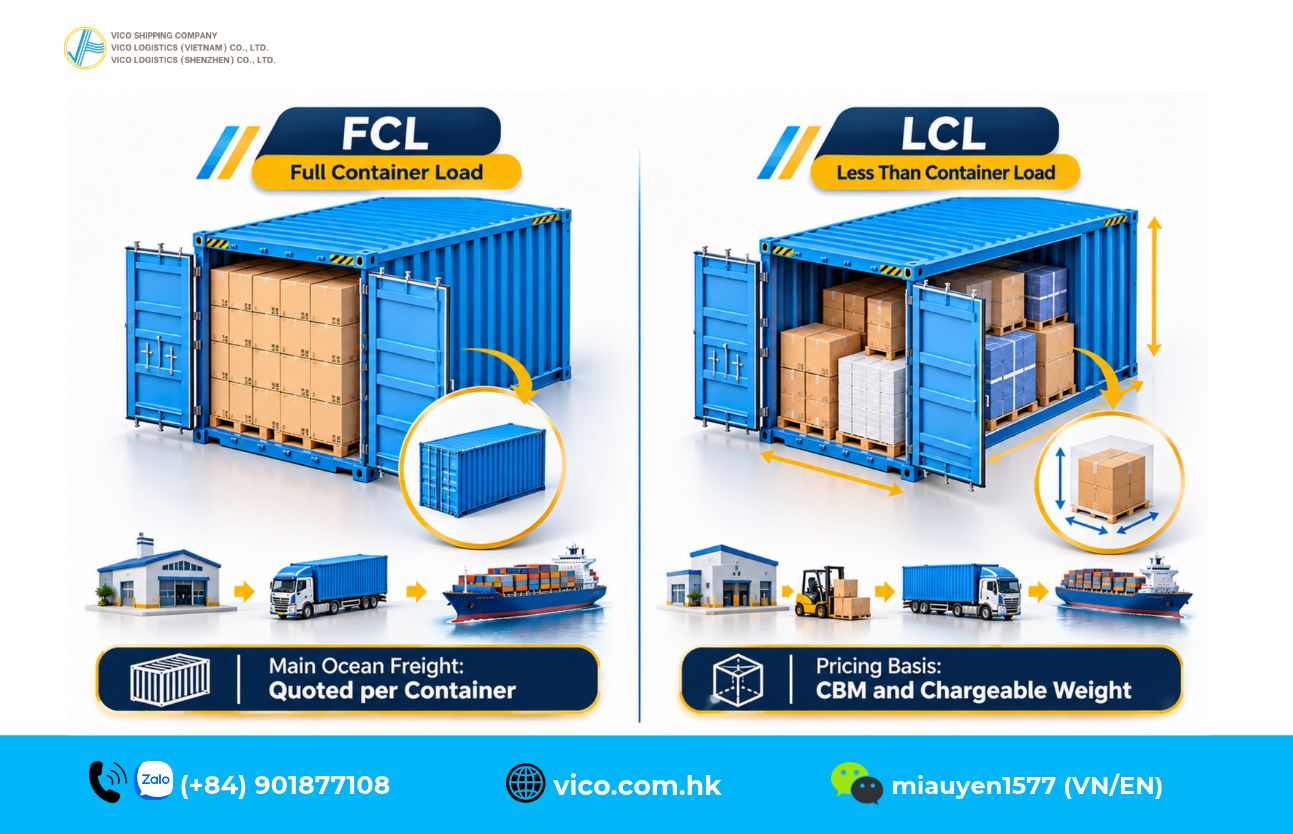
The core difference between FCL and LCL lies in how container space is allocated and how freight charges are calculated.
|
Comparison Factor
|
FCL Shipping
|
LCL Shipping
|
|---|---|---|
|
Full Name
|
Full Container Load
|
Less than Container Load
|
|
Container Usage
|
Dedicated exclusively to one shipper's cargo
|
Shared among multiple shippers
|
|
Pricing Basis
|
Usually charged at a flat rate per container
|
Usually charged by volume (CBM) or chargeable weight
|
|
Cargo Volume
|
Better suited for larger shipments
|
Better suited for smaller shipments
|
|
Handling Process
|
Fewer intermediate handling touchpoints
|
Requires consolidation and deconsolidation at CFS
|
|
Transit Time
|
More predictable and consistent
|
May take longer due to consolidation/devanning
|
|
Cargo Control
|
Higher control over loading and sealing
|
Less control due to shared container space
|
|
Damage Risk
|
Minimal handling lowers risk of damage
|
More handling stages may increase damage risk
|
|
Flexibility
|
Ideal for large or recurring shipments
|
Ideal for small or irregular shipments
|
|
Empty Container Return
|
Must coordinate empty container return
|
Shipper/consignee does not manage shared container
|
In summary: FCL is generally suitable for large shipments requiring dedicated container space, while LCL is more practical for smaller shipments that do not justify booking a full container.
However, cargo volume alone should not be the sole deciding factor. Total landed cost, cargo characteristics, delivery deadlines, and destination port charges all play a crucial role.
4. FCL vs LCL Costs: Which Option Is Cheaper?
There is no fixed answer to whether FCL or LCL is cheaper. The most cost-effective option depends on your cargo volume, shipping route, ocean freight rates, and local charges.
The two methods use entirely different pricing structures.
4.1. How Are FCL Shipping Costs Calculated?
FCL rates are typically quoted as a flat rate per container type, such as:
- 20GP FCL (20ft General Purpose Container)
- 40GP FCL (40ft General Purpose Container)
- 40HC FCL (40ft High Cube Container)
Main ocean freight is based on the container size and shipping lane rather than the exact number of cubic meters (CBM) loaded inside.
Example: If two shipments both use a 20GP container on the same route, their base ocean freight rates may be identical even if one shipment occupies more space inside the container than the other.
However, total FCL costs may also include:
- Origin Terminal Handling Charges (Origin THC)
- Documentation fees
- Container trucking fees
- Customs clearance fees
- Destination terminal charges
- Demurrage and detention charges, if incurred
- Other surcharges depending on the trade lane or cargo specifics
4.2. How Are LCL Shipping Costs Calculated?
LCL rates are usually calculated based on CBM (Cubic Meter) or W/M (Weight or Measurement).
Under the standard W/M pricing method, the chargeable unit is determined by comparing the shipment's volume against its gross weight. Whichever value is greater is used to calculate freight charges, subject to the forwarder's tariff and minimum charge rules.
Example:
- Cargo volume: 3 CBM
- Gross weight: 2 metric tons
- Chargeable basis under W/M rule (1 CBM = 1 ton): 3 revenue tons
This is an illustrative example only. Actual billing rules, minimum charges, and chargeable weight conversions must be confirmed directly with your freight forwarder.
LCL shipping costs typically include:
- Origin CFS handling charges
- Consolidation charges
- Ocean freight
- Destination CFS handling charges
- Deconsolidation charges
- Documentation fees
- Customs clearance fees
- Inland door-to-door delivery fees
- Other applicable surcharges
4.3. When Does FCL Become More Economical Than LCL?
As shipment volume increases, total LCL costs rise proportionally since you are paying for more chargeable space. Once cargo reaches a certain volume threshold, booking a full container often becomes cheaper than paying per CBM for LCL.
However, there is no universal CBM threshold that applies to every trade lane. The break-even point varies depending on:
- Port of loading and port of discharge
- Current FCL and LCL market freight rates
- Origin and destination CFS warehouse fees
- Cargo weight and dimensions
- Equipment (empty container) availability
- Inland trucking costs
- Customs and forwarding requirements
Practical Tip: If your shipment volume is approaching a level where booking a full container might be price-competitive, request quotes for both FCL and LCL. Compare the total door-to-door landed cost rather than looking solely at the base ocean freight rate.
5. FCL vs LCL Transit Times: Which Method Is Faster?
FCL generally offers more predictable and consistent transit times because it bypasses the consolidation and deconsolidation processes required for LCL.
With LCL, cargo must be received, sorted, consolidated, and stuffed into a container alongside other shipments before the vessel departs. At the destination port, the shared container must be moved to a warehouse to be devanned before individual shipments are released. These extra steps can extend the overall transit time.
|
Process Stage
|
FCL
|
LCL
|
|---|---|---|
|
Cargo Preparation
|
Required
|
Required
|
|
Origin Warehouse Consolidation
|
Usually not required
|
Required
|
|
Container Loading
|
Loaded directly into container
|
Co-loaded with multiple shipments
|
|
Ocean Transit
|
Required
|
Required
|
|
Destination Deconsolidation
|
Usually not required
|
Required
|
|
Cargo Release
|
Handled as a full container
|
Separated and released per shipment
|
Actual transit times also depend on the shipping route, vessel schedules, port congestion, customs clearance procedures, warehouse operations, and other operational factors.
If your shipment has a strict delivery deadline, discuss the full end-to-end transit schedule with your freight forwarder before deciding between LCL and FCL.
6. When Should You Choose FCL or LCL?
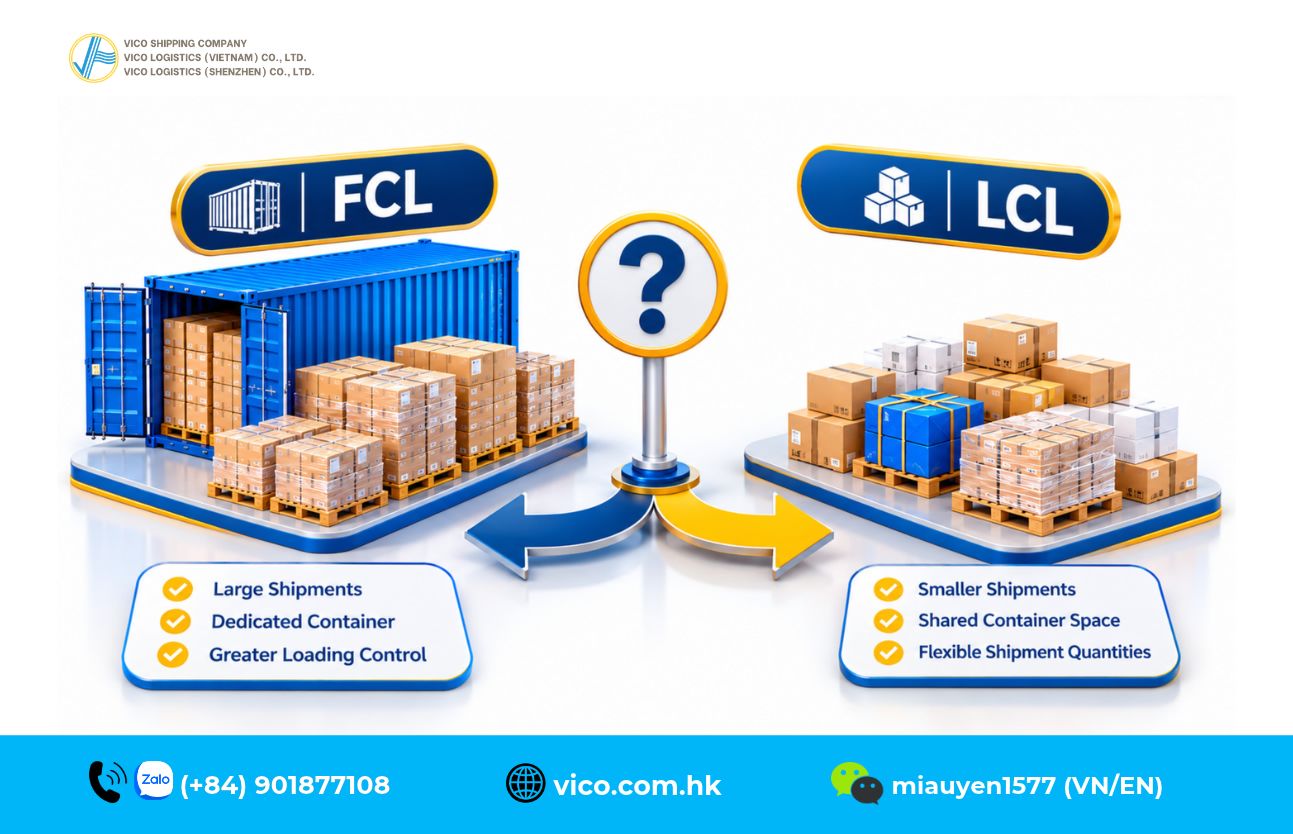
Choosing between FCL and LCL involves more than just comparing cargo volume. You should also consider cargo value, packaging specifications, delivery urgency, and total logistics costs.
6.1. Choose FCL Shipping When:
- You have a large volume of cargo: If your goods occupy most of a container's space, FCL offers superior cost efficiency.
- Your goods are fragile or high-value: FCL involves fewer intermediate handling stages and dedicates the entire container to your shipment.
- You need tight control over loading: FCL allows your business to directly oversee cargo stuffing, lashing, and container sealing.
- Your shipment has a strict schedule: FCL eliminates the waiting time required for LCL consolidation and devanning (though vessel schedules and port operations can still affect timelines).
- You ship goods regularly: Businesses with steady shipping volumes benefit greatly from scheduled, recurring FCL shipments.
6.2. Choose LCL Shipping When:
- Your cargo volume is relatively small: LCL lets you pay only for the space or weight used rather than renting an entire container.
- You are testing new suppliers or markets: Small shipments allow businesses to evaluate product quality and market demand before committing to larger orders.
- You need to replenish inventory in small batches: LCL supports more agile procurement and inventory management strategies.
- You do not have enough cargo to optimize FCL costs: If the total cost of booking a full container is significantly higher than LCL, LCL is the smarter choice.
6.3. FCL vs LCL: Practical Examples
|
Shipment Scenario
|
Recommended Option
|
Reason
|
|---|---|---|
|
Small quantity product samples
|
LCL
|
No need to book an entire container
|
|
Small trial order from a new supplier
|
LCL
|
Minimizes financial commitment and risk on initial orders
|
|
High-volume packaged cargo
|
Compare both, typically FCL
|
Full container flat rates can be more competitive
|
|
High-value goods requiring dedicated space
|
FCL
|
Better security control and fewer handling touchpoints
|
|
Regular large-volume imports
|
FCL
|
Aligns well with scheduled full-container supply chains
|
|
Small, frequent inventory restocks
|
LCL
|
Supports flexible, smaller batch shipments
|
These are general guidelines rather than rigid booking rules. Your final decision should be based on actual quotes for your specific shipment and trade lane.
7. How to Calculate Cargo Volume (CBM) for LCL Shipping
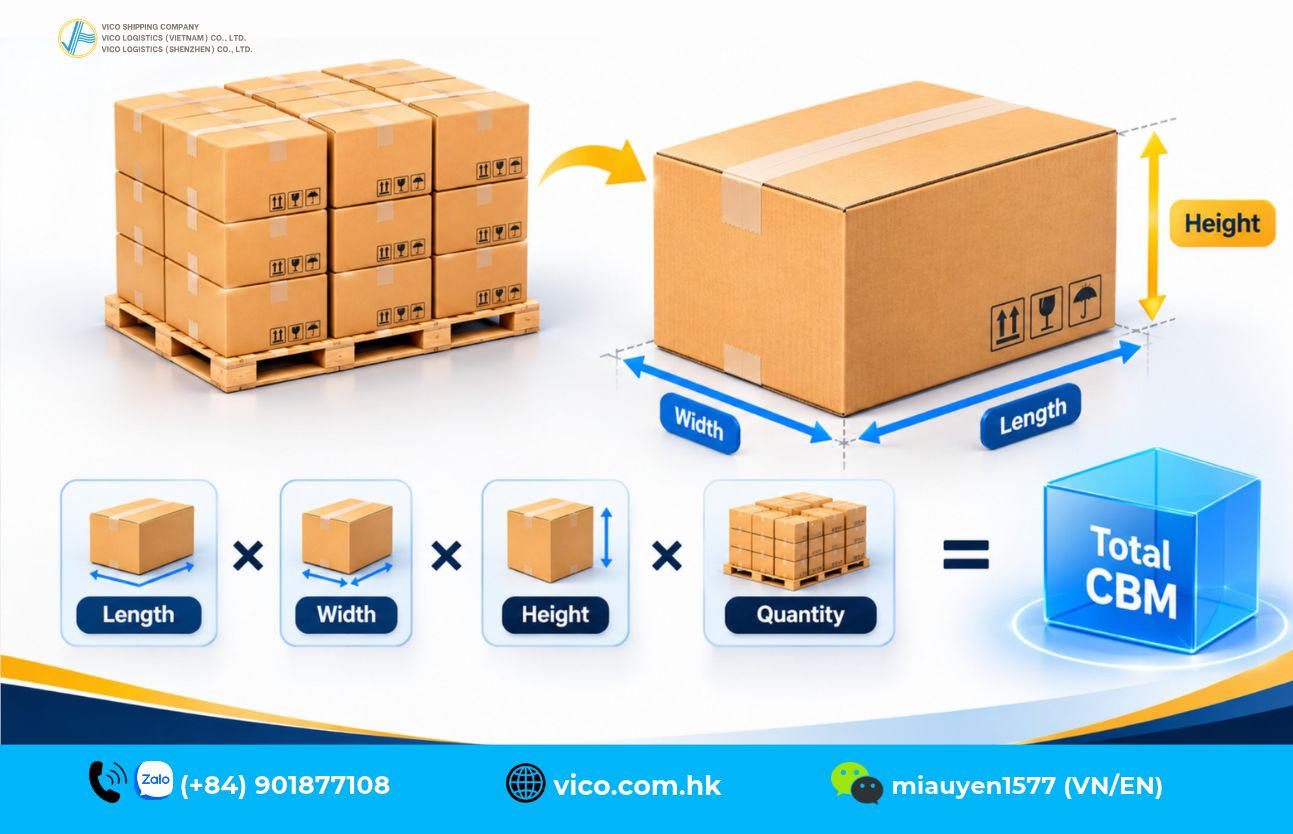
CBM stands for Cubic Meter. It is the standard unit of volume measurement used to calculate LCL freight charges.
The basic formula is:
CBM = Length (m) × Width (m) × Height (m) × Quantity
Example: A shipment consists of 10 cartons, each measuring:
- Length: 0.6m
- Width: 0.4m
- Height: 0.5m
The total volume is: 0.6 × 0.4 × 0.5 × 10 = 1.2 CBM
If dimensions are measured in centimeters (cm), convert them to meters (m) before calculating. Example: (60cm × 40cm × 50cm × 10) / 1,000,000 = 1.2 CBM
7.1. Information Needed to Calculate LCL Freight
To receive an accurate LCL quote, prepare the following details:
- Total number of packages/cartons
- Length, width, and height of each package
- Total gross weight
- Cargo description
- Product specifications and HS Code, if available
- Port of Loading (POL)
- Port of Discharge (POD)
- Final delivery address (if door-to-door service is required)
Providing accurate dimensions and weights helps your freight forwarder determine the exact chargeable volume or weight and identify any special handling requirements.
8. What Should You Check Before Booking FCL or LCL?
Before confirming your booking, use this checklist to avoid unexpected charges and operational delays.
8.1. Cargo Details
- Confirm exact cargo description and quantity.
- Verify package dimensions and total CBM.
- Confirm gross weight and packaging condition.
- Identify whether the cargo is fragile, high-value, or requires special handling.
8.2. Cost Comparison
- Request quotes for both FCL and LCL when applicable.
- Check local charges at both origin and destination ports.
- Confirm CFS handling fees and documentation fees for LCL shipments.
- Verify inland trucking, customs clearance, and door-to-door delivery costs.
- Clarify minimum charges and any other applicable surcharges.
8.3. Shipping Schedule
- Confirm estimated vessel sailing schedules.
- Check port cut-off times and warehouse cargo receiving deadlines.
- Factor in buffer time for LCL consolidation and deconsolidation.
- Confirm customs clearance and final delivery plans.
8.4. Shipping Documents
- Commercial Invoice
- Packing List
- Bill of Lading (B/L) or equivalent transport document
- Certificate of Origin (C/O), if required
- Other permits or certificates depending on the commodity and importing country
10. Frequently Asked Questions About FCL and LCL
10.1. What is the main difference between FCL and LCL?
FCL means one shipper books an entire container exclusively for their cargo, whereas LCL means multiple shippers share space within a single container. FCL is typically charged at a flat rate per container, while LCL is charged based on chargeable volume or weight.
10.2. Is FCL cheaper than LCL?
FCL can be more cost-effective for larger shipments because the flat container rate is spread across a greater volume of goods. LCL is usually more economical for smaller shipments. The actual break-even point depends on the shipping lane, freight rates, and local port charges.
10.3. Is LCL slower than FCL?
LCL can take longer because cargo must be consolidated at the port of origin and deconsolidated at the port of destination. Actual transit times also depend on the trade lane, vessel schedules, warehouse operations, and customs clearance.
10.4. What does LCL stand for in shipping?
LCL stands for Less than Container Load. It refers to a shipping method in which cargo from multiple shippers is consolidated into one shared container.
10.5. What does FCL stand for in shipping?
FCL stands for Full Container Load. It refers to a shipment where a single shipper books an entire container exclusively for their cargo, even if the goods do not fill the container's maximum capacity.
10.6. How many CBM do I need for FCL?
There is no strict minimum CBM requirement to book FCL. A shipper can book a full container even if their cargo does not fill the entire space. Whether FCL is economical depends on comparing the full container rate against the total cost of shipping via LCL.
10.7. Can I ship a small quantity via FCL?
Yes. You can book a full FCL container even for a relatively small shipment. However, LCL will generally be more cost-effective if your cargo only occupies a small fraction of the container space.
10.8. How is LCL freight calculated?
LCL freight is typically calculated based on chargeable volume or weight, most commonly using the W/M (Weight or Measurement) system. Minimum charges and port/CFS handling fees may also apply. Always confirm the exact billing basis with your freight forwarder.
10.9. Should I choose FCL or LCL when importing from China to Vietnam?
The right choice depends on your cargo volume, gross weight, commodity type, transit schedule, and destination port charges. For smaller loads, LCL is often ideal. For larger shipments or sensitive goods, FCL offers greater control and cost efficiency. Requesting quotes for both options is the most practical way to compare and decide.
Why Choose VICO Logistics for FCL and LCL Shipping?
Choosing the right shipping mode is only one part of an effective international logistics plan. Businesses also need seamless, reliable coordination across freight forwarding, customs clearance, documentation, and last-mile delivery.
VICO Logistics supports businesses with end-to-end international freight and cross-border logistics solutions across Vietnam, China, Hong Kong, and Cambodia.
Our team can help you:
- Evaluate whether FCL or LCL is better suited for your shipment.
- Calculate cargo volume and review shipment specifications.
- Compare viable shipping options based on your route and cargo requirements.
- Coordinate ocean freight and cross-border overland transport.
- Handle customs clearance and import/export documentation.
- Design tailored logistics solutions aligned with your business needs.
Whether you are shipping a few cubic meters of LCL cargo or managing recurring full-container loads, an optimal logistics plan always balances total cost, transit timelines, cargo characteristics, and destination requirements.
Need help deciding between FCL and LCL? Send VICO Logistics your cargo details and shipping route. Our team will evaluate your shipment and help you compare the most suitable FCL and LCL options.
- Factory Coffee: The Global Coffee Harvest Calendar
- What's So Good About Vietnam Manufacturers
- Electronics Shipping: Mastering The Logistics Of High-Value Technology
- Door To Door Cambodia Shipping: The Ultimate Logistics Solution For 2026
- Trucking Cambodia - Vietnam: Fast & Reliable Cross-Border Solutions 2026
- How Many Digits Does an HS Code Have? How to Read 6-Digit and 8-Digit HS Codes
- What is DPU? DPU Term in Incoterms 2020 and Parties' Responsibilities
- EUDR Compliance Vietnam: A Critical Requirement for Coffee Exporters
Get a Logistics Quote in just 5 minutes
Professional international transportation and supply chain solutions tailored for your business.
Get a quote now ↗Quick Contact
🇻🇳 Ms Uyen
Hotline / Zalo
(+84) 901 877 108WeChat (VN/EN)
miauyen1577Scan to Contact
Zalo
🇨🇳 Ms Schyler
Office Hotline
(+852) 3759 9300WeChat ID
Schyler_skylarScan to Contact
VICO International Logistics — Your Trusted Logistics Partner in Indochina
Senior member of international logistics and trade associations: Eurocham, JCtrans, VICOFA, VITAS, and more.