
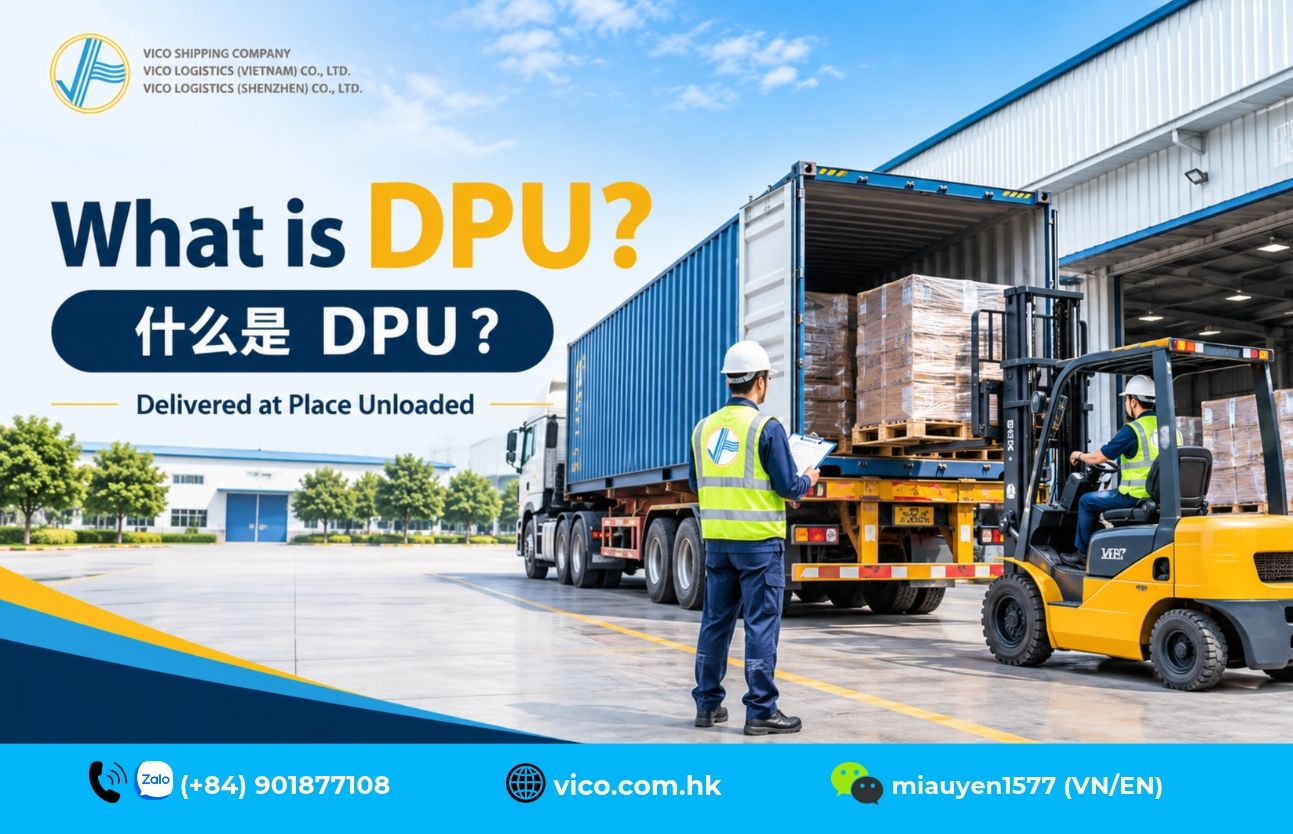
In import-export activities, choosing the right delivery term directly affects shipping costs, cargo handling responsibilities, and business risks. One of the terms used in international transactions is DPU (Delivered at Place Unloaded).
So, what is DPU? Under the DPU term in Incoterms 2020, the seller must arrange for the transportation of goods to the agreed destination and bear the responsibility for unloading the goods from the arriving means of transport at the destination. The buyer receives the goods after they have been unloaded and is responsible for import customs clearance and related taxes.
To better understand the DPU term, businesses need to grasp the responsibilities of each party, cost allocation, the point of risk transfer, and the differences between DPU, DAP, and DDP.
1. What is DPU?
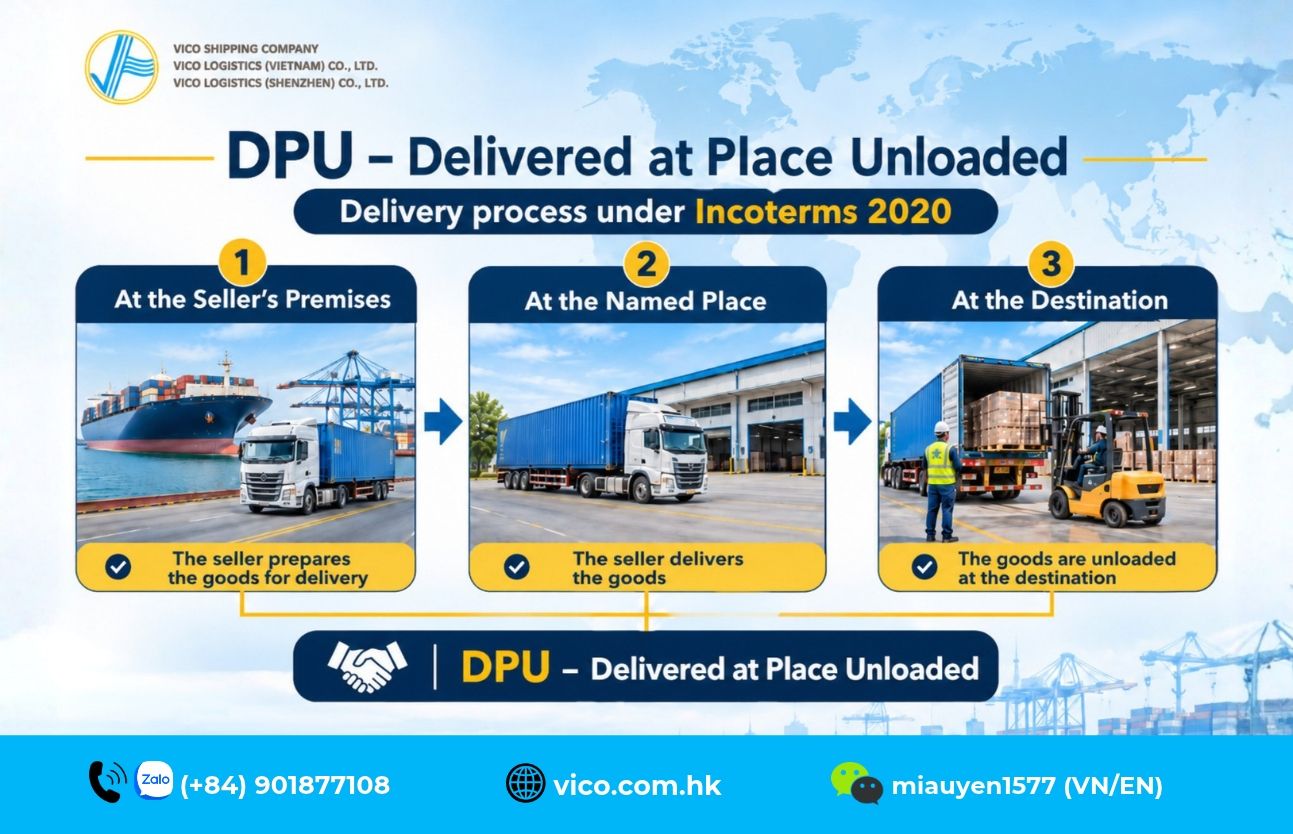
DPU stands for Delivered at Place Unloaded.
It is one of the 11 delivery terms under the Incoterms 2020 rules issued by the International Chamber of Commerce (ICC).
Under DPU, the seller fulfills their delivery obligation when the goods are transported to the agreed destination, unloaded from the arriving means of transport, and placed at the disposal of the buyer.
The distinctive feature of this term is that the seller bears the responsibility and cost of unloading at the place of delivery. It is also the only rule in Incoterms 2020 that requires the seller to unload the goods at the destination.
1.1. How is DPU applied in Incoterms 2020?
DPU was introduced in Incoterms 2020 to replace the DAT (Delivered at Terminal) term in Incoterms 2010.
This change expands the scope of the delivery location. Instead of being limited to a terminal (such as a station, port, or transport hub), DPU allows the parties to choose a more flexible delivery location.
For example:
- Seaport in the importing country.
- International airport.
- Warehouse or distribution center.
- Buyer's factory.
- Any specific location agreed upon by both parties in the contract.
Thus, DPU helps businesses be more flexible when organizing international transportation and handing over goods.
1.2. Which modes of transport does DPU apply to?
DPU can be used for all modes of transport, including:
- Sea transport.
- Air transport.
- Road transport.
- Rail transport.
- Multimodal transport.
Businesses can use DPU when goods are transported by a single mode or a combination of multiple modes of transport.
2. Characteristics of DPU in Incoterms 2020
To use DPU accurately, businesses need to understand three key factors: the place of delivery, unloading responsibility, and the point of risk transfer.
2.1. Place of delivery under DPU
Under DPU, the seller is responsible for bringing the goods to the destination agreed upon in the contract.
This location can be a seaport, warehouse, factory, or another specific address.
When drafting a contract, businesses should clearly state the exact location and unloading point rather than just the name of the city or country.
Example: DPU VICO Warehouse, Ho Chi Minh City, Vietnam, Incoterms 2020.
Clearly defining the place of delivery helps the parties avoid disputes regarding the scope of transportation, costs, and delivery responsibilities.
2.2. Timing of risk transfer in DPU
An important characteristic of DPU is that risk is only transferred from the seller to the buyer after the goods have been unloaded at the designated delivery location and placed at the buyer's disposal.
This means:
- During transit to the delivery location: the seller bears the risk.
- During the unloading process at the delivery location: the seller bears the risk.
- After the goods are unloaded and delivered to the buyer in accordance with DPU terms: the risk transfers to the buyer.
For example, if goods are damaged during unloading at the buyer's warehouse, the risk still belongs to the seller under DPU terms.
This is a key difference compared to DAP, where risk transfers before the goods are unloaded from the transport vehicle.
2.3. Is cargo insurance mandatory under DPU?
Incoterms 2020 does not mandate either the seller or the buyer to purchase cargo insurance under DPU.
However, since the seller bears the risk throughout transit and unloading at the destination, considering cargo insurance is essential for financial risk management.
Both parties should agree on the insurance scope, insured value, and liability handling procedures in case of loss.
3. Responsibilities of buyer and seller under DPU
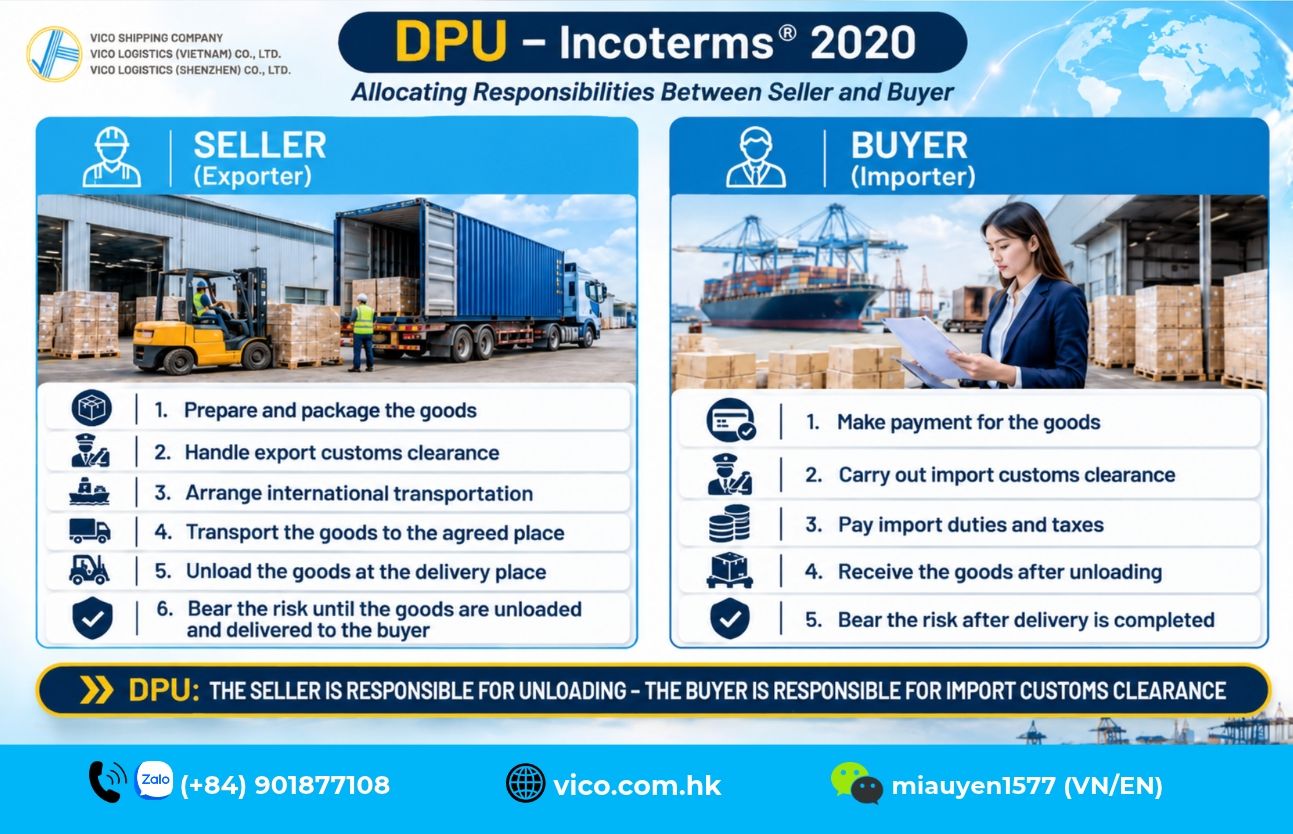
In a DPU transaction, responsibilities are clearly divided. The seller undertakes most transportation and unloading obligations, while the buyer handles import customs clearance and accepts the goods after unloading.
3.1. Seller's responsibilities
Under DPU Incoterms 2020, the seller has the following primary responsibilities:
- Goods preparation and packaging: The seller must prepare the goods in accordance with the sales contract, package them, and apply markings suitable for the product characteristics and transport requirements.
- Export customs clearance: The seller is responsible for export customs clearance procedures, export licenses, and necessary documentation under applicable regulations.
- Organizing transportation: The seller must contract or arrange transport of the goods to the agreed destination. Transport costs are the seller's responsibility until delivery obligations under DPU are fulfilled.
- Unloading at destination: This is the seller's most critical obligation under DPU. The seller must arrange vehicles, equipment, and labor necessary to unload the goods from the transport vehicle at the agreed delivery location.
- Bearing risk during transit and unloading: The seller bears the risk of loss or damage to the goods until they are unloaded and delivered to the buyer per DPU terms.
3.2. Buyer's responsibilities
The buyer is responsible for:
- Payment: Making payment to the seller according to the methods and deadlines agreed in the sales contract.
- Import customs clearance: The buyer is responsible for import customs clearance, obtaining import licenses if required, and providing necessary documentation.
- Import duties and related taxes: Import duties, fees, and related charges are handled by the buyer in accordance with the regulations of the importing country.
- Accepting the goods: The buyer takes delivery of the goods after the seller completes unloading at the agreed delivery location.
- Bearing risk after delivery under DPU: Following completed delivery, the buyer assumes responsibility for the goods in subsequent stages.
3.3. Responsibility allocation matrix between buyer and seller
|
Task
|
Seller
|
Buyer
|
|---|---|---|
|
Goods preparation
|
Responsible
|
No
|
|
Packaging
|
Responsible
|
No
|
|
Export clearance
|
Responsible
|
No
|
|
Transport to destination
|
Responsible
|
No
|
|
Unloading at destination
|
Responsible
|
No
|
|
Import clearance
|
No
|
Responsible
|
|
Import duties
|
No
|
Responsible
|
|
Receiving goods after unloading
|
No
|
Responsible
|
|
Risk before unloading is complete
|
Responsible
|
No
|
|
Risk after delivery is complete
|
No
|
Responsible
|
Note: The table above illustrates the principle of responsibility allocation under DPU. Certain incidental costs and document support obligations must be determined according to the contract and specific provisions of Incoterms 2020.
4. What costs are included under DPU?
Under DPU, the seller bears most costs to bring the goods to the destination and complete unloading. Major cost items include:
|
Cost Item
|
Responsible Party
|
|---|---|
|
Goods packaging costs
|
Seller
|
|
Domestic transport in the exporting country
|
Seller
|
|
Export clearance fees
|
Seller
|
|
International freight
|
Seller
|
|
Transit costs (if any)
|
Seller
|
|
Transport to delivery location
|
Seller
|
|
Unloading costs at destination
|
Seller
|
|
Import clearance fees
|
Buyer
|
|
Import duties and related taxes
|
Buyer
|
|
Onward transport past delivery location
|
Buyer
|
Note: Certain port or terminal unloading charges may already be included in the freight contract. Parties should check to avoid double-charging or disputes over who pays.
5. Comparing DPU, DAP, and DDP in Incoterms 2020
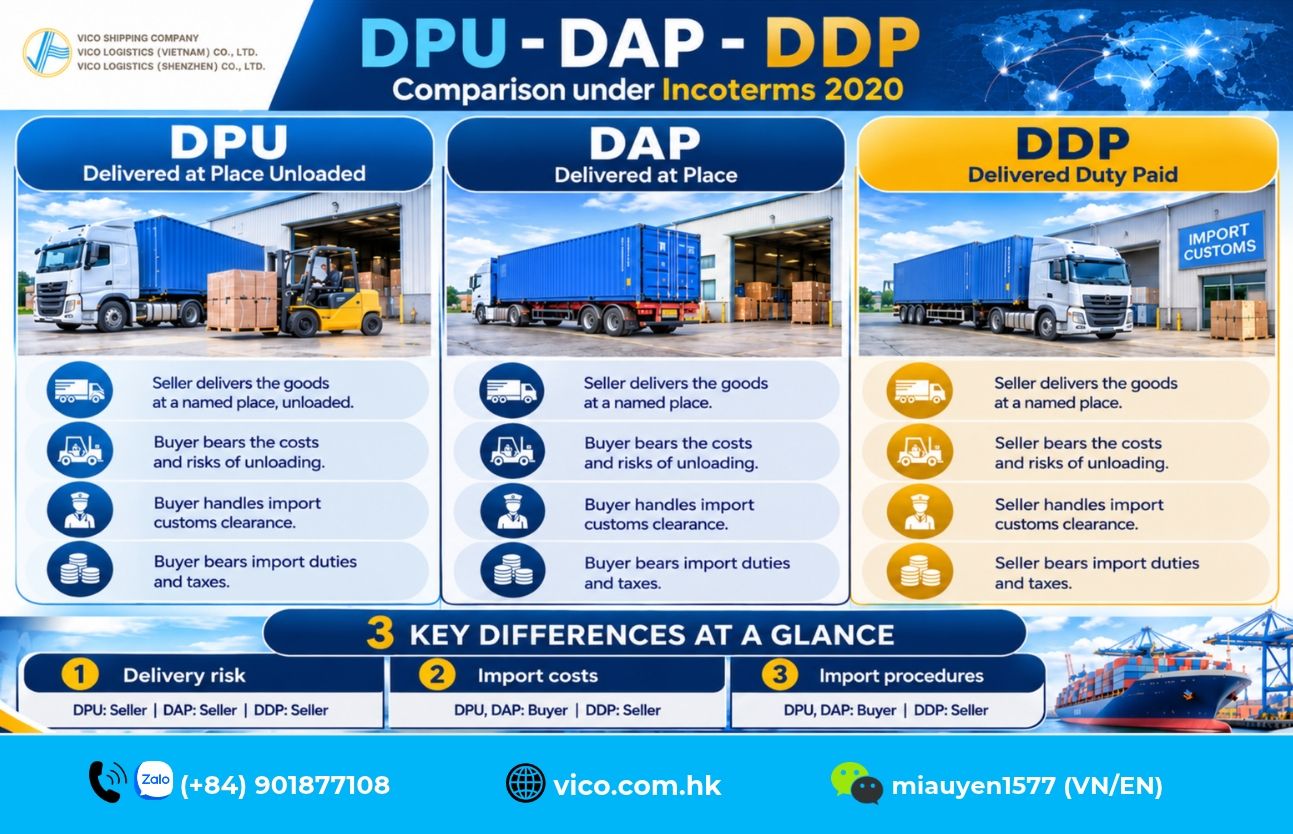
DPU, DAP, and DDP all belong to Group D in Incoterms 2020. These terms require the seller to bring goods to the destination. However, differences lie in unloading obligations and import customs responsibilities.
5.1. How do DPU and DAP differ?
These two terms are frequently confused because both require the seller to transport goods to the destination. The most critical difference is the unloading responsibility.
|
Criteria
|
DPU
|
DAP
|
|---|---|---|
|
Full name
|
Delivered at Place Unloaded
|
Delivered at Place
|
|
Transport to destination
|
Seller
|
Seller
|
|
Unloading at destination
|
Seller
|
Buyer
|
|
Risk transfer
|
After unloading
|
Before unloading
|
|
Export clearance
|
Seller
|
Seller
|
|
Import clearance
|
Buyer
|
Buyer
|
|
Import duties
|
Buyer
|
Buyer
|
|
Modes of transport
|
All modes
|
All modes
|
Example: A Vietnamese enterprise imports machinery from China and requests delivery to its factory in Binh Duong.
- If using DAP Binh Duong: the seller transports goods to the factory, placing them on the transport vehicle ready for unloading. The buyer is responsible for unloading and risks during unloading.
- If using DPU Binh Duong: the seller must transport goods to the factory and is responsible for unloading them at the agreed location. Risk transfers after unloading is complete.
Thus, if the buyer wants the seller to handle unloading at the destination, DPU may be the more suitable choice.
5.2. How do DPU and DDP differ?
DPU and DDP both require the seller to arrange transport to the destination, but differ in import customs responsibilities.
|
Criteria
|
DPU
|
DDP
|
|---|---|---|
|
Transport to destination
|
Seller
|
Seller
|
|
Unloading at destination
|
Seller
|
Buyer
|
|
Export clearance
|
Seller
|
Seller
|
|
Import clearance
|
Buyer
|
Seller
|
|
Import duties
|
Buyer
|
Seller
|
|
Risk transfer
|
After unloading
|
When goods arrive, ready for unloading
|
Note that DDP does not require the seller to unload goods at the delivery point. The seller must complete import procedures and pay import duties as prescribed. Meanwhile, DPU requires the seller to unload the goods, but the buyer is responsible for import customs clearance. Therefore, businesses must evaluate customs clearance capability in the importing country before selecting the appropriate term.
6. Practical example of DPU in import and export
To better understand how DPU is applied, consider the following scenario:
Scenario: A Vietnamese enterprise imports a production line from China. Both parties agree on the delivery term: DPU – Buyer's factory in Binh Duong, Vietnam, Incoterms 2020.
Responsibilities are allocated as follows:
- Step 1: In China: The seller prepares and packs the machinery, completes export customs clearance, and organizes goods transportation.
- Step 2: International transport: The seller is responsible for organizing transport from China to Vietnam, including agreed transport legs.
- Step 3: Import customs clearance in Vietnam: The buyer handles import customs clearance, pays import duties, and settles related taxes under regulations.
- Step 4: Delivery to the factory: The seller continues to organize transport to the agreed delivery location in Binh Duong.
- Step 5: Unloading and handover: The seller arranges equipment and labor to unload machinery from the transport vehicle at the factory. Once unloaded and placed at the buyer's disposal, delivery under DPU is complete and risk is transferred.
Through the example above, DPU suits transactions where the buyer wants the seller to handle both transportation and unloading at the destination. However, for oversized, heavy, or specialized equipment shipments, both parties must coordinate the unloading plan beforehand to avoid costs and risks.
7. When should businesses use DPU?
DPU can benefit both buyer and seller if responsibilities are structured according to each party's operational capabilities.
7.1. Cases where DPU should be used
- Buyer wants delivered and unloaded goods: DPU fits when the buyer prefers not to manage or organize unloading at the destination.
- Seller has transport and unloading capabilities: If the seller possesses logistics networks, transport partners, and unloading equipment capabilities in the importing country, DPU simplifies the handover process for the buyer.
- Cargo requires specialized unloading equipment: Industrial machinery or large-scale goods can use DPU if the seller can arrange appropriate unloading logistics.
7.2. Cases where DPU should not be used
DPU may be unsuitable if:
- The seller lacks the capability to organize unloading in the destination country.
- The delivery site lacks adequate space or unloading equipment.
- Unloading costs are excessively high or difficult to control.
- The buyer prefers to actively manage the entire unloading process.
In these instances, DAP may serve as a better alternative since the seller is not obligated to unload at destination.
8. Key risks businesses should note when using DPU
Although DPU offers convenience to buyers, companies must monitor several critical issues.
8.1. Failure to specify delivery location clearly
If contracts only list a city or port without precise delivery points, disputes over domestic transport costs and handover obligations may arise.
Solution: Clearly state exact addresses, delivery zones, and unloading points in contracts.
8.2. Unprepared unloading equipment
Certain commodities require forklifts, cranes, or specialized support gear. Without prior planning, delivery can face delays and unexpected expenses.
Solution: Evaluate cargo traits, weight, dimensions, and actual conditions at the delivery spot before signing contracts.
8.3. Misunderstanding import customs responsibilities
A common mistake assumes the seller handles all import responsibilities because they paid freight to destination. In reality, under DPU, the buyer handles import clearance and related taxes.
Solution: Clearly delineate customs duties, import licenses, taxes, and document requirements during early negotiations.
8.4. Incomplete logistics cost budgeting
Beyond international freight, companies must factor in domestic transport, port fees, storage, unloading gear costs, and miscellaneous expenses.
Solution: Request detailed milestone-based logistics cost estimations from service providers.
9. VICO Logistics – International transport and logistics solutions
Selecting proper Incoterms represents only the first step toward effective import-export operations. Businesses also need clear shipping plans, tight cost controls, and seamless workflow coordination.
VICO Logistics provides international transport and cargo solutions, supporting businesses across activities including:
- Ocean freight, road transport, and multimodal logistics.
- Cross-border shipping across Vietnam, Cambodia, China, and regional markets.
- Customs declaration and clearance services.
- Transport planning consultancy aligned with Incoterms rules.
- Cargo handover organization and supply chain stage coordination.
Aimed at becoming a strategic supply chain partner, VICO Logistics helps enterprises optimize expenses, timelines, and operational risks in international trade.
10. Frequently Asked Questions about DPU (FAQ)
10.1. What does DPU stand for?
DPU stands for Delivered at Place Unloaded, meaning delivery at place unloaded. This is one of 11 delivery terms under Incoterms 2020.
10.2. Does DPU apply to sea transport?
Yes. DPU applies to any mode of transport, including sea freight, air freight, road transport, rail transport, and multimodal shipments.
10.3. Who is responsible for unloading under DPU?
The seller is responsible for arranging and paying for unloading at the agreed delivery location. This is a unique trait of DPU within Incoterms 2020.
10.4. Does DPU include import duties?
No. Under DPU, the buyer handles import customs clearance and pays import duties along with associated taxes.
10.5. How does DPU differ from DAP?
The main difference lies in unloading duties. Under DPU, the seller must unload goods at destination. Under DAP, the seller delivers goods ready for unloading on the transport vehicle, leaving unloading responsibilities to the buyer.
10.6. Is the seller mandated to buy insurance under DPU?
No. Incoterms 2020 does not require either party to buy insurance under DPU. However, parties should consider insurance to mitigate transport risks.
10.7. When did DPU replace DAT?
DPU was introduced in Incoterms 2020 to replace DAT (Delivered at Terminal) from Incoterms 2010, allowing greater flexibility in delivery locations beyond terminal points.
11. Conclusion
DPU (Delivered at Place Unloaded) is an Incoterms 2020 delivery term where the seller arranges transport and unloads goods at the agreed destination. The buyer manages import clearance and associated duties.
Understanding exact responsibilities, expenses, and risk transition under DPU helps businesses select ideal trade terms, minimize disputes, and streamline international logistics operations.
- Factory Coffee: The Global Coffee Harvest Calendar
- What's So Good About Vietnam Manufacturers
- Electronics Shipping: Mastering The Logistics Of High-Value Technology
- Door To Door Cambodia Shipping: The Ultimate Logistics Solution For 2026
- Trucking Cambodia - Vietnam: Fast & Reliable Cross-Border Solutions 2026
- Which Incoterm Suits the Seller? Comparing EXW, FCA, FOB, CIF
- What is Import VAT? How to Calculate Import Value Added Tax in 2026
- How Many Digits Does an HS Code Have? How to Read 6-Digit and 8-Digit HS Codes
Get a Logistics Quote in just 5 minutes
Professional international transportation and supply chain solutions tailored for your business.
Get a quote now ↗Quick Contact
🇻🇳 Ms Uyen
Hotline / Zalo
(+84) 901 877 108WeChat (VN/EN)
miauyen1577Scan to Contact
Zalo
🇨🇳 Ms Schyler
Office Hotline
(+852) 3759 9300WeChat ID
Schyler_skylarScan to Contact
VICO International Logistics — Your Trusted Logistics Partner in Indochina
Senior member of international logistics and trade associations: Eurocham, JCtrans, VICOFA, VITAS, and more.