

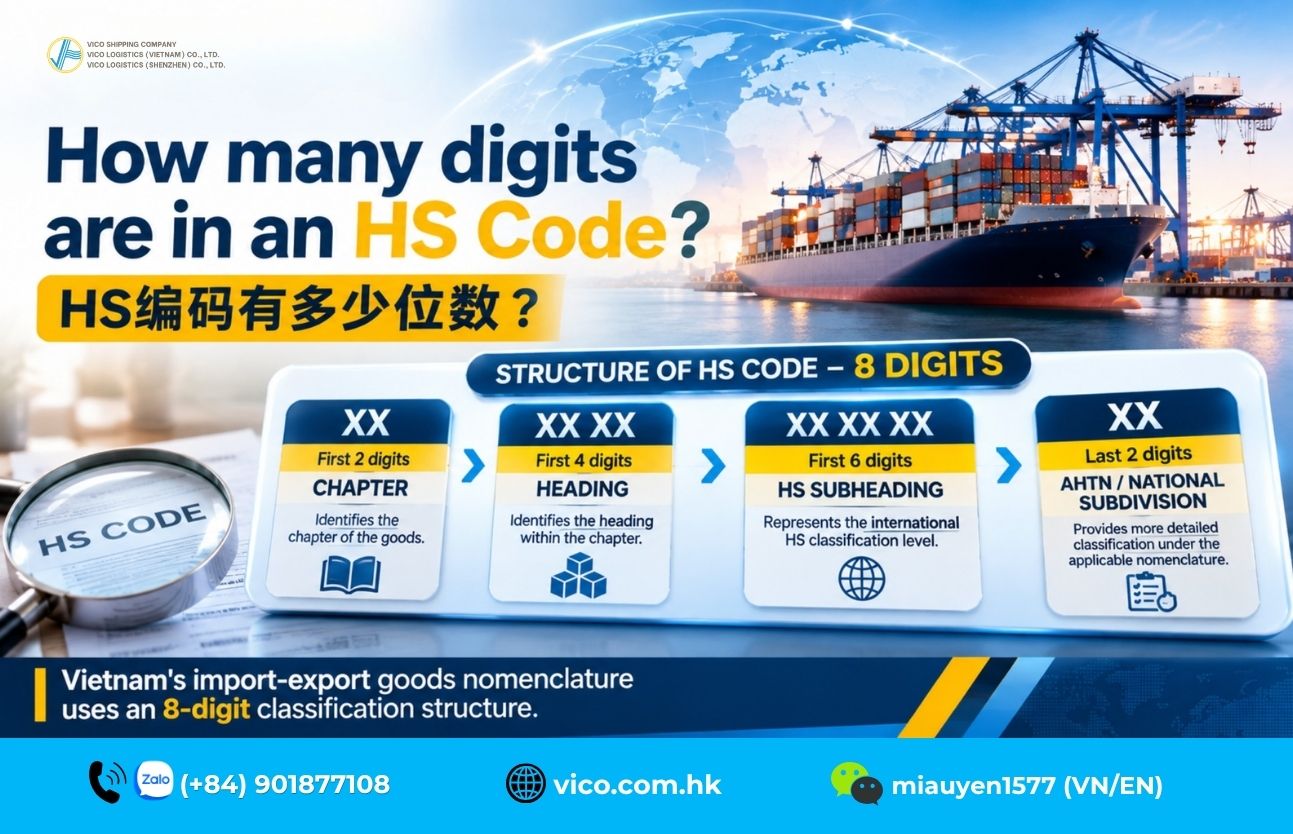
How many digits does an HS Code have? The international HS code has 6 digits, but in Vietnam, the commodity codes in the Export and Import Commodity List are expressed at the 8-digit level. The last two digits allow more detailed classification of goods under the nomenclature applied in Vietnam and ASEAN.
Therefore, when researching or looking up HS codes for import-export, businesses need to distinguish between the 6-digit international HS code and the 8-digit HS code used in tariff schedules and customs procedures in Vietnam. Determining the correct code not only ensures accurate declarations but also supports checking tax rates, goods management policies and related requirements.
1. How many digits does an HS Code have?
The international HS Code has 6 digits under the Harmonized System (HS) developed by the World Customs Organization (WCO).
However, each country or region may add further digits to classify goods more specifically, for the purposes of management, building tariff schedules and compiling trade statistics.
In Vietnam, the commodity codes in the Export and Import Commodity List are built on an 8-digit structure:
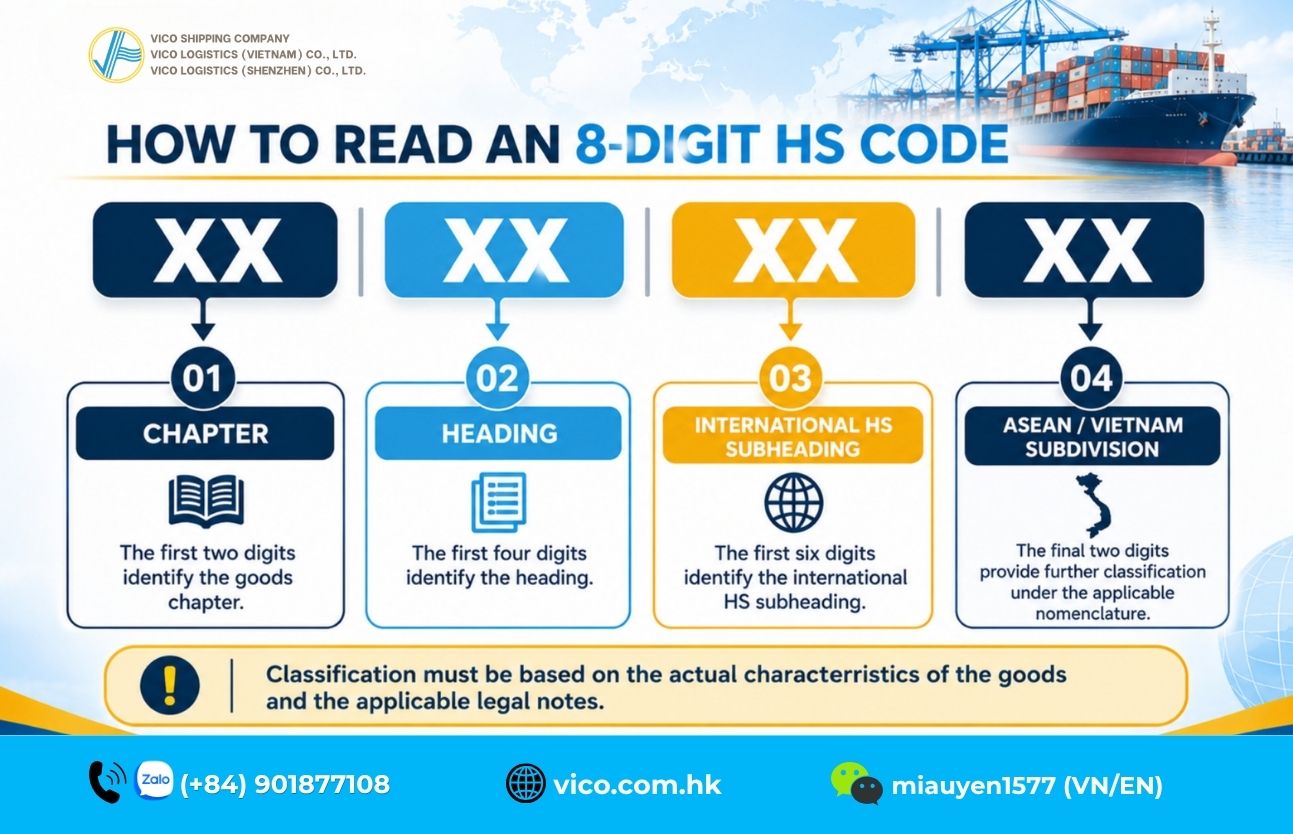
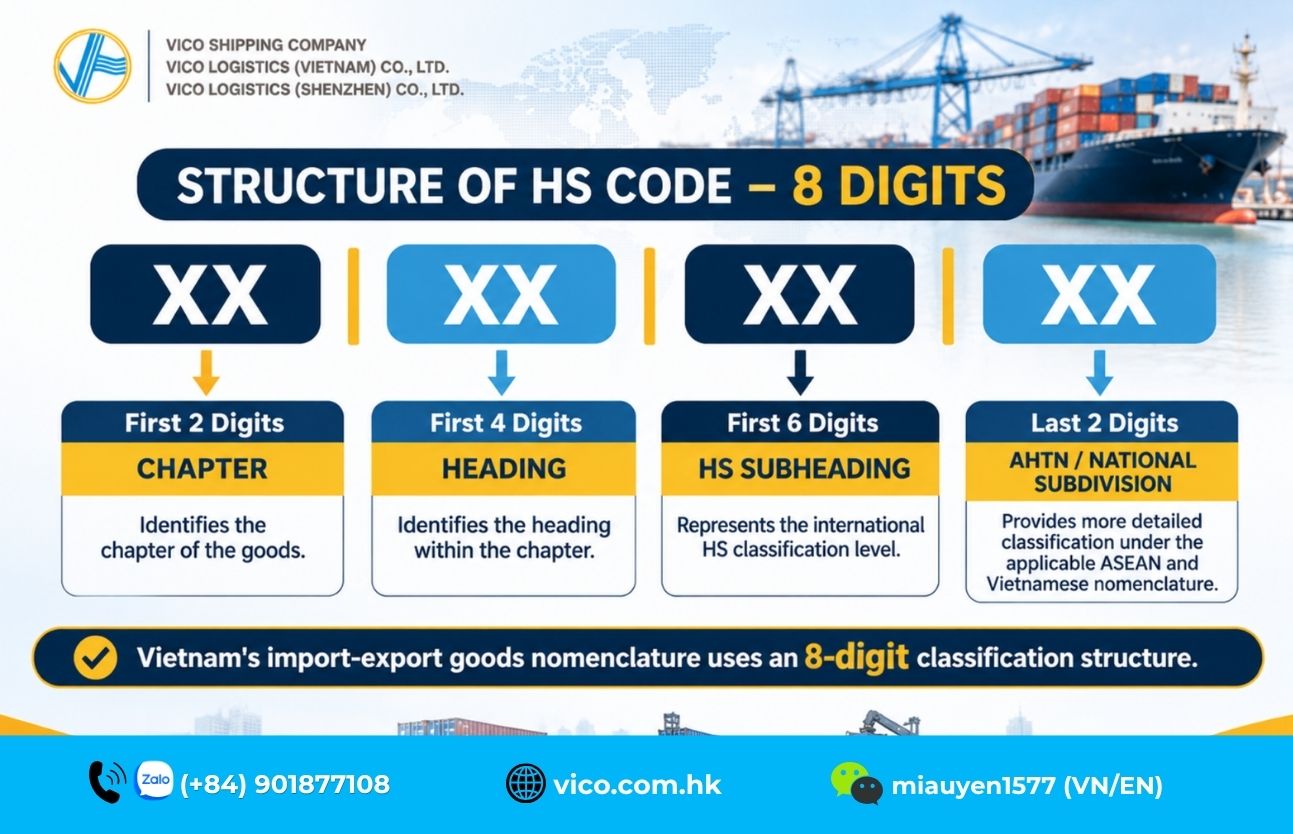
- First 2 digits: Identify the chapter of the goods.
- First 4 digits: Identify the heading.
- First 6 digits: Identify the subheading under the international HS.
- Last 2 digits: Provide more detailed classification under the commodity list applied in Vietnam and ASEAN.
In simple terms:
|
Code system
|
Number of digits
|
Meaning
|
|---|---|---|
|
International HS
|
6 digits
|
Common goods classification structure developed by the WCO
|
|
AHTN (ASEAN)
|
8 digits
|
Extends the 6-digit HS with two regional subheading digits
|
|
Vietnam
|
8 digits
|
Export and Import Commodity List built on the HS and AHTN
|
Note: Not every country uses 8-digit HS codes. Some countries may extend codes to 10 digits or more under their own tariff systems. Therefore, the code used for declaration must be determined according to the regulations of the relevant importing or exporting country.
2. Why do HS codes have 6, 8 or 10 digits?
The difference in the number of digits stems from how countries apply and extend the international goods classification system.
2.1. 6-digit HS code – the international classification system
The WCO developed the HS to create a common language for classifying goods in international trade.
Each group of goods is identified by a 6-digit code. This allows countries to share a common classification foundation when trading goods, compiling trade statistics and building tariff schedules.
For example, two countries may use the same first 6 digits to identify a group of goods under the HS, even though the full declaration codes of the two countries may differ.
2.2. 8-digit HS code – the AHTN system and Vietnam
ASEAN uses the ASEAN Harmonised Tariff Nomenclature (AHTN), which has an 8-digit structure.
The two additional digits divide goods groups in more detail than the international HS level.
Vietnam applies an export and import commodity list built on the HS and the AHTN. Therefore, when looking up commodity codes for declaration in Vietnam, businesses need to cross-check down to the appropriate code level in the 8-digit list.
2.3. 10-digit HS code – the classification systems of some countries
Some countries use code systems longer than 8 digits for tariff management, statistics and trade policy.
For instance, the United States uses the HTS at the 10-digit level for many tariff classification purposes. The European Union also has a classification system extended from the HS and the CN nomenclature to TARIC.
This means that Vietnam's 8-digit HS code does not necessarily match the declaration code in the importing country exactly.
Conclusion: The first six digits are the international HS foundation; the digits that follow depend on the classification system of each region or country.
3. What parts make up the structure of an HS code?
To understand how to read an HS code, businesses need to grasp the basic classification levels: Chapter, Heading and Subheading.
An 8-digit HS code can be illustrated by the following structure:
XX.XX.XX.XX
Where:
|
Digit position
|
Level
|
Meaning
|
|---|---|---|
|
Digits 1–2
|
Chapter
|
Identifies the chapter of the goods
|
|
Digits 3–4
|
Heading
|
Identifies the goods group within the chapter
|
|
Digits 5–6
|
HS Subheading
|
Detailed classification under the international HS
|
|
Digits 7–8
|
Extended subheading
|
Detailed classification under the list applied in Vietnam and ASEAN
|
3.1. The first two digits: the goods chapter
The first two digits identify the chapter in which the goods are classified.
The HS is organized into chapters and headings according to the characteristics and nature of goods. Each chapter includes related groups of products.
When determining the chapter, consider the nature of the product, its composition, its use and the relevant classification notes.
3.2. The next two digits: the heading
The third and fourth digits identify the heading within the corresponding chapter.
At this level, goods are classified more specifically based on the characteristics and descriptions in the HS nomenclature.
3.3. The fifth and sixth digits: the international subheading
The next two digits form the 6-digit HS subheading level.
This is the most detailed level of the international HS. Member countries use this foundation to develop their own classification lists.
3.4. The seventh and eighth digits: the detailed subheading
The last two digits are used to classify goods in more detail under the AHTN system and the list applied in Vietnam.
When making customs declarations, businesses should not rely only on the first 6 digits but should check the full goods description and the corresponding 8-digit code.
4. Distinguishing 6-digit and 8-digit HS codes
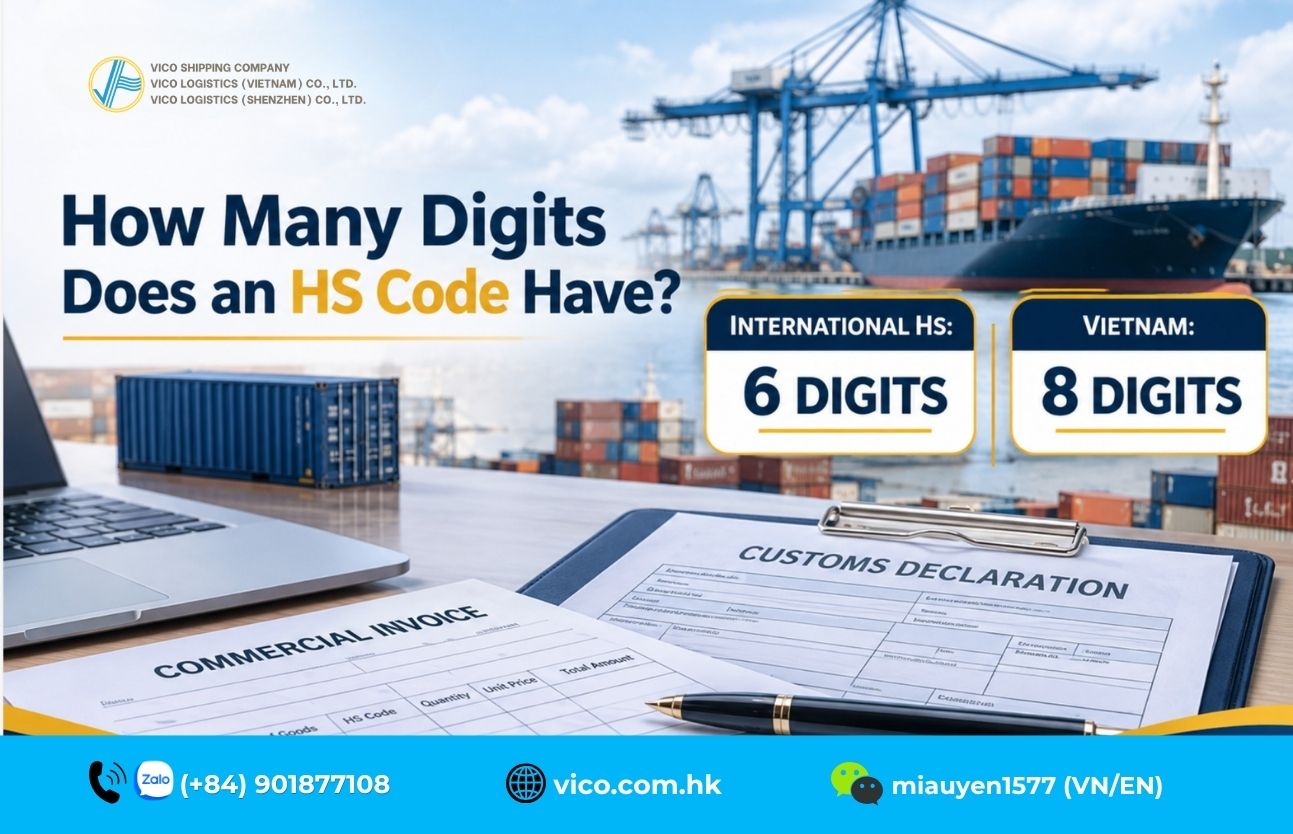
Although both belong to the goods classification system, 6-digit and 8-digit HS codes have different scopes of use.
|
Criterion
|
6-digit HS code
|
8-digit HS code
|
|---|---|---|
|
System
|
International HS
|
AHTN and the list applied in Vietnam
|
|
Basis of development
|
WCO
|
HS combined with extended subheadings
|
|
Scope
|
International classification foundation
|
More detailed classification at regional/national level
|
|
Level of detail
|
International level
|
More detailed than the 6-digit HS
|
|
Application
|
Reference for international goods classification
|
Looking up tariff schedules and making declarations under the Vietnamese list
|
Illustrative example: A product has an international HS code of 6 digits. When looked up in Vietnam's list, this code may be extended to an 8-digit code to identify a more detailed subheading.
Do not add two digits to a 6-digit HS code on your own. The last two digits must be determined from the official commodity list and based on the actual characteristics of the product.
5. How many HS code digits should be used when exporting or importing in Vietnam?
When carrying out customs procedures in Vietnam, businesses need to determine the commodity code according to Vietnam's Export and Import Commodity List and the relevant tariff schedule, normally at the 8-digit level.
However, two situations should be distinguished:
5.1. Businesses importing goods into Vietnam
When importing, businesses need to determine the HS code that fits the actual goods under the list currently applied in Vietnam.
The commodity code is the basis for looking up and cross-checking information such as:
- Preferential import duty and related taxes.
- Specialized management policies.
- Requirements for licenses, inspection or quality certification, if any.
- Conditions for enjoying tariff preferences based on origin and the corresponding trade agreements.
Businesses need to check the goods description, notes and classification rules, rather than simply looking for a code whose name resembles the product.
5.2. Businesses exporting goods abroad
When exporting, businesses need to determine the commodity code according to the regulations and list applied in Vietnam.
At the same time, note that the importing country may use a more detailed code or a different grouping in the extended digits.
Therefore, the HS code declared in Vietnam and the tariff code used by the partner in the importing country may not be exactly the same.
Businesses should consult the importer or the customs declaration agent in the destination country to verify the appropriate code.
6. How to accurately look up the HS code for goods
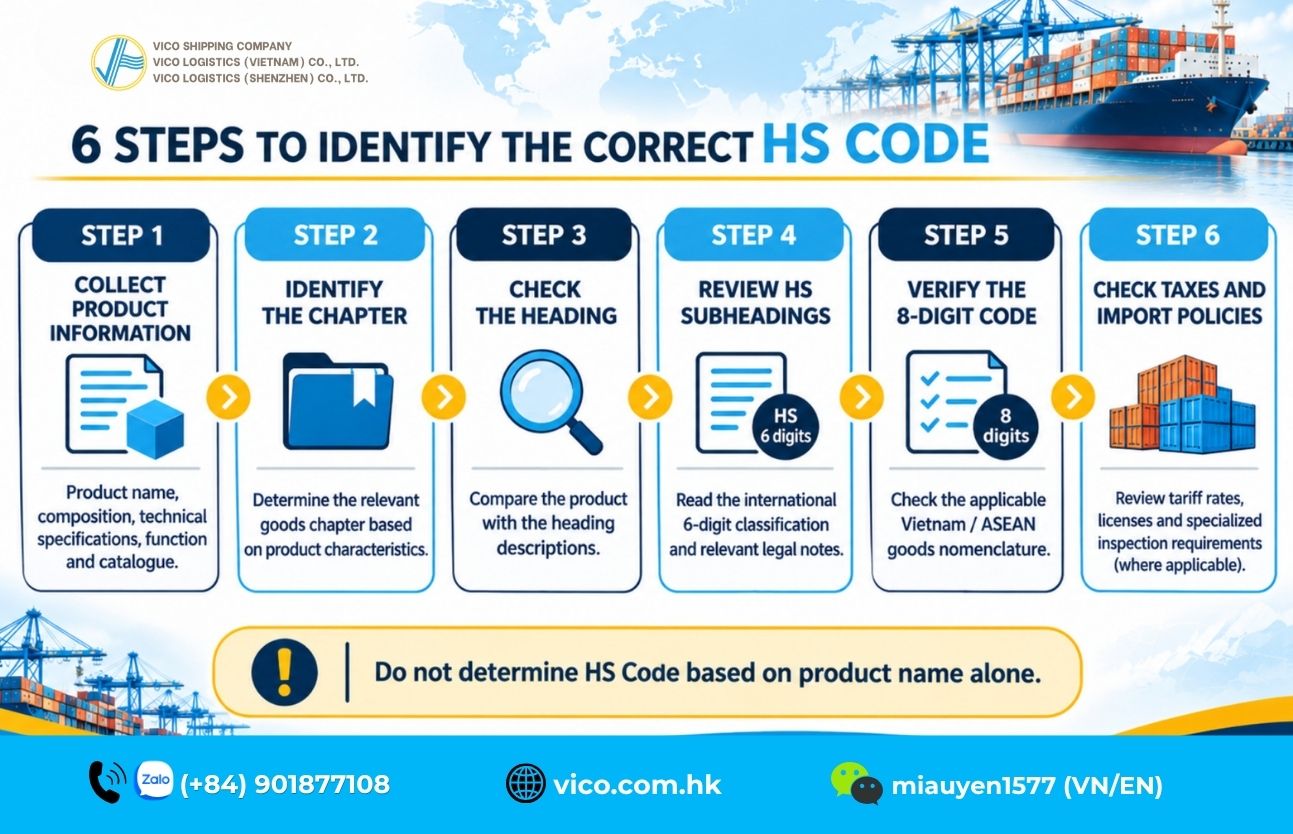
Determining an HS code is not simply a matter of searching the product name on Google and picking a code with a similar description. Classification must be based on the nature, composition, structure, use and the rules for classifying goods.
Businesses can follow these steps:
Step 1: Gather detailed information about the goods
Before looking up the code, prepare:
- The commercial name and technical name of the product.
- Composition and constituent materials.
- Use and main function.
- Specifications, dimensions and technical parameters.
- Condition of the goods: raw material, semi-finished product or finished product.
- Catalogue, images, technical documents or product description.
The more complete the information, the stronger the basis for determining the HS code.
Step 2: Determine the goods chapter
Based on the characteristics and nature of the product, determine the appropriate chapter in the Export and Import Commodity List.
Do not choose a chapter based only on the business's line of work or the commercial name.
Step 3: Cross-check the heading and subheading
After determining the chapter, continue checking the heading and subheading in classification order.
Read carefully:
- The heading description.
- Section and chapter notes.
- Subheading notes.
- The General Rules for the Interpretation of the classification of goods.
Step 4: Check the 8-digit code in the Vietnamese list
Cross-check the international 6-digit HS code against the extended subheading in Vietnam's Export and Import Commodity List.
Do not guess the last two digits or directly apply another country's code to Vietnam.
Step 5: Check the tariff schedule and item-specific policies
After determining the provisional code, continue checking:
- Ordinary or preferential import duty.
- Value-added tax and other taxes, if any.
- Special preferential duty under trade agreements, if conditions are met.
- Licensing and specialized inspection policies.
- Specific regulations for particular items.
Step 6: Keep records of the classification basis
Businesses should keep catalogues, technical documents, product composition, analysis results and the basis for determining the HS code.
For complex goods or goods that may be classified in several ways, businesses may consider carrying out the advance ruling procedure for commodity codes in accordance with customs regulations.
7. What consequences can a wrong HS code cause?
The HS code directly affects many aspects of import-export activities. If goods are classified incorrectly, businesses may face the following problems:
7.1. Incorrect determination of tax rates
Each HS code may correspond to different tax rates and tax policies.
If the wrong code is applied, the business risks underpaying or overpaying its tax obligations, leading to requests for adjustment and handling in accordance with regulations.
7.2. Failing to identify the correct goods management policy
Some items may be subject to specialized management, quality inspection, quarantine or licensing requirements.
If the HS code is determined incorrectly, the business may miss required procedures or prepare unsuitable documentation.
7.3. Delays in customs clearance
When the declared information does not match the nature of the goods or the supporting documents, the customs authority may ask the business to provide explanations, supplement documents or carry out inspection steps in accordance with regulations.
This can affect delivery plans, storage and shipment schedules.
7.4. Increased costs and compliance risks
Adjusting an HS code or handling errors can incur additional costs and time for the business. In cases of violation, the business may also be subject to penalties under current law.
Therefore, determining the correct HS code from the start is an important step in import-export planning.
8. Important notes when determining the HS code
To minimize errors, businesses should note the following:
- Do not rely only on the commercial name: One product name may be used for various goods with different compositions or uses.
- Do not copy HS codes from previous shipments: Changes in a product's composition, structure, use or processing status may lead to a different classification result.
- Do not assume the exporting country's code is the same as Vietnam's: The extended digits may differ between tariff systems.
- Check the version of the nomenclature and tariff schedule: The HS and related lists may be updated periodically. Use the documents and tariff schedule in effect at the time the procedure is carried out.
- Read the notes and classification rules: A code with a similar goods description is not necessarily the appropriate code. Classification must be based on the relevant legal and technical grounds.
9. Frequently asked questions about the number of digits in an HS Code
9.1. How many digits does the international HS Code have?
The international HS Code has 6 digits under the goods classification system developed by the WCO. Countries may add further digits to classify goods in more detail.
9.2. How many digits does an HS code have in Vietnam?
Vietnam's Export and Import Commodity List uses 8-digit codes. The first six digits follow the international HS, and the next two digits are used for more detailed classification.
9.3. Are 6-digit and 8-digit HS codes the same?
Not entirely. The first six digits belong to the international HS structure, while the last two digits are an extension under the list applied in the region or country.
9.4. Does every country use 8-digit HS codes?
No. Countries may use 8-digit, 10-digit or other extended structures depending on their tariff systems. Businesses need to look up codes according to the regulations of the country where the procedure is carried out.
9.5. Can a 6-digit HS code be used for customs declarations in Vietnam?
It is not advisable to use only the 6-digit code when a declaration must follow Vietnam's commodity code list. Businesses need to determine the appropriate detailed code in the list and tariff schedule currently in effect.
9.6. Can two products with the same name have different HS codes?
Yes. The HS code also depends on composition, structure, use, degree of processing, technical characteristics and classification rules. Therefore, a code cannot be determined from the name alone.
9.7. Do HS codes change over time?
They may. The international HS nomenclature is reviewed and updated by the WCO on a periodic cycle; regional and national tariff lists may also be adjusted. Businesses need to check the version in effect at the time of declaration.
10. VICO Logistics supports HS code consulting and import-export procedures

Determining the correct HS code is one of the important steps for businesses to proactively calculate costs, check item policies and prepare customs documents.
However, for items with complex structures, multiple components, or that may fall under several classification groups, businesses need to carefully assess technical documents and legal grounds before making a declaration.
VICO Logistics accompanies businesses in logistics activities and supports import-export procedures, including:
- Advising on, cross-checking information for and supporting HS code lookup based on goods documents.
- Supporting the preparation and checking of import-export documents.
- Advising on customs declaration and clearance procedures.
- Supporting international transport, domestic transport and cross-border logistics.
- Coordinating the checking of document requirements and item policies for each shipment.
If your business is preparing to import or export an item but is unsure about the HS code, please prepare the catalogue, composition, technical specifications and description of use to receive support with cross-checking.
- Factory Coffee: The Global Coffee Harvest Calendar
- What's So Good About Vietnam Manufacturers
- Electronics Shipping: Mastering The Logistics Of High-Value Technology
- Door To Door Cambodia Shipping: The Ultimate Logistics Solution For 2026
- Trucking Cambodia - Vietnam: Fast & Reliable Cross-Border Solutions 2026
- What Is an Insurance Certificate? How to Verify and Use It
- What Is an Air Waybill (AWB)? How to Read & Track an AWB
- Who Is Responsible for Cargo Damage? Incoterms 2020
Get a Logistics Quote in just 5 minutes
Professional international transportation and supply chain solutions tailored for your business.
Get a quote now ↗Quick Contact
🇻🇳 Ms Uyen
Hotline / Zalo
(+84) 901 877 108WeChat (VN/EN)
miauyen1577Scan to Contact
Zalo
🇨🇳 Ms Schyler
Office Hotline
(+852) 3759 9300WeChat ID
Schyler_skylarScan to Contact
VICO International Logistics — Your Trusted Logistics Partner in Indochina
Senior member of international logistics and trade associations: Eurocham, JCtrans, VICOFA, VITAS, and more.