



How is import tax calculated? For goods subject to a percentage-based tax rate, the payable import tax is calculated by multiplying the import dutiable value by the applicable tax rate. Besides the import tax, businesses may also have to pay Value Added Tax (VAT) and certain other taxes depending on the specific item.
Determining the exact tax amount helps businesses estimate costs, set selling prices, and limit unexpected expenses. However, to calculate taxes accurately, businesses must correctly identify the HS code, customs value, origin of goods, and current tax policies.
The article below will provide a step-by-step guide on how to calculate import tax in Vietnam, along with practical examples and methods for looking up tax rates so businesses can apply them to their shipments.
1. What is import tax?
Import tax is a tax levied on imported goods that are subject to taxation under Vietnamese law. Import tax is primarily regulated by the Law on Export and Import Duties No. 107/2016/QH13 and related guiding, amending, and supplementing documents.
For example, a business in Vietnam imports machinery, equipment, or raw materials from China. When clearing customs, the business needs to determine whether the goods are subject to import tax and, if so, what the applicable tax rate is.
When are goods subject to import tax?
Imported goods entering Vietnam that fall under the taxable category may incur an import tax obligation during customs clearance. However, not all shipments are subject to import tax. Some cases may be tax-exempt or subject to a 0% tax rate when meeting legal conditions.
In particular, goods that meet the rules of origin under Free Trade Agreements (FTAs) may enjoy special preferential import tax rates.
How does import tax differ from VAT?
|
Criteria
|
Import Tax
|
VAT
|
|
Nature
|
Tax on imported goods subject to taxation
|
Tax on the value added
|
|
Calculation basis
|
Dutiable value and tax rate (or other methods)
|
VAT taxable price and tax rate
|
|
Tax rate
|
Based on HS code, origin, and policy
|
Based on VAT regulations for the item
|
|
0% Import Tax
|
No percentage-based import tax incurred
|
VAT may still apply
|
A key point for businesses to remember is that a 0% import tax does not mean the entire shipment is exempt from all taxes.
2. How is import tax calculated?
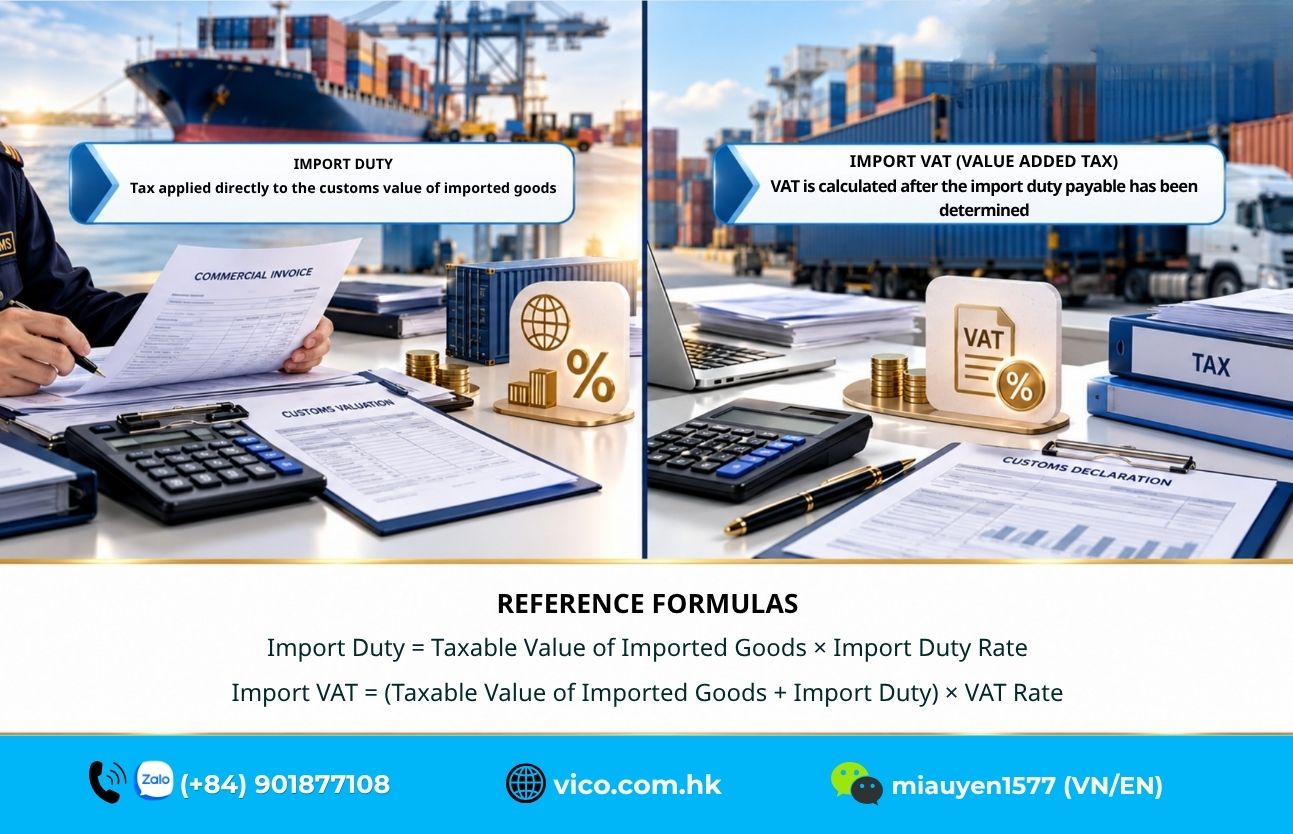
For goods applying the percentage-based tax calculation method, the basic formula is as follows:
IMPORT TAX CALCULATION FORMULA
T_NK = V_HQ × r_NK
Where:
Import Tax Amount: The amount of import tax payable.
Import Dutiable Value: The customs value for tax calculation in VND.
Import Tax Rate: The applicable import tax rate.
To use this formula, businesses need to determine two crucial pieces of information: the import dutiable value and the import tax rate.
2.1. What is the import dutiable value?
The import dutiable value is the customs value determined according to legal regulations. For imported goods, the basic principle is to determine the actual price paid or payable up to the first port of import, using the appropriate customs valuation method.
In many standard international trade transactions, this value can be understood to be close to the CIF price, which includes:
- The value of the goods.
- International freight charges to the first port of import.
- International insurance fees, if any and if required to be added.
For example, a business imports goods under FOB terms with the following hypothetical information:
|
Item
|
Value
|
|
FOB Price
|
8,000 USD
|
|
International Freight
|
1,000 USD
|
|
Insurance Fee
|
100 USD
|
|
Total Hypothetical Value
|
9,100 USD
|
In this case:
Hypothetical dutiable value = 8,000 + 1,000 + 100 = 9,100 USD.
Assuming the customs exchange rate is 25,000 VND/USD:
Dutiable value = 9,100 × 25,000 = 227,500,000 VND.
This is a simplified example. The actual customs value also depends on specific additions, deductions, and valuation methods as prescribed by law. The actual exchange rate used must be the one applied by the customs authority.
Is import tax calculated based on CIF or FOB?
This is one of the most common questions when businesses start importing. As a rule, import tax is not simply calculated based on the FOB price if that price does not yet include the costs that must be added to the customs value.
For FOB transactions, businesses typically need to add international freight and insurance costs up to the first port of import. If purchasing under CIF terms, the purchase price already includes freight and insurance according to the delivery terms. However, it is still necessary to check for any valuation adjustments as regulated.
Note: CIF is just a common interpretation in suitable transactions, not the sole customs valuation method for all shipments.
2.2. How is the import tax rate determined?
The import tax rate depends on several factors, the most important being:
- The HS code of the goods.
- The origin of the goods.
- The tax policy at the time of customs declaration registration.
- Conditions for enjoying tariff preferences.
Under Vietnam's import tax mechanism, there are three common groups of tax rates to distinguish:
|
Tax Rate Type
|
Application
|
|
Standard tax rate
|
Goods that do not meet the conditions for preferential or special preferential tax rates
|
|
Preferential tax rate (MFN)
|
Goods that meet the conditions for preferential tax rates as prescribed
|
|
Special preferential tax rate
|
Goods that meet the conditions of specific trade agreements and related tariff schedules
|
For example, two shipments with the same value and the same type of goods but different origins may be subject to different tax rates. Therefore, businesses should not determine the tax rate simply by asking "which country is this imported from?", but must fully check the HS code, origin, and conditions for applying preferences.
The preferential import tariff schedule is regulated by Decree 26/2023/ND-CP and amending/supplementing documents, including Decree 108/2025/ND-CP and Decree 199/2025/ND-CP.
2.3. Specific (absolute) import tax and mixed tax
Besides the percentage-based method, some items may be subject to different methods.
Specific import tax:
Tax payable = Actual quantity of imported goods × Absolute tax amount per unit of goods.
Mixed import tax:
Tax payable = Tax calculated by percentage + Specific tax amount.
These methods apply depending on the type of goods and regulations in the corresponding tariff schedule; businesses cannot arbitrarily choose them over the percentage-based method.
3. How to calculate import tax and VAT
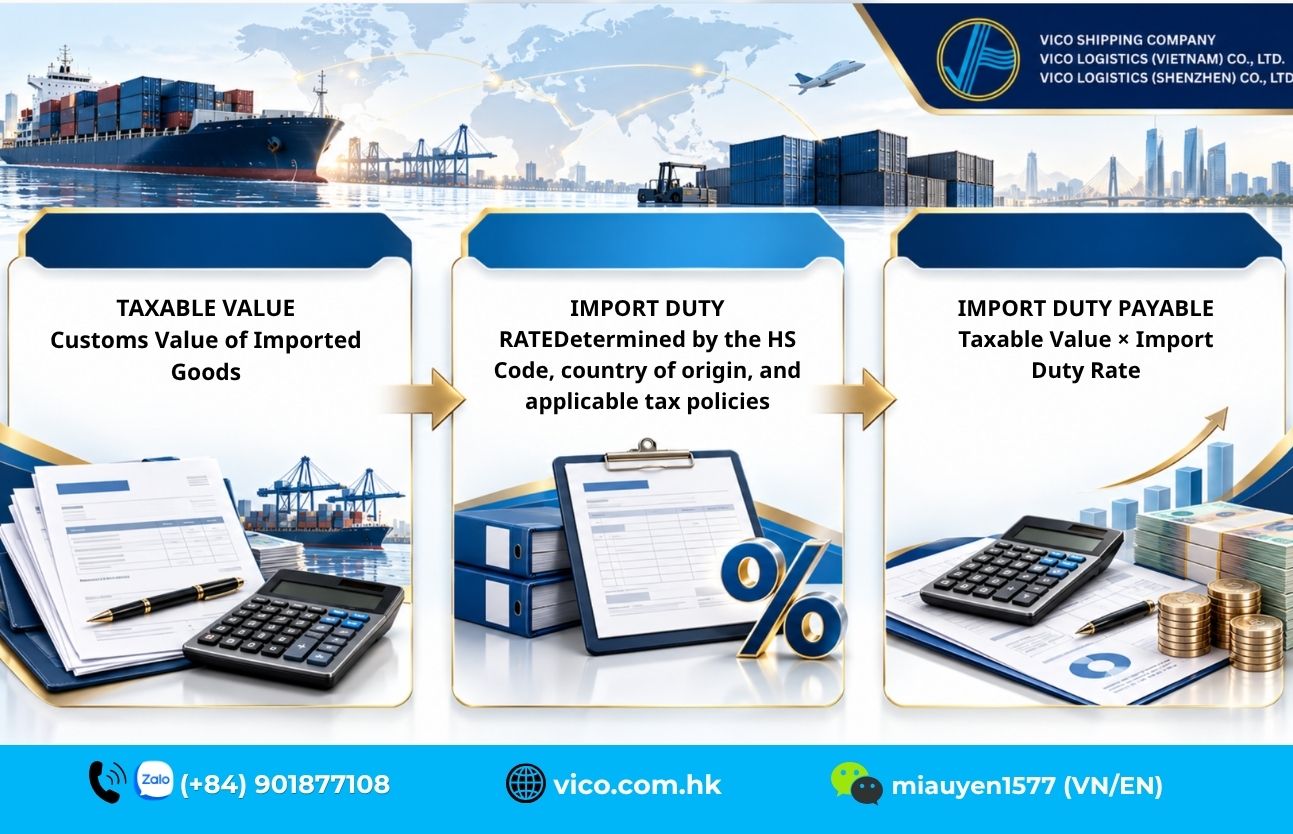
When importing goods, businesses usually care about the total tax payable, not just the import tax. For goods subject to VAT, the basis for calculating VAT at the import stage may include the import dutiable value, import tax, supplementary import taxes, and other applicable taxes.
3.1. VAT calculation formula for imported goods
According to the Law on Value Added Tax No. 48/2024/QH15, the VAT taxable price for imported goods includes the import dutiable value plus the import tax, supplementary import taxes, special consumption tax, and environmental protection tax (if any).
General formula:
Imported Goods VAT = VAT Taxable Price × VAT Rate
In typical cases without supplementary taxes, special consumption tax, or environmental protection tax:
VAT = (Import Dutiable Value + Import Tax) × VAT Rate
Note on tax rates for 2026: According to Resolution 204/2025/QH15 and Decree 174/2025/ND-CP, certain goods and services subject to a 10% tax rate are reduced to 8% from July 1, 2025, to the end of December 31, 2026. Some groups of goods are excluded from this reduction. Businesses need to verify whether their specific item applies for the 8% rate or another rate, rather than assuming all imports are subject to 8% or 10% VAT.
3.2. Total tax payable upon importation
For a shipment that only incurs import tax and VAT:
Total tax payable = Import Tax + VAT
In other cases, goods may also be subject to:
- Special consumption tax.
- Environmental protection tax.
- Anti-dumping tax.
- Anti-subsidy tax.
- Safeguard tax and other supplementary import taxes as prescribed.
Businesses must correctly identify the order and calculation basis for each type of tax. Do not simply add all tax rates together and multiply directly by the value of the goods.
4. Practical examples of import tax calculation
To better understand, let's look at the three examples below.
Example 1: Shipment with a dutiable value of 100 million VND
Suppose a business imports a shipment with the following details:
- Import dutiable value: 100,000,000 VND.
- Hypothetical import tax rate: 10%.
- Hypothetical VAT rate: 8%.
- No other taxes apply.
ILLUSTRATIVE TAX CALCULATION RESULTS
|
Tax
|
Amount
|
|
Import Tax
|
10,000,000 VND
|
|
VAT
|
8,800,000 VND
|
|
Total Tax Payable
|
18,800,000 VND
|
This example uses hypothetical rates to illustrate the method and does not represent a specific HS code.
Step 1: Calculate import tax
100,000,000 × 10% = 10,000,000 VND.
Step 2: Calculate VAT
(100,000,000 + 10,000,000) × 8% = 8,800,000 VND.
Step 3: Calculate total tax
10,000,000 + 8,800,000 = 18,800,000 VND.
Thus, the total tax payable in this example is 18.8 million VND, excluding logistics or other procedural costs.
Example 2: Calculating tax for goods imported under FOB terms
A Vietnamese business buys goods from abroad under FOB terms.
Hypothetical information:
|
Indicator
|
Value
|
|
FOB Price
|
10,000 USD
|
|
International Freight
|
1,000 USD
|
|
International Insurance
|
100 USD
|
|
Hypothetical Exchange Rate
|
25,000 VND/USD
|
|
Hypothetical Import Tax Rate
|
5%
|
|
Hypothetical VAT Rate
|
8%
|
Assuming no other value adjustments and no supplementary taxes.
Step 1: Determine dutiable value
(10,000 + 1,000 + 100) × 25,000 = 277,500,000 VND.
Step 2: Calculate import tax
277,500,000 × 5% = 13,875,000 VND.
Step 3: Calculate VAT
(277,500,000 + 13,875,000) × 8% = 23,310,000 VND.
Step 4: Calculate total tax payable
13,875,000 + 23,310,000 = 37,185,000 VND.
If the business only used the FOB price of 10,000 USD as the basis and ignored the mandatory additions to the customs value, the cost estimate would be inaccurate.
Example 3: Imported goods enjoying a 0% tax rate
Suppose a shipment has:
- Dutiable value: 200,000,000 VND.
- Valid import tax rate: 0%.
- Applicable VAT rate: 8%.
- No other taxes apply.
Results:
|
Tax Category
|
Amount
|
|
Import Tax
|
0 VND
|
|
VAT
|
16,000,000 VND
|
|
Total Tax
|
16,000,000 VND
|
This example shows that even when the import tax is 0%, a business may still incur VAT obligations. This is a crucial point to note when calculating total import costs.
5. How to look up import tax rates by HS code and origin

To accurately determine the tax amount, the critical step is not plugging numbers into a formula, but identifying the correct tax rate applicable to the item. Businesses can follow these four steps:
Step 1: Determine the HS code of the goods
The HS (Harmonized System) Code is a standardized numerical method of classifying traded products used internationally and in customs management. When determining an HS code, consider:
Product name and description.
- Composition and materials.
- Usage and function.
- Technical specifications.
- Operating principles (if any).
- Goods classification rules and relevant legal notes.
Note: Determining the wrong HS code can lead to applying the incorrect tax rate and affect import procedures.
Step 2: Look up the import tariff schedule
After determining the HS code, cross-reference it with the currently effective tariff schedule. Use official sources such as:
- Vietnam Customs Portal.
- The Government's legal database.
- Preferential import tariff schedules and special preferential tariff schedules under respective FTAs.
- Always pay attention to the applicable period, as tax rates may be amended over time.
Step 3: Check the origin of goods and C/O
A C/O (Certificate of Origin) verifies where the goods were made. If a business wants to enjoy special preferential import tax rates under an FTA, the goods must meet the agreement's conditions, including rules of origin, transportation conditions, and valid C/O documentation.
Not all products bought from China, for example, automatically enjoy a 0% import tax. The specific rate depends on the HS code, tariff reduction roadmap, origin, and application conditions.
Step 4: Identify other relevant taxes and obligations
After finding the import tax rate, check:
- The VAT rate and any tax reduction conditions.
- Special consumption tax.
- Environmental protection tax.
- Anti-dumping tax or other trade defense measures.
- Relevant tax exemption/reduction conditions.
- Only after completing these steps can a business reliably estimate its total tax liability.
6. Common mistakes when calculating import tax
Mistake 1: Calculating tax solely based on the purchase price. Businesses often use the price on the Commercial Invoice without factoring in freight, insurance, and other value adjustments, leading to discrepancies with the valid customs value. Fix: Check Incoterms, freight, insurance, and valuation documents beforehand.
Mistake 2: Applying the wrong HS code. Classifying goods based only on their commercial name without checking technical specifications can lead to wrong tax rates and missing licenses. Fix: Gather catalogs, technical descriptions, and product literature before classifying.
Mistake 3: Assuming a C/O guarantees tax exemption. A C/O doesn't automatically mean a 0% tax rate; goods must meet all conditions for preferences. Fix: Verify the correct FTA, rules of origin, documentation, and effective timing.
Mistake 4: Forgetting to calculate VAT. Some businesses only estimate the import tax. VAT is often a significant expense, even if import tax is 0%. Fix: Create separate calculations for each tax type.
Mistake 5: Using outdated tariff schedules or exchange rates. Tax rates and customs exchange rates fluctuate. Fix: Always verify effective dates and current data when registering declarations.
7. How to accurately estimate total import costs?
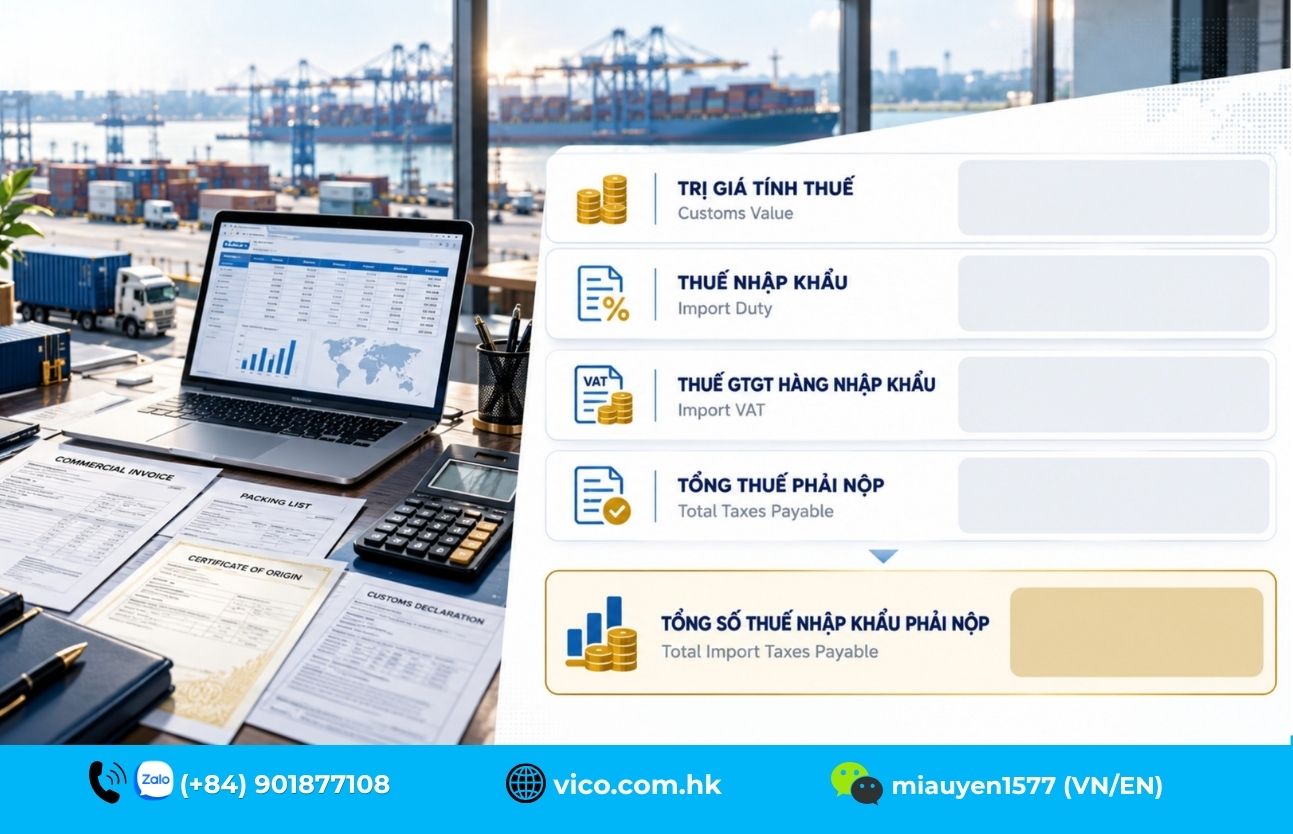
Knowing the tax payable is only part of the import cost calculation. To determine the full budget, businesses must account for logistics and procedural costs. Common expenses include:
- Purchase price from the supplier.
- International freight.
- Cargo insurance.
- Import tax and related taxes.
- Port or airport handling charges.
- Customs clearance fees.
- Specialized inspection fees (if applicable).
- Storage, yard, or container demurrage/detention fees (if any).
- Inland transportation to the warehouse.
Ensure you do not double-count freight or insurance if they are already included in the purchase price under the agreed Incoterms.
8. Frequently Asked Questions (FAQs) about calculating import tax
Is import tax calculated based on CIF or FOB price?
It is based on the valid customs value, which is generally close to the CIF price. If importing under FOB, you must add international freight, insurance, and other adjustments as prescribed.
Do I have to pay VAT if the import tax is 0%?
Yes, if the goods fall under the VAT taxable category. Import tax and VAT are two distinct taxes.
How much tax do I pay to import goods from China to Vietnam?
There is no flat rate. The tax rate depends on the HS code, origin, tariff schedule, and conditions for trade preferences.
Does having a C/O Form E guarantee a 0% import tax?
Not necessarily. You must check the HS code, the ACFTA tariff schedule, origin rules, and relevant regulations. The rate could be 0% or another rate depending on the applied roadmap.
Is import tax calculated based on the purchase price or the selling price in Vietnam?
For the percentage-based method, the basis is the import dutiable value (customs value), not the domestic resale price in Vietnam.
Can I calculate the import tax myself before the goods arrive?
Yes. You can estimate it if you have sufficient information about the goods, HS code, value, origin, and tax rate. However, the official tax amount will be determined according to regulations during customs clearance.
9. How VICO Logistics supports importing businesses

Calculating import tax requires more than just multiplying value by a tax rate. Businesses must also determine the correct HS code, verify origin, check preference conditions, and navigate customs regulations.
For businesses importing goods from China or global markets into Vietnam, preparing this information in advance limits unexpected costs and improves delivery planning.
VICO Logistics supports businesses by:
- Consulting and reviewing goods information to determine HS codes and tax rates.
- Assisting in checking origin documents and conditions for tariff preferences.
- Estimating taxes and logistics costs based on shipment details.
- Supporting customs declaration and preparing import documentation.
- Providing tailored sea, air, and cross-border road transport solutions for each shipment.
Need to check taxes and estimate import costs?
If you are preparing to import goods to Vietnam but are unsure about the HS code, tax rate, or total costs, you can send your shipment details to VICO Logistics for a preliminary assessment.
Information to prepare: Product name, description or catalog, HS code (if known), country of origin, cargo value, delivery terms (Incoterms), volume/weight, and expected port/border gate.
Contact VICO Logistics for advice on import procedures, transportation, and quotes suited to your business needs.
- Factory Coffee: The Global Coffee Harvest Calendar
- What's So Good About Vietnam Manufacturers
- Electronics Shipping: Mastering The Logistics Of High-Value Technology
- Door To Door Cambodia Shipping: The Ultimate Logistics Solution For 2026
- Trucking Cambodia - Vietnam: Fast & Reliable Cross-Border Solutions 2026
- What Is an Air Waybill (AWB)? How to Read & Track an AWB
- What Is MSDS/SDS? 16 Sections and Its Role in Import and Export
Get a Logistics Quote in just 5 minutes
Professional international transportation and supply chain solutions tailored for your business.
Get a quote now ↗Quick Contact
🇻🇳 Ms Uyen
Hotline / Zalo
(+84) 901 877 108WeChat (VN/EN)
miauyen1577Scan to Contact
Zalo
🇨🇳 Ms Schyler
Office Hotline
(+852) 3759 9300WeChat ID
Schyler_skylarScan to Contact
VICO International Logistics — Your Trusted Logistics Partner in Indochina
Senior member of international logistics and trade associations: Eurocham, JCtrans, VICOFA, VITAS, and more.