

| Table of Contents 1. Hanoi’s New Truck Restrictions Are Redefining Vietnam Urban Logistics Strategy 2. What the New Hanoi Truck Restrictions Actually Say 3. Why This Matters Beyond Traffic Management 4. The Impact on Last Mile and Short Haul Freight 5. Compliance as a Competitive Differentiator 6. What This Signals About the Future of Urban Freight in Vietnam 7. How VICO Creates Value Under Urban Restrictions 8. Conclusion |
Navigating New Hanoi Truck Restrictions: What Logistics Businesses Need to Know
1. Hanoi’s New Truck Restrictions Are Redefining Vietnam Urban Logistics Strategy
In early 2026, Hanoi quietly triggered one of its most consequential logistics policy shifts in years. New regulations banning trucks over two tons from operating in the inner city during daytime hours are not just a traffic management measure. They represent a structural change in how goods move through Vietnam’s capital.
While the headlines focus on congestion and enforcement, the deeper story is about compliance pressure, operational redesign, and the growing gap between companies that plan for regulatory friction and those that react too late. For logistics users operating in Hanoi, the rule change forces a reassessment of vehicle selection, route planning, scheduling, and partner choice.
This article synthesises reporting from Dantri, Nhan Dan and Luat Khoa, while situating the policy within broader urban freight trends. More importantly, it explains what the restrictions mean in practical terms for businesses and how logistics providers such as VICO can create value by absorbing regulatory complexity on behalf of customers.
>> The Most Common Types of Trucks in Vietnam’s Transport and Key Considerations for Safe Shipping
2. What the New Hanoi Truck Restrictions Actually Say
According to reporting by Dantri and Nhan Dan, Hanoi has formally issued new regulations governing road transport activities across the city, with a strong focus on restricting heavy trucks in inner urban areas. Under the new rules, trucks with a permitted load of two tons or more are prohibited from operating in inner city districts during daytime hours, as part of a broader effort to reduce congestion, traffic accidents, and emissions in densely populated zones.
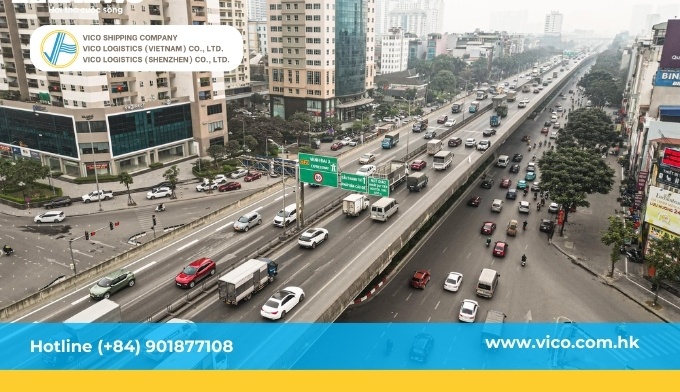
The restricted area is clearly defined, covering all roads inside a designated boundary encircling the city centre. This boundary includes major arterial routes such as Pham Van Dong, Ring Road 3, Nguyen Van Linh, Vo Van Kiet, Thang Long Bridge, and surrounding connectors. Within this zone, access for freight vehicles is tightly controlled, although a limited number of designated corridors, including Nguyen Van Cu, Co Linh, Bac Thang Long – Vuc De, and sections of Thang Long Boulevard, remain open to regulated truck traffic.
In terms of operating hours, the regulation establishes strict time windows.
Trucks under two tons may operate only outside peak hours.
Trucks of two tons or more are permitted to operate only between 9:00 p.m. and 6:00 a.m. the following morning.
Priority vehicles as defined under Vietnam’s Road Traffic Safety Law may operate 24/7, while oversized, overweight, and special-purpose vehicles must comply with individual circulation permits and approved schedules.
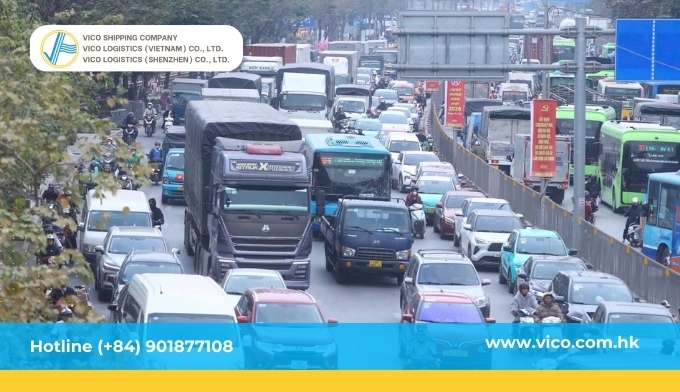
The policy is scheduled to take effect from mid-January 2026, following a pilot phase announced by city authorities. Enforcement will concentrate on core inner districts rather than peripheral routes, but for many shippers, this distinction offers little relief. Distribution centres, retail outlets, construction sites, and manufacturing customers are overwhelmingly located within these restricted zones, meaning access limitations directly affect daily operations.
Analysis from Luat Khoa adds an important strategic context. The regulation is not an isolated traffic control measure but part of a broader shift in Hanoi’s transport governance, where urban livability, safety, and environmental considerations increasingly take precedence over unrestricted freight access. This trajectory mirrors policy developments already seen in Bangkok, Jakarta, and several major cities in southern China.
For logistics operators, the key takeaway is not the specific tonnage threshold or individual road names. It is the clear signal that urban freight in Vietnam will face tighter controls, narrower operating windows, and higher compliance expectations going forward. Companies that treat this regulation as a temporary inconvenience risk repeated disruption, while those that adapt their networks and partners early will be far better positioned for the next phase of urban logistics regulation.
3. Why This Trucking Restrictions Beyond Traffic Management in Vietnam
From a business perspective, the restriction is not about inconvenience. It directly affects cost structures, service reliability, and risk exposure.
Companies that rely on daytime deliveries into central Hanoi now face three immediate pressures.
First, limited delivery windows push more freight into night time operations, increasing labour costs and complicating warehouse coordination.
Second, non compliance risks fines, delays, or confiscation of vehicles, which can cascade into missed customer commitments.
Third, asset mismatch becomes visible. Vehicles that were optimal yesterday become liabilities overnight.
Urban freight policy also tends to tighten incrementally. What begins as a time based restriction often evolves into permit systems, emission standards, or zone based access fees. Businesses that treat the current rule as a one off adjustment may find themselves repeatedly restructuring operations.
This is where logistics strategy shifts from transport execution to regulatory navigation. Companies no longer need trucks alone. They need partners who understand where regulation is heading and can adjust networks before disruption occurs.
4. The Impact of Hanoi Trucking Restrictions on Last-Mile and Short-Haul Freight in Northern Vietnam
Hanoi trucking restrictions have the most immediate impact on sectors that depend heavily on short-haul and last-mile delivery. Retail replenishment, food and beverage distribution, FMCG, construction materials, and light manufacturing all rely on predictable daytime access to inner-city areas. With daytime truck access now limited, these sectors face growing pressure to rethink how goods move into Hanoi and surrounding urban zones in Northern Vietnam.
Under Hanoi trucking restrictions, delivery patterns are shifting. Shipment sizes tend to decrease while delivery frequency increases, creating a cost and efficiency paradox. Smaller vehicles can legally access restricted zones, but without careful route and load planning, they often drive up per-unit delivery costs and reduce overall transport efficiency.
Some businesses attempt to self-adjust by adding vans, splitting shipments, or shifting deliveries to off-peak hours. In practice, these responses often lead to fragmented fleets, underutilised capacity, and higher administrative complexity. Without an integrated logistics strategy, the operational burden created by Hanoi trucking restrictions can quickly outweigh any short-term compliance benefits.
A more sustainable response lies in network redesign. This includes reconfiguring consolidation points, optimising delivery sequencing, and selecting vehicle types that align with both regulatory requirements and demand density. As Hanoi trucking restrictions continue to shape urban freight policy, companies that redesign their logistics networks proactively will be far better positioned to control costs and maintain service reliability.
5. Compliance as a Competitive Differentiator
The Hanoi restriction highlights a broader shift in Vietnam’s logistics market. Compliance is no longer a background concern. It is becoming a differentiator.
As regulations grow more granular, logistics providers that invest in compliance frameworks gain a structural advantage. This includes understanding local enforcement practices, maintaining up to date permits, selecting compliant vehicles, and designing routes that minimise regulatory exposure.
Our logistics’ role in this environment is not merely to move goods from point A to point B. It is to act as an intermediary between policy and practice. By monitoring regulatory developments and translating them into operational decisions, VICO Logistics allows customers to focus on their core business rather than traffic rules.
6. What This Signals About the Future of Urban Freight in Vietnam
Hanoi is not an outlier. Ho Chi Minh City has already experimented with truck time windows and zone based access. Da Nang and Hai Phong are studying similar measures as traffic volumes rise.
Urban freight in Vietnam is entering a phase of managed access rather than open flow. This will reward logistics strategies that are modular, data informed, and regulation aware.
Businesses that build supply chains assuming permanent unrestricted access will face rising friction. Those that partner with logistics providers capable of absorbing regulatory change will remain resilient.
7. How VICO Creates Value Under Urban Restrictions
In the context of Hanoi’s daytime truck ban, we create value in three core ways.
First, through regulatory intelligence. By continuously tracking policy changes at city and national level, VICO Logistics anticipates restrictions before they disrupt operations. This allows customers to plan proactively rather than reactively.
Second, through network flexibility. We design transport solutions that can adapt to time windows, vehicle limits, and access zones without compromising service levels. This includes the use of appropriate vehicle types, dynamic routing, and coordinated scheduling across warehouses and distribution points.
Third, through risk reduction. Compliance failures carry financial and reputational costs. By embedding compliance into execution, VICO Logistics reduces exposure for customers operating in complex urban environments.
8. Conclusion: What Hanoi Truck Restrictions Mean for the Future of Urban Logistics
Hanoi’s ban on daytime truck operations over two tons is a turning point for urban logistics. It signals a future where freight movement is increasingly shaped by regulation rather than road capacity alone.
For businesses, the lesson is not to fight the policy but to adapt intelligently. Urban logistics now demands partners who understand the regulatory landscape as deeply as they understand transport execution.
VICO sits at that intersection. By translating policy into practical logistics solutions, we help customers navigate change without sacrificing efficiency or reliability. As Vietnam’s cities continue to evolve, that capability will only become more valuable.
Learn more the next article at
- Choosing the Right Incoterm for Vietnam–China Trade
- Long Thanh International Airport Why Vietnam’s New Aviation Hub Will Redefine Air Freight and Logistics
- Logistics 101: The Complete Guide to Import Goods to Vietnam
----------------------------------------------------------------
VICO Logistics – Your Indochina Expert
Premium member of Eurocham, JCtrans, VICOFA, VITAS... associations
Owned offices:
- Hong Kong (Causeway Bay),
- China (Luohu-Shenzhen, Hongkou-Shanghai),
- Vietnam (Bay Hien - Ho Chi Minh, Hai Chau- Da Nang, Gia Vien- Hai Phong).
Follow us for more valuable information
Book now: https://vico.com.hk/#quotation
| Contact us:
|