


When importing goods into Vietnam, enterprises must pay close attention to various types of taxes, including Value Added Tax (VAT). This tax directly impacts total import costs, cost of goods sold (COGS), and corporate financial planning.
So, what is Import VAT? What are the applicable Import VAT rates? How is Import VAT calculated? Does the taxable value include import duties?
In this article, VICO Logistics will help businesses clearly understand Import VAT regulations, how to determine the taxable base, calculation formulas, and key considerations during customs procedures.
1. What is Import VAT?
Import VAT (Import Value Added Tax) is a value-added tax applied to taxable goods imported into Vietnam.
It is an indirect tax calculated on the taxable base value of imported goods in accordance with the law. Importers are responsible for declaring and paying this tax at the import stage.
Under the Law on Value Added Tax No. 48/2024/QH15, organizations and individuals importing taxable goods are designated as VAT taxpayers.
Import VAT key features include:
- Determined based on the taxable value and the tax rate applied to each specific commodity.
- The taxable value includes not only the value of goods but may also cover import duties and other applicable taxes.
- Tax rates depend on the nature, classification, and specific tax regulations governing each item.
- Import VAT paid at customs clearance can be credited/deducted if the business meets all statutory requirements.
Note: Import VAT differs from import duties. Import duties are determined based on HS codes, country of origin, and corresponding tariff policies; whereas Import VAT is calculated on the VAT taxable value pursuant to value-added tax laws.
2. Are Imported Goods Subject to Import VAT?
Not all imported goods are subject to Import VAT.
According to Articles 3 and 5 of the Law on Value Added Tax, goods intended for production, business, and consumption in Vietnam are subject to VAT, except for cases explicitly exempted by law.
Key categories of imported goods exempt from Import VAT include:
- Unprocessed or minimally processed cultivation, forestry, livestock, and aquaculture products (farmed or caught) meeting legal criteria.
- Breeding stock and plant propagation materials as specified by law.
- Animal feed and aquatic feed conforming to regulations.
- Certain salt products.
- Goods in transit or transshipment through Vietnamese territory.
- Temporary imports for re-export and temporary exports for re-import under statutory conditions.
- Imported raw materials for producing or processing export goods under compliant contracts.
- Imported goods for humanitarian aid or non-refundable aid.
- Certain goods under duty-free allowances such as personal luggage, gifts, and movable assets complying with legal criteria.
The list above highlights main categories only. Determining whether a commodity is non-taxable requires assessing the actual nature of the goods, submitted documentation, and specific case conditions.
Enterprises should verify tax policies prior to signing import contracts to avoid cost underestimation or regulatory misapplication.
3. What is the Import VAT Rate?
Import VAT rates are determined under the Law on VAT and relevant guiding documents.
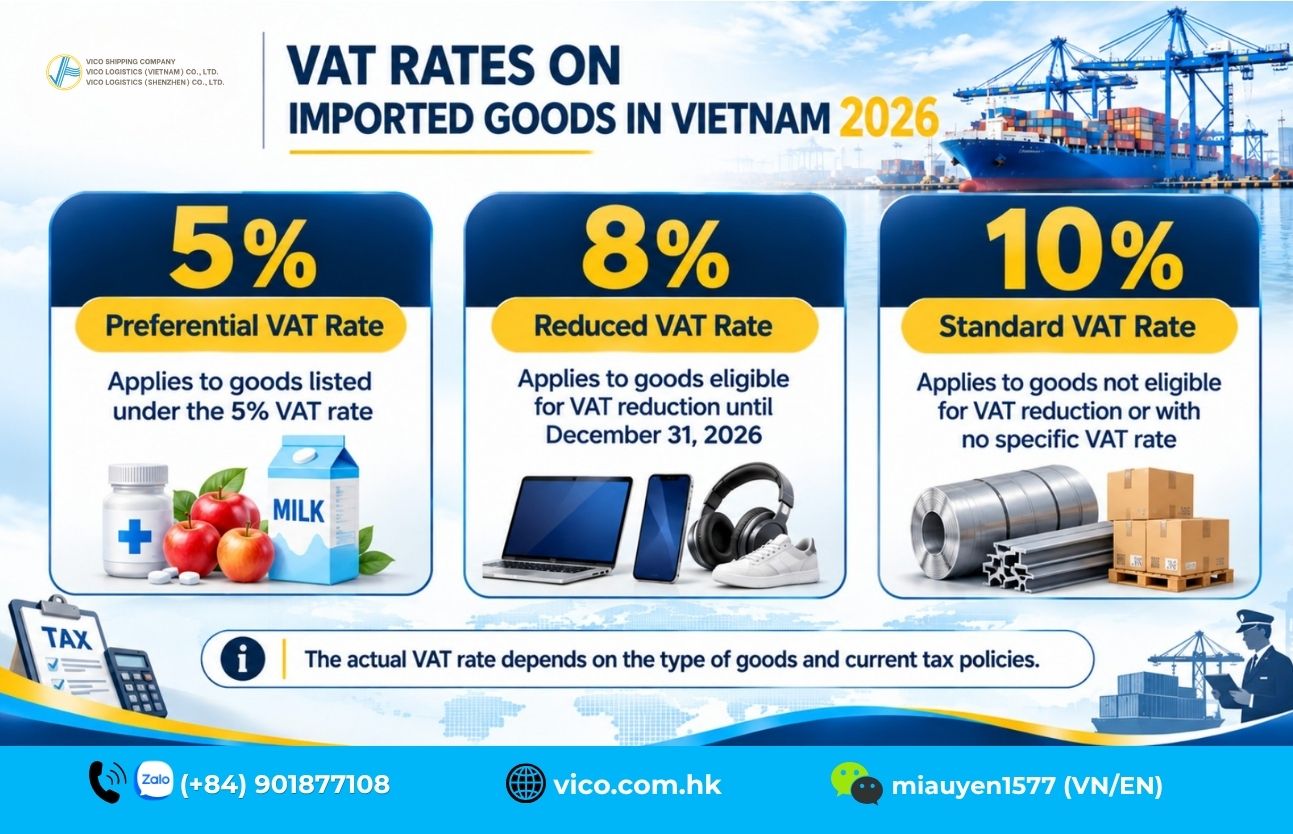
Key VAT rates to note are 5%, 8%, and 10%. Additionally, non-taxable goods incur 0% VAT at the import stage.
3.1. 5% Import VAT Rate
The 5% rate applies to specific goods and services stipulated in Clause 2, Article 9 of the Law on VAT.
Representative categories include:
- Clean water for production and daily life, excluding statutory exceptions.
- Commercial agricultural, livestock, and aquaculture products under legal conditions.
- Agricultural products and services within specified directories.
- Certain medical equipment and instruments.
- Preventive and curative medicines.
- Select books and cultural products as prescribed.
For imported goods, businesses must verify exact commodity names, product characteristics, and tax line schedules rather than relying solely on commercial trade names.
3.2. 8% Import VAT Rate
In 2026, select goods subject to the standard 10% VAT rate qualify for a reduced 8% rate under the national VAT reduction policy.
Legal basis:
- National Assembly Resolution No. 204/2025/QH15.
- Government Decree No. 174/2025/ND-CP.
This tax reduction policy is effective from July 1, 2025, through December 31, 2026.
However, the 8% VAT rate does not apply to all imported goods.
Excluded sectors and product groups include:
- Telecommunications.
- Financial services, banking, securities, and insurance.
- Real estate business.
- Metal products.
- Mining products (excluding coal).
- Goods and services subject to Special Consumption Tax (SCT), excluding gasoline.
Therefore, importers must cross-reference their specific items against current exclusion lists to confirm eligibility.
Example: An enterprise importing machinery equipment subject to a 10% standard rate that qualifies for the tax reduction policy can apply an 8% Import VAT rate at customs clearance.
Please note that starting January 1, 2027, businesses should re-evaluate applicable tax rates if the reduction policy is modified or discontinued.
3.3. 10% Import VAT Rate
The standard 10% rate applies to goods and services not eligible for 0%, 5%, or the temporary 2% VAT reduction.
This is the standard general rate under the Law on VAT.
Items listed in the exclusion list for the 2% tax cut continue to incur the standard 10% rate unless specific tax provisions state otherwise.
For instance, non-eligible metal products or SCT-dutiable goods continue to be taxed at their standard prescribed rates.
3.4. VAT-Exempt Imported Goods
Certain imported goods fall under non-taxable status as per Article 5 of the Law on VAT.
This status should not be confused with the 0% VAT rate.
Key differences:
- VAT-Exempt (Non-taxable): Goods legally defined as outside the VAT taxable scope.
- 0% VAT Rate: Goods subject to VAT that qualify for a 0% rate upon meeting statutory export conditions.
Importers must not assume that non-taxable imports automatically qualify as 0% VAT rate items.
Import VAT Summary Table
|
VAT Rate
|
Applicable Scope
|
|---|---|
|
5%
|
Goods listed under the 5% VAT tariff schedule
|
|
8%
|
Eligible goods reduced from 10% to 8% until December 31, 2026
|
|
10%
|
Goods under the standard VAT rate not eligible for reduction
|
|
Exempt
|
Goods designated as non-taxable under statutory provisions
|
4. What Components Form the Import VAT Taxable Base?
Understanding the taxable base composition is vital when calculating import tax liabilities.
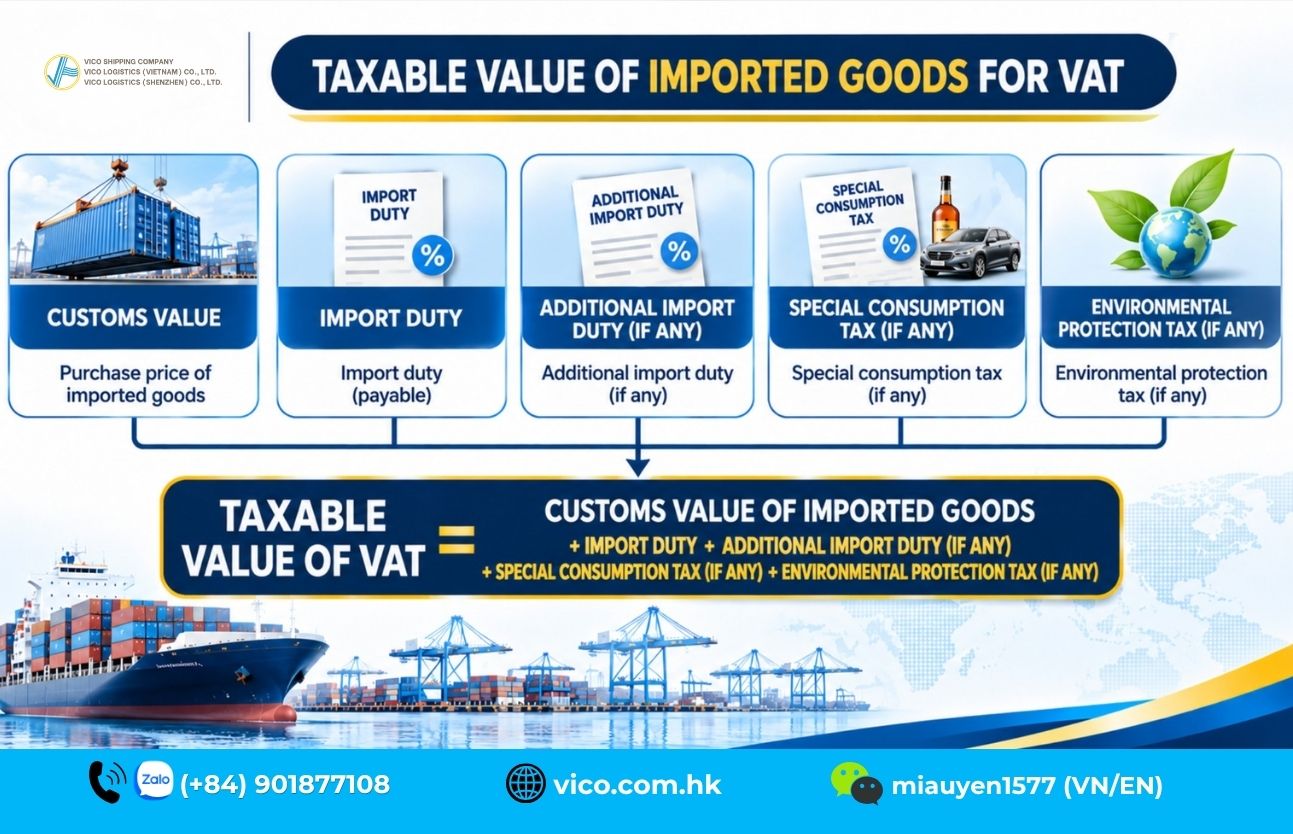
According to Clause 1, Article 7 of the Law on VAT No. 48/2024/QH15, the Import VAT taxable base equals:
- Dutiable import value (Customs value).
- Import duty.
- Additional import duties (if any).
- Special Consumption Tax (SCT, if any).
- Environmental Protection Tax (EPT, if any).
Formula representation:
Import VAT Taxable Base = Import Dutiable Value + Import Duty + Additional Import Duty + Special Consumption Tax + Environmental Protection Tax.
Where:
- Import Dutiable Value: Customs value determined pursuant to import/export tax legislation. In international trade, this value is typically built upon the transaction price plus statutory adjustments.
- Import Duty: Calculated based on HS Code, country of origin, and applicable duty rates.
- Additional Import Duty: Applies to goods subject to safeguard, anti-dumping, or countervailing duties.
- Special Consumption Tax: Included in the VAT base only if the commodity is subject to SCT.
- Environmental Protection Tax: Added to the base value if the item is subject to EPT.
Note: Domestic inland freight, warehouse fees, customs clearance charges, or logistics service fees incurred post-importation should not be added automatically to the Import VAT base. Customs value must be distinguished from post-importation operational expenses.
5. Import VAT Calculation Formula
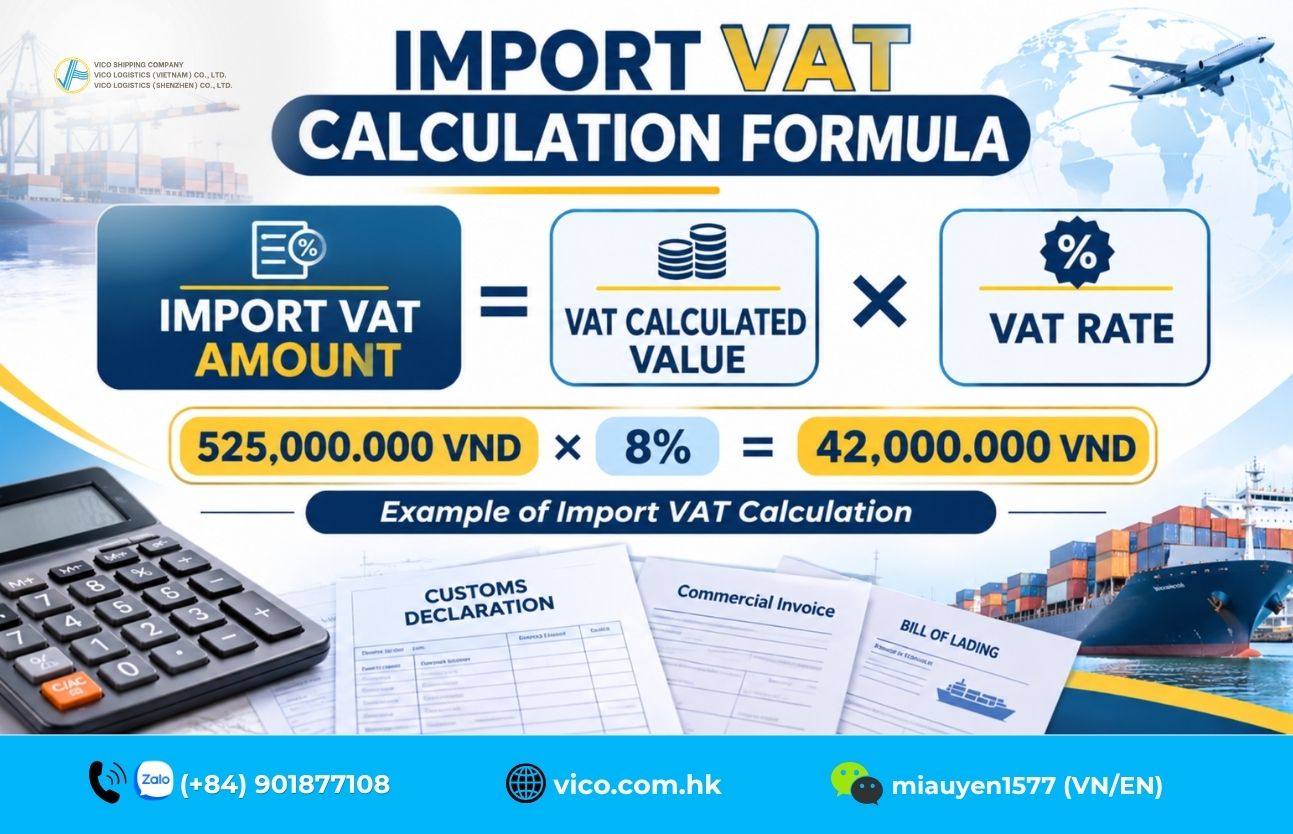
Once the taxable base and tax rate are determined, apply the following formula:
Import VAT Payable = Import VAT Taxable Base × Applicable VAT Rate.
Where:
- Import VAT Taxable Base: Total assessable value established by law.
- VAT Rate: 5%, 8%, or 10% based on commodity classification and tax policy.
5.1. Formula for Calculating Taxable Base
Import VAT Taxable Base = Import Dutiable Value + Import Duty + Additional Import Duty (if any) + Special Consumption Tax (if any) + Environmental Protection Tax (if any).
5.2. Practical Import VAT Calculation Example
Assume Enterprise A imports a shipment from China with the following parameters:
|
Item / Description
|
Value (VND)
|
|---|---|
|
Import Dutiable Value (Customs Value)
|
500,000,000 VND
|
|
Import Duty Rate
|
5%
|
|
Import Duty Payable
|
25,000,000 VND
|
|
Additional Import Duty
|
0 VND
|
|
Special Consumption Tax (SCT)
|
0 VND
|
|
Environmental Protection Tax (EPT)
|
0 VND
|
|
Applicable VAT Rate
|
8%
|
Step 1: Calculate Import Duty
500,000,000 × 5% = 25,000,000 VND.
Step 2: Determine Import VAT Taxable Base
500,000,000 + 25,000,000 = 525,000,000 VND.
Step 3: Calculate Import VAT Payable
525,000,000 × 8% = 42,000,000 VND.
Summary Result:
- Import Dutiable Value: 500,000,000 VND.
- Import Duty: 25,000,000 VND.
- Import VAT: 42,000,000 VND.
- Total Tax Liabilities (Duty + VAT): 67,000,000 VND.
Thus, Enterprise A must prepare 67,000,000 VND for customs tax payments, excluding terminal handling charges, customs clearance fees, and inland transportation costs.
Disclaimer: This scenario serves as an illustrative calculation example. The 5% import duty and 8% VAT are assumed figures. Actual liabilities must be calculated using exact HS codes, origin certificates, and tax schedules at declaration registration.
6. Declaration Timing and Import VAT Payment Deadlines
Importers must adhere to declaration timelines and payment deadlines to prevent late payment penalties or customs clearance delays.
Under VAT law, the tax point for imported goods is established at the time of customs declaration registration.
Tax payment deadlines depend on tax administration laws and the importer's compliance status.
Generally, tax obligations must be fully satisfied prior to customs clearance or goods release, unless credit guarantees or authorized payment deferrals apply.
Enterprises should proactively prepare:
- Customs declaration dossier.
- Commercial Invoice.
- Packing List.
- Bill of Lading.
- Certificate of Origin (C/O), if applicable.
- Specialized inspection permits, if required.
- Liquidity to settle tax obligations.
Thorough preparation prior to cargo arrival prevents clearance bottlenecks and minimizes demurrage, detention, and storage costs.
7. Is Import VAT Deductible/Creditable?
Yes. Businesses can claim input VAT credits for Import VAT paid at clearance, provided all legal conditions are fulfilled.
According to Article 14 of the Law on VAT and guiding provisions in Decree No. 181/2025/ND-CP, key deduction criteria include:
- Valid Import VAT Payment Voucher: Possessing legitimate receipts/vouchers proving Import VAT settlement at customs.
- Non-Cash Payment Documentation: For purchases (including imports) valued at 5,000,000 VND or higher (VAT inclusive), non-cash payment proofs (bank wire transfers) are mandatory, except for specified statutory exceptions.
- Usage for VAT-Liable Business Activities: Input VAT must relate directly to producing or trading VAT-dutiable goods and services.
Example:
Enterprise A imports raw materials to manufacture VAT-liable goods.
- Import VAT paid at clearance: 42,000,000 VND.
- Valid tax payment voucher available.
- Bank transfer payment conditions met.
Upon satisfying these requirements, Enterprise A can declare a 42,000,000 VND input VAT credit on its periodic tax return.
Note: Deductibility does not exempt the enterprise from paying Import VAT during initial customs clearance. Import VAT must be settled upfront before claiming input tax credits.
8. Common Mistakes When Calculating Import VAT
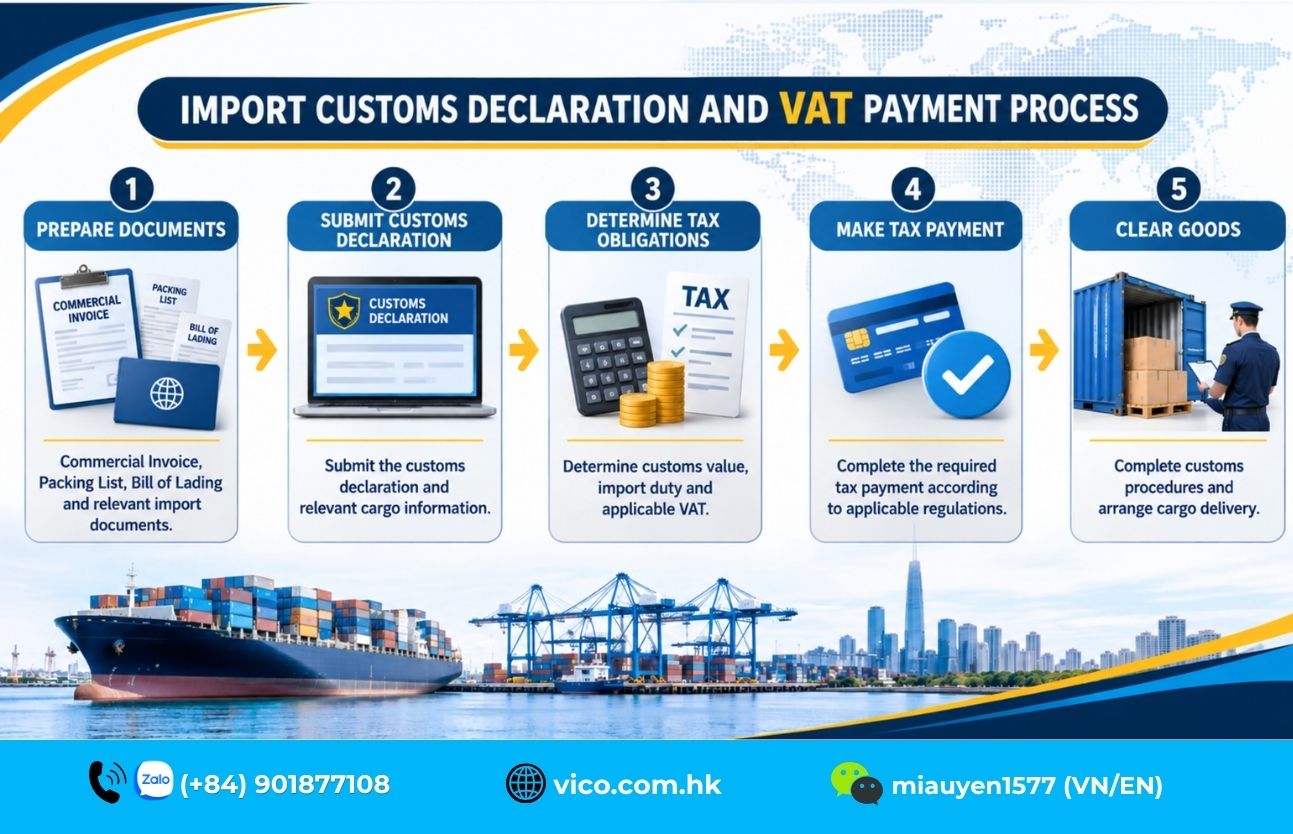
Importers frequently encounter errors leading to inaccurate cost projections or customs clearance disputes.
8.1. Confusing Import Duty with Import VAT
These are distinct tax categories with separate calculation bases.
Import Duty is assessed directly on the customs dutiable value and duty rate.
Import VAT is assessed on the composite VAT base, which includes the customs value plus import duties and other applicable taxes.
8.2. Applying the 8% VAT Rate Universally
The temporary 2% VAT reduction does not cover all imported goods.
Businesses must cross-check their items against statutory exclusion lists, particularly metals, mining products, and SCT-dutiable commodities.
8.3. Misclassifying HS Codes
HS code classification forms the legal foundation for tax rates, duty exemptions, and specialized management policy application.
Incorrect classification results in duty miscalculations, tax penalties, or required supplementary declarations.
8.4. Omitting Tax Components in Cost Estimates
Some importers only calculate purchase prices and freight charges while neglecting total tax liabilities.
This oversight inflates actual landed costs and erodes profit margins.
Before placing orders, prepare a cost estimate including:
- Import customs dutiable value.
- Import duties.
- Additional import duties (if any).
- Special Consumption Tax (if any).
- Environmental Protection Tax (if any).
- Import VAT.
- International freight charges.
- Customs clearance and local transport fees.
- Demurrage, detention, and warehousing costs.
9. Frequently Asked Questions (FAQ) about Import VAT
9.1. What are the current Import VAT rates?
Import VAT rates are 5%, 8%, or 10% depending on commodity classification and current tax reduction policies. Specific items qualify for non-taxable status under VAT regulations.
9.2. Is Import VAT calculated solely on the CIF price?
No. Import VAT is not calculated by multiplying CIF value directly by the VAT rate.
The Import VAT taxable base equals the import dutiable value plus import duty, additional import duty (if any), special consumption tax (if any), and environmental protection tax (if any).
While dutiable value often derives from CIF price, statutory valuation adjustments may apply.
9.3. Is import duty added to the VAT taxable base?
Yes. Import duty is added to the VAT taxable base pursuant to Article 7 of the Law on VAT.
9.4. Do imported goods qualify for the 8% VAT rate?
Yes, provided the item belongs to the tax reduction scope (reduced from 10% to 8%) under active regulations. Not all commodities qualify.
9.5. Is input VAT deductible for VAT-exempt imported goods?
In principle, input VAT incurred for non-taxable (exempt) goods and services is non-deductible and non-refundable, unless statutory exceptions apply.
9.6. Must Import VAT be paid prior to customs clearance?
Generally, import tax obligations must be fully cleared before goods release or clearance, unless bank guarantees or credit deferrals apply.
9.7. Can Import VAT be estimated in advance?
Yes. Enterprises can project VAT liabilities prior to vessel arrival using estimated customs values, tariff rates, and tax formulas.
However, official tax liabilities depend on finalized customs valuation, HS codes, origin proofs, and tax laws effective at declaration registration.
10. VICO Logistics – Partnering in Import Cost Management
Calculating Import VAT is just one aspect of total import cost budgeting. To effectively control budgets and mitigate operational risks, businesses must evaluate HS codes, origin criteria, duty schedules, specialized inspections, customs documentation, and freight solutions concurrently.
VICO Logistics provides comprehensive logistics solutions and end-to-end import/export customs brokerage, streamlining international transport and customs clearance.
Our core services include:
- International sea and land freight consulting.
- Customs declaration filing and import/export documentation assistance.
- Commodity verification, HS code lookup, and regulatory policy support.
- Cross-border freight management across Vietnam – China – Cambodia and global shipping corridors.
- Integrated freight forwarding, clearance execution, and door-to-door delivery.
If your business is preparing an import shipment and requires accurate landed cost projections, tax advice, or customs clearance solutions, contact VICO Logistics today for expert support.
- Factory Coffee: The Global Coffee Harvest Calendar
- What's So Good About Vietnam Manufacturers
- Electronics Shipping: Mastering The Logistics Of High-Value Technology
- Door To Door Cambodia Shipping: The Ultimate Logistics Solution For 2026
- Trucking Cambodia - Vietnam: Fast & Reliable Cross-Border Solutions 2026
- What Are Green, Yellow, and Red Customs Channels? Differences & Handling Guide
- What Is a Customs Declaration? A Complete A–Z Guide for Businesses
- What Is an HS Code? How to Find HS Codes, Calculate Duties, and Avoid Incorrect Declarations
- What Is a Sales Contract? 12 Key Details to Check Before Signing
- What Is MSDS/SDS? 16 Sections and Its Role in Import and Export
- What Is an Insurance Certificate? How to Verify and Use It
- What Is an Air Waybill (AWB)? How to Read & Track an AWB
Get a Logistics Quote in just 5 minutes
Professional international transportation and supply chain solutions tailored for your business.
Get a quote now ↗Quick Contact
🇻🇳 Ms Uyen
Hotline / Zalo
(+84) 901 877 108WeChat (VN/EN)
miauyen1577Scan to Contact
Zalo
🇨🇳 Ms Schyler
Office Hotline
(+852) 3759 9300WeChat ID
Schyler_skylarScan to Contact
VICO International Logistics — Your Trusted Logistics Partner in Indochina
Senior member of international logistics and trade associations: Eurocham, JCtrans, VICOFA, VITAS, and more.