

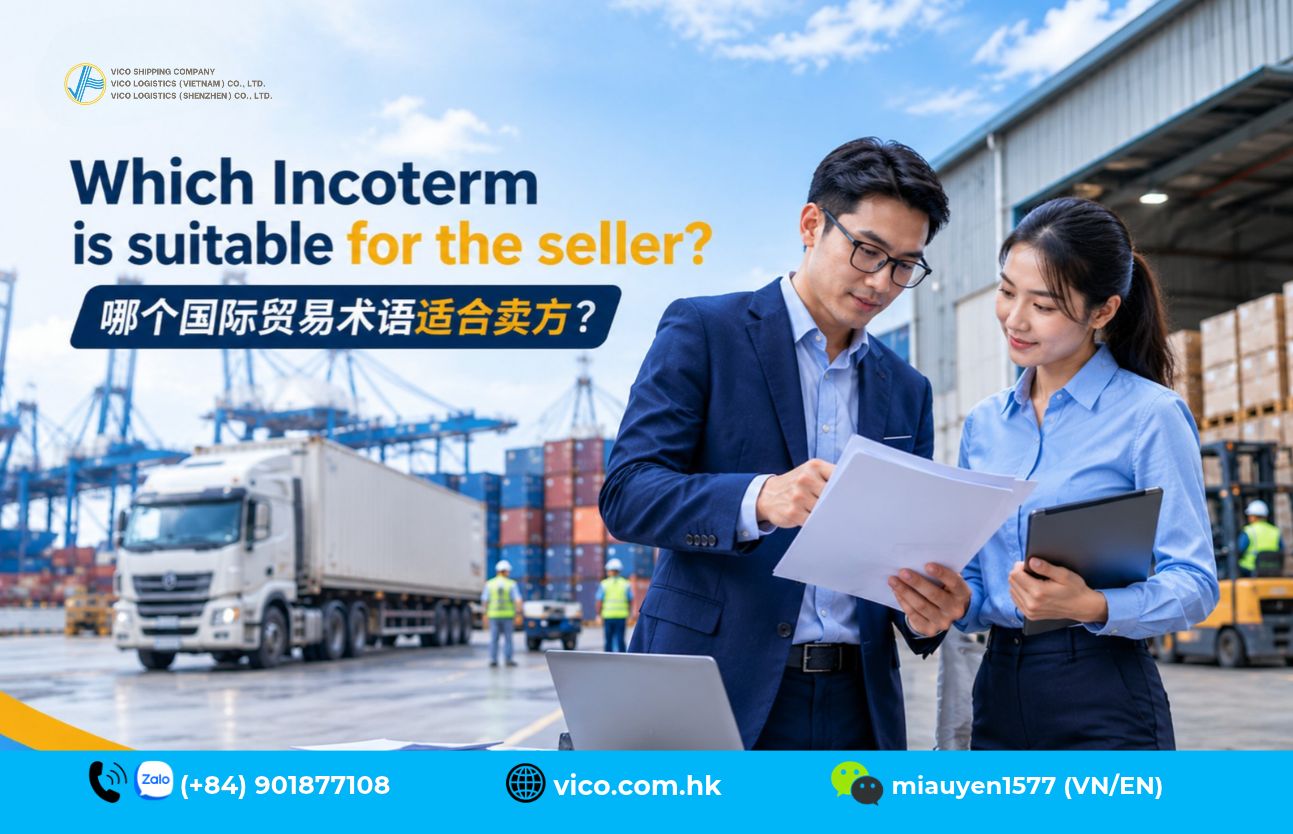
When exporting goods, choosing the appropriate Incoterms rule directly impacts transportation costs, delivery responsibilities, and the level of risk borne by the seller. A well-suited delivery term not only helps businesses control costs but also minimizes disputes and enhances negotiation efficiency with international partners.
So, which Incoterm is best for sellers? Should you choose EXW, FCA, FOB, or CIF when exporting goods? Which condition helps sellers minimize responsibilities, proactively control logistics, and optimize profits?
In practice, there is no single "best" Incoterms rule for every seller. The right choice depends on transportation capabilities, cargo types, handling methods, export customs clearance capacity, and mutual agreements between both parties.
In this article, VICO Logistics analyzes popular Incoterms rules from a seller's perspective, helping businesses select the optimal delivery option for their export operations.
1. Which Incoterm is Suitable for Sellers?
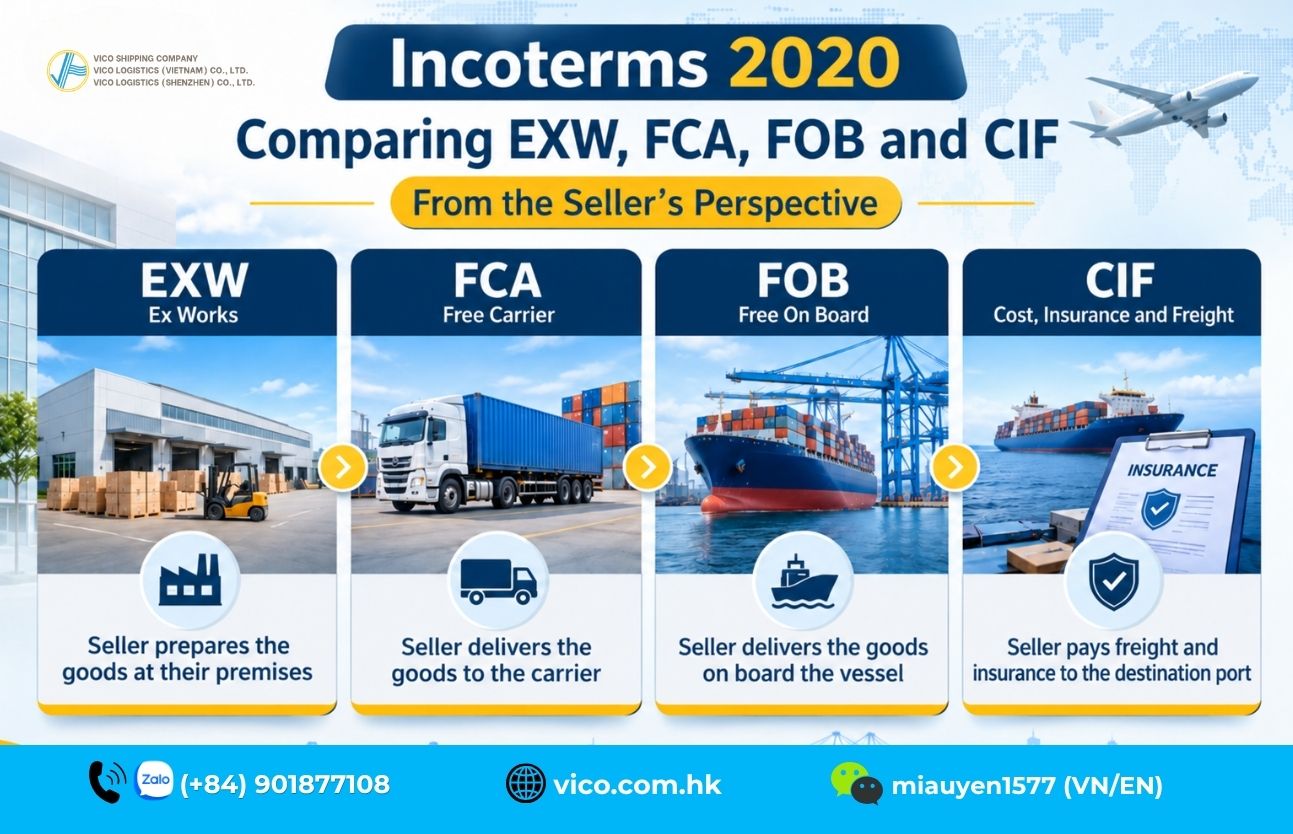
If a seller aims to minimize responsibilities and shipping costs to the absolute minimum, EXW represents the lowest obligation level for the seller.
However, for international export operations, FCA is typically a more practical and flexible choice, especially when cargo is transported in containers or via multi-modal transport.
Meanwhile:
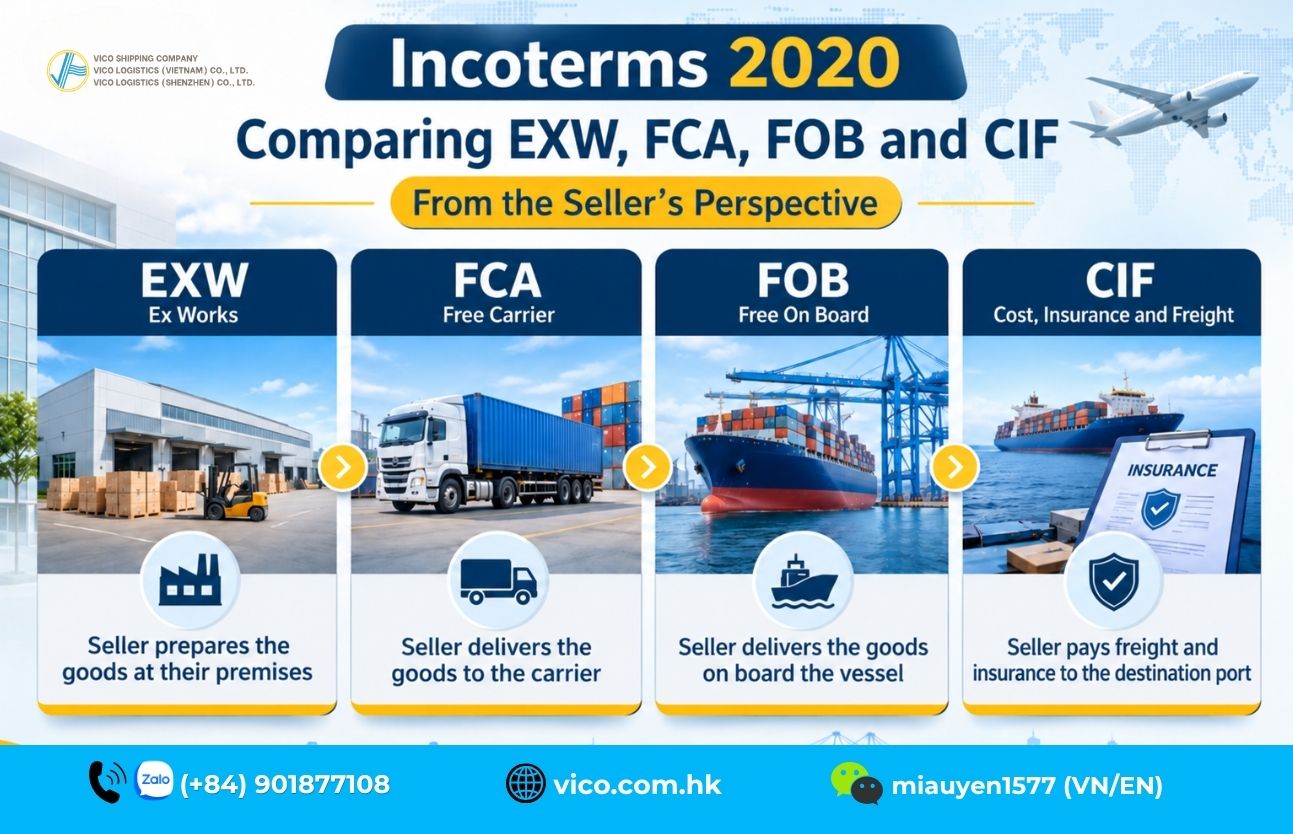
- EXW (Ex Works): Suitable when the seller wants to deliver goods at their factory or warehouse and limit transport responsibilities.
- FCA (Free Carrier): Suitable for exporting enterprises wishing to complete export customs clearance and hand over goods to a carrier nominated by the buyer.
- FOB (Free On Board): Suitable for maritime shipments loaded directly onto the vessel at the port of departure.
- CIF (Cost, Insurance and Freight): Suitable when the seller wants to proactively charter vessels, pay freight, and purchase insurance to the destination port.
Summary Table of Incoterms Suiting Sellers
|
Term
|
Seller's Responsibility
|
Suitable When
|
|---|---|---|
|
EXW
|
Minimum
|
Delivering at works / factory
|
|
FCA
|
Low to Moderate
|
Exporting containerized cargo
|
|
FOB
|
Moderate
|
Cargo loaded directly onto vessel
|
|
CIF
|
Higher
|
Seller controls freight and insurance
|
Note: Responsibility levels in the table are relative. Actual obligations depend on the agreed delivery terms, specified locations, and contract clauses.
An essential point to understand is that Incoterms allocate obligations, costs, and risks between sellers and buyers. The party paying for freight does not automatically bear the risk of goods throughout the entire transit.
2. What Factors Should Sellers Consider When Choosing Incoterms?
Before deciding on a delivery term, businesses must evaluate several critical factors.
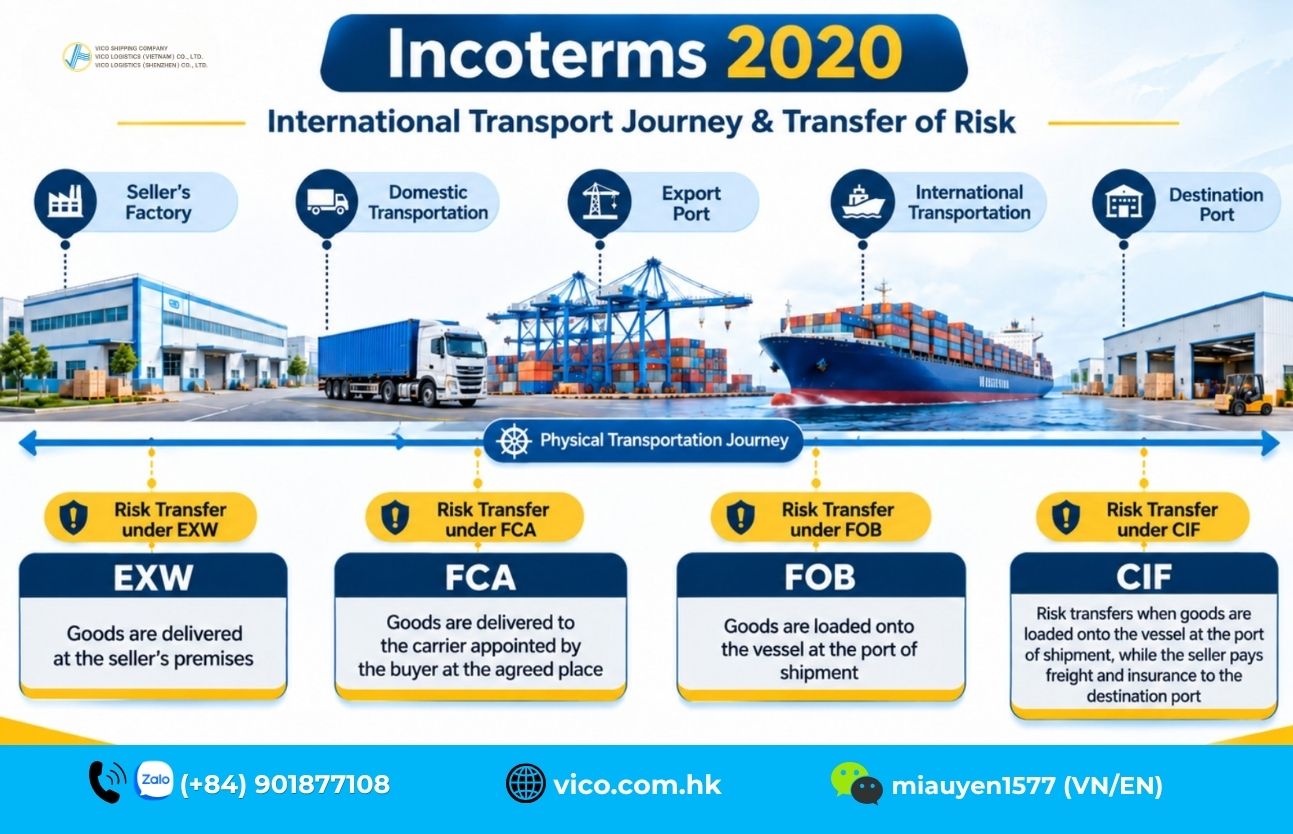
2.1. Transportation Costs and Budget Control
Logistics expenses can account for a significant portion of total export order values.
If selecting a term requiring the seller to pay international freight, businesses must calculate:
- Inland transport costs from factory to port.
- Export customs declaration and clearance fees.
- Terminal handling charges (THC) at the port.
- International freight rates.
- Cargo insurance premiums if obligation to insure applies.
- Documentation and forwarding fees.
Under EXW, the seller has the lowest transport obligation. Conversely, under CIF, the seller must contract and pay for carriage and insurance to the agreed destination port.
Therefore, businesses must compare total logistics expenses against selling prices to determine the appropriate term.
2.2. Risk Transfer Timing
This is a particularly crucial factor in export transactions.
Sellers must precisely identify the exact moment when risk responsibility shifts to the buyer.
For example:
- EXW: Risk transfers when goods are placed at the buyer's disposal at the designated delivery point, unloaded from the collecting vehicle.
- FCA: Risk transfers when goods are delivered to the carrier or another person nominated by the buyer at the agreed location.
- FOB: Risk transfers when goods are loaded on board the vessel at the port of departure.
- CIF: Risk also transfers when goods are loaded on board the vessel at the port of departure, even though the seller pays freight and insurance to the destination port.
Hence, sellers should not look solely at the destination place to determine risk transfer timing.
2.3. Customs Procedures and Export Documentation
The capacity to handle export customs procedures also influences Incoterms selection.
Under EXW, the seller has no obligation to perform export clearance. However, in cross-border transactions, this may cause difficulties if the buyer cannot directly execute procedures in the exporting country.
Under FCA, FOB, CIF, and other export terms, the seller is responsible for executing export customs clearance pursuant to regulations.
Businesses should consider:
- Do we have sufficient customs declaration capabilities?
- Can we prepare export documents on time?
- Do we meet specialized licensing requirements?
- Is there a logistics provider supporting export procedures?
2.4. Logistics Control Capabilities
If a business maintains a strong network of shipping partners, selecting CFR or CIF can offer better proactiveness in booking, carrier selection, and pricing strategies.
Conversely, if a business lacks extensive international transport experience, FCA or FOB can help reduce responsibilities regarding the international main carriage leg.
The key is selecting terms matching operational capabilities rather than taking on extra responsibilities solely for negotiation leverage.
3. Comparing 4 Popular Incoterms Rules for Sellers
3.1. EXW – Ex Works: Minimum Seller Obligations
EXW (Ex Works) means the seller delivers goods when placing them at the disposal of the buyer at a named place, usually the seller's factory, warehouse, or business premises.
Under EXW Incoterms 2020, the seller is not obliged to load the goods on collecting vehicles and has no obligation to clear the goods for export.
Seller's Responsibilities:
- Prepare goods according to the sales contract.
- Package and mark goods appropriately.
- Place goods at the buyer's disposal at the delivery location.
- Provide commercial invoices and agreed documentation.
Advantages for Sellers:
- Reduced transportation responsibilities.
- No need to hire transport vehicles.
- No international freight costs.
- Early risk transfer.
Disadvantages:
- The buyer must organize cargo collection and export clearance based on EXW allocation.
- Potential difficulties if an overseas buyer cannot directly handle export clearance in the seller's country.
- Limited control over transit after delivery.
When to use EXW?
EXW suits buyers capable of organizing collection at the seller's premises and executing required export formalities.
For cross-border export transactions, businesses should consider FCA instead of defaulting to EXW.
3.2. FCA – Free Carrier: Flexibility for Exporting Businesses
FCA (Free Carrier) means the seller delivers the goods to the carrier or another person nominated by the buyer at an agreed place.
The seller is responsible for export customs clearance.
This is a highly recommended term for enterprises exporting containerized cargo and multi-modal shipments.
Seller's Responsibilities:
- Prepare goods and documents as contracted.
- Perform export customs clearance.
- Deliver goods to the buyer-nominated carrier at the agreed location.
- Bear costs and risks up to the delivery point under FCA rules.
Advantages for Sellers:
- Proactive handling of export customs.
- No international freight payment under default FCA obligations.
- Ability to deliver at factories or other designated places.
- Compatible with containers, road, rail, air, and multimodal transport.
Disadvantages:
- The seller must still arrange delivery to the agreed handover point.
- Requires coordination with the buyer's nominated carrier.
- Must execute export customs clearance.
When to use FCA?
FCA fits manufacturers or trading companies exporting containerized goods, especially when goods are handed over to carriers at warehouses, container yards (CY), or agreed logistics facilities.
Example: A Vietnamese enterprise exports containerized cargo to China. The buyer nominates the shipping line and international forwarder. The seller prepares goods, files export customs, and hands over the container at the agreed location.
In this case, FCA is often more appropriate than FOB if cargo is handed over at the container yard prior to vessel loading.
3.3. FOB – Free On Board: Popular in Maritime Exports
FOB (Free On Board) applies exclusively to sea and inland waterway transport.
Under FOB Incoterms 2020, the seller delivers goods when they are placed on board the vessel nominated by the buyer at the agreed port of shipment.
Seller's Responsibilities:
- Prepare and package cargo.
- Transport goods to the export port as agreed.
- Execute export customs clearance.
- Bear necessary expenses to load cargo onto the vessel.
- Provide shipping documents as prescribed.
Advantages for Sellers:
- No international ocean freight payments.
- No obligation to purchase cargo insurance under FOB.
- Risk transfers upon vessel loading.
- Proactivity in organizing domestic transport and export stages.
Disadvantages:
- The seller bears costs and risks until goods are on board.
- Requires close coordination with shipping lines, ports, and forwarders.
- Potential cost overruns if cargo misses vessel closing times.
When to use FOB?
FOB fits cargo loaded directly onto vessels, such as bulk goods, breakbulk, or shipments organized via vessel-loading structures.
Crucial Note: Do not use FOB mechanically for containerized shipments.
For containers handed over to carriers at container yards before vessel loading, FCA is usually more appropriate since sellers do not directly control the exact container loading moment onto the ship.
3.4. CIF – Cost, Insurance and Freight: Seller Controls Freight & Insurance
CIF applies exclusively to sea and inland waterway transport.
Under CIF, the seller must:
- Deliver goods on board the vessel at the port of shipment.
- Perform export customs clearance.
- Contract and pay freight costs to the named destination port.
- Procure cargo insurance matching minimum Institute Cargo Clauses coverage, unless agreed otherwise.
A distinctive feature of CIF is that the seller pays transport and insurance costs to the destination port, but cargo risk transfers to the buyer immediately upon loading at the origin port.
Advantages for Sellers:
- Proactive selection of shipping lines and transport routes.
- Ability to quote prices inclusive of freight and insurance.
- Enhanced capability to provide turnkey delivery solutions.
- Value-added service enhancement in commercial transactions.
Disadvantages:
- Must advance or pay international freight.
- Must purchase mandatory insurance under CIF.
- Requires management of shipping schedules, transport docs, and insurance policies.
- Subject to ocean freight rate fluctuations.
When to use CIF?
CIF suits sellers experienced in organizing maritime transport, capable of negotiating favorable freight rates, and wishing to offer destination-inclusive pricing to buyers.
Example: A Vietnamese enterprise exports goods to Singapore. The seller books space with the shipping line, pays ocean freight, and buys insurance to Singapore port. The buyer takes delivery at the destination port.
However, sellers must understand that paying freight to Singapore does not mean bearing cargo risks all the way to Singapore.
4. Other Incoterms Rules Sellers Should Know
Beyond EXW, FCA, FOB, and CIF, sellers should understand remaining terms to choose fitting options.
4.1. FAS – Free Alongside Ship
The seller delivers when goods are placed alongside the vessel nominated by the buyer at the shipment port.
The seller handles export clearance and bears costs/risks until goods are alongside.
FAS suits specific bulk goods or specialized port-handling methods.
4.2. CFR – Cost and Freight
CFR shares identical risk allocation with CIF, but the seller has no obligation to insure the cargo for the buyer.
The seller pays freight to the destination port while risk transfers upon loading at origin.
4.3. CPT – Carriage Paid To
The seller contracts and pays carriage to the named destination place.
However, risk transfers when goods are handed over to the carrier under CPT rules, not upon arrival.
4.4. CIP – Carriage and Insurance Paid To
Similar to CPT, but the seller must also procure cargo insurance under CIP Incoterms 2020 rules.
CIP default insurance coverage is typically broader than CIF.
4.5. DAP – Delivered at Place
The seller arranges transport to the agreed destination place. Goods are delivered when placed at the buyer's disposal on arriving transport, ready for unloading.
The seller bears risks to destination, while the buyer handles unloading and import clearance.
4.6. DPU – Delivered at Place Unloaded
The seller bears responsibility for bringing goods to destination and unloading them.
This term requires careful consideration since sellers assume added unloading responsibilities at destination.
4.7. DDP – Delivered Duty Paid
DDP places maximum responsibilities on the seller for delivering goods to destination.
The seller handles transport, risks, export/import customs clearance, and pays import duties and related taxes.
DDP should only be chosen when sellers can fully satisfy legal, tax, and import requirements in the destination country.
5. Should You Choose EXW, FCA, FOB, or CIF?
To choose accurately, businesses must define their objectives and logistics capabilities.
Detailed Comparison Table: EXW, FCA, FOB, and CIF
|
Criteria
|
EXW
|
FCA
|
FOB
|
CIF
|
|---|---|---|---|---|
|
Works Delivery
|
Possible
|
Possible
|
No
|
No
|
|
Export Clearance
|
Buyer (by rule implication)
|
Seller
|
Seller
|
Seller
|
|
International Carriage Contract
|
Buyer
|
Buyer
|
Buyer
|
Seller
|
|
International Freight Payment
|
Buyer
|
Buyer
|
Buyer
|
Seller
|
|
Insurance Obligation
|
No
|
No
|
No
|
Yes
|
|
Risk Transfer Timing
|
At EXW delivery point
|
At FCA delivery point
|
Upon vessel loading
|
Upon vessel loading
|
|
Transport Mode
|
Any mode
|
Any mode
|
Sea & inland waterway
|
Sea & inland waterway
|
Scenario-Based Recommendations
- Scenario 1: Business only wants to deliver at factory
Consider EXW if the buyer has sufficient capability to collect goods and handle export formalities. - Scenario 2: Exporting containerized cargo
Consider FCA as it suits handing over containers to carriers at warehouses or container yards. - Scenario 3: Exporting bulk cargo by sea
Consider FOB if cargo is loaded directly onto vessels and both parties clearly define the loading port. - Scenario 4: Wanting control over ocean freight and insurance
Choose CIF if cargo suits maritime transport and the business possesses organizational capabilities. - Scenario 5: Selling on port-delivery pricing without insurance obligation
Consider CFR instead of CIF.
Therefore, Incoterms selection should not rely solely on minimizing seller costs. Enterprises must review transport organization capabilities, negotiation leverage, and cargo control levels.
6. Practical Incoterms Selection Example for Sellers
Assume a Vietnamese enterprise produces and exports 2 containers of goods to China.
Company profile characteristics:
- Factory located in Vietnam.
- Cargo packed in 40-foot containers.
- Buyer has international transport partners.
- Seller can handle export customs declarations.
- Buyer wants to proactively select shipping lines.
In this scenario, FCA is a suitable option.
If using FCA:
- Seller prepares goods at the factory.
- Seller executes export customs clearance.
- Seller transports goods to the agreed handover location.
- Seller delivers goods to the buyer-nominated carrier.
- Risk transfers upon handover at the specified FCA point.
The buyer proceeds with international transport under contracts with carriers or forwarders.
If using FOB:
The seller must arrange loading onto the vessel at the export port. However, if containers are handed over at container yards prior to loading, FCA reflects actual handover points more accurately.
If using CIF:
The seller must charter vessels, pay freight, and buy insurance to destination. This suits enterprises wanting to offer inclusive delivery pricing.
Through this example, FCA stands out as a recommended option for containerized exports when buyers wish to control international main carriage.
7. Common Mistakes Sellers Must Avoid
7.1. Assuming EXW is Always Most Beneficial
EXW reduces seller obligations but creates hurdles in export clearance if buyers cannot handle formalities locally.
Thus, weigh FCA for cross-border transactions.
7.2. Using FOB for All Containerized Cargo
FOB applies strictly to maritime and inland waterway transport via vessel loading.
If containers are handed over at container yards prior to loading, FCA is more fitting.
7.3. Confusing Freight Payers with Risk Bearers
This is a frequent source of disputes.
For instance, under CIF, the seller pays freight and insurance to destination, yet risk transfers upon vessel loading at origin.
7.4. Omitting Precise Delivery Locations
Writing merely FCA Vietnam or FOB Vietnam is insufficient.
Specify exact locations or ports.
Examples:
- FCA VICO-designated warehouse, Ho Chi Minh City, Vietnam (use exact agreed address).
- FOB Cat Lai Port, Ho Chi Minh City, Vietnam.
- CIF Shanghai Port, China.
Specific delivery points clarify obligations, costs, and risk transfer timing.
7.5. Failing to Harmonize Document Responsibilities
Sellers and buyers must agree on required document types, issuance timing, and transfer methods.
Common documents include:
- Commercial Invoice.
- Packing List.
- Bill of Lading (B/L).
- Certificate of Origin (C/O).
- Insurance Certificate (if applicable).
- Specialized licenses and regulatory certificates.
8. How to Incorporate Incoterms into Export Contracts
After choosing appropriate terms, explicitly state delivery rules in sales contracts.
Basic Structure: [Incoterms Rule] + [Named Place/Port] + Incoterms® 2020
Examples:
- EXW Seller's Factory, Binh Duong, Vietnam – Incoterms® 2020.
- FCA Cat Lai Container Terminal, Ho Chi Minh City, Vietnam – Incoterms® 2020.
- FOB Cat Lai Port, Ho Chi Minh City, Vietnam – Incoterms® 2020.
- CIF Shanghai Port, China – Incoterms® 2020.
Contracts should additionally stipulate:
- Delivery schedules.
- Packaging specifications.
- Transport requirements.
- Documentation responsibilities.
- Payment terms.
- Insurance conditions (if any).
- Procedures for delayed delivery or cost overruns.
- Force majeure clauses and party liabilities.
Note: Incoterms do not govern title transfer, payment methods, breach penalties, or full contract terms. These require separate contractual agreements.
9. Frequently Asked Questions (FAQ) for Sellers
9.1. Which Incoterm is most advantageous for sellers?
EXW imposes minimal obligations. However, in international trade, FCA is typically more practical since sellers manage export clearance and hand over cargo at suitable locations.
9.2. Should sellers choose FOB or CIF?
FOB suits sellers wanting to load cargo on board without international ocean freight or mandatory insurance obligations.
CIF suits sellers wanting to proactively charter ships, pay freight, and insure cargo to destination.
9.3. Is EXW or FCA better for sellers?
EXW involves fewer duties, but FCA aligns better with cross-border exports because sellers take charge of export customs clearance.
9.4. Must sellers buy insurance under CIF?
Yes. Under CIF Incoterms 2020, sellers must procure cargo insurance meeting minimum coverage requirements unless mutually agreed otherwise.
9.5. Does FOB apply to road transport?
No. FOB applies solely to sea and inland waterway transport. For road, air, or multimodal transport, use FCA or CPT.
9.6. Can sellers independently choose Incoterms?
Sellers can propose terms in quotations and negotiate with buyers. Final terms require mutual agreement codified in sales contracts.
9.7. Do Incoterms 2020 apply to both exports and imports?
Yes. Incoterms 2020 govern obligations, costs, and risks across both export and import transactions.
10. VICO Logistics – Supporting Businesses in Transport Planning
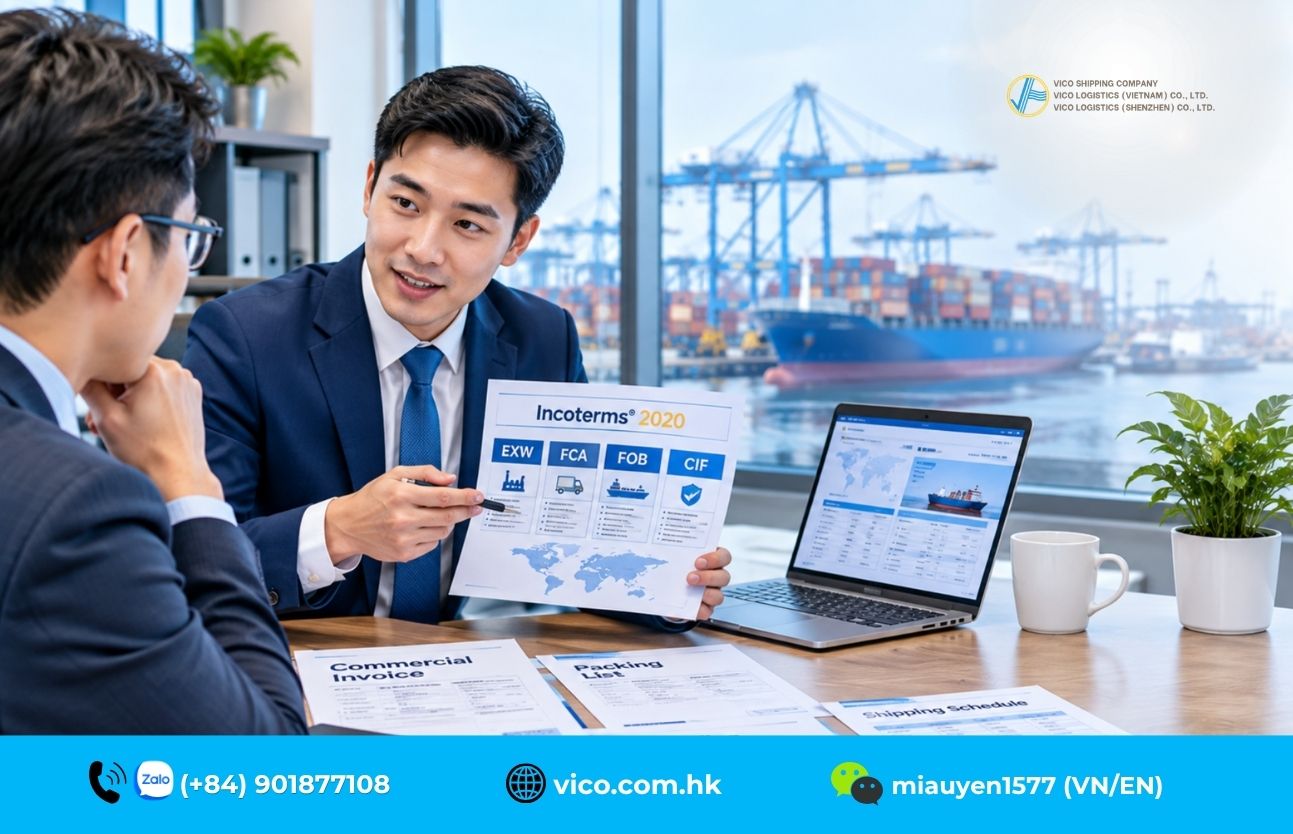
Choosing proper Incoterms goes beyond delivery rules; it directly affects how businesses organize transport, control budgets, and collaborate globally.
Particularly for enterprises exporting from Vietnam to China, Cambodia, and other international markets, selecting proper transport arrangements at the quotation stage helps curb unexpected contract expenses.
VICO Logistics assists businesses through:
- International sea and land freight consulting.
- Import/export logistics execution between Vietnam – China – Cambodia.
- Export and import customs clearance support.
- Documentation and handover coordination consulting.
- Tailored logistics planning matching delivery terms and corporate needs.
If your enterprise hesitates between EXW, FCA, FOB, or CIF, early consultation with a logistics provider clarifies transit legs, costs, and cargo handover points.
- Factory Coffee: The Global Coffee Harvest Calendar
- What's So Good About Vietnam Manufacturers
- Electronics Shipping: Mastering The Logistics Of High-Value Technology
- Door To Door Cambodia Shipping: The Ultimate Logistics Solution For 2026
- Trucking Cambodia - Vietnam: Fast & Reliable Cross-Border Solutions 2026
- Who Is Responsible for Cargo Damage? Incoterms 2020
- FCA vs FOB: Key Differences, Costs, Risks & When to Use Each
- Which Incoterm is Right for the Buyer? Selection Guide 2020
Get a Logistics Quote in just 5 minutes
Professional international transportation and supply chain solutions tailored for your business.
Get a quote now ↗Quick Contact
🇻🇳 Ms Uyen
Hotline / Zalo
(+84) 901 877 108WeChat (VN/EN)
miauyen1577Scan to Contact
Zalo
🇨🇳 Ms Schyler
Office Hotline
(+852) 3759 9300WeChat ID
Schyler_skylarScan to Contact
VICO International Logistics — Your Trusted Logistics Partner in Indochina
Senior member of international logistics and trade associations: Eurocham, JCtrans, VICOFA, VITAS, and more.