

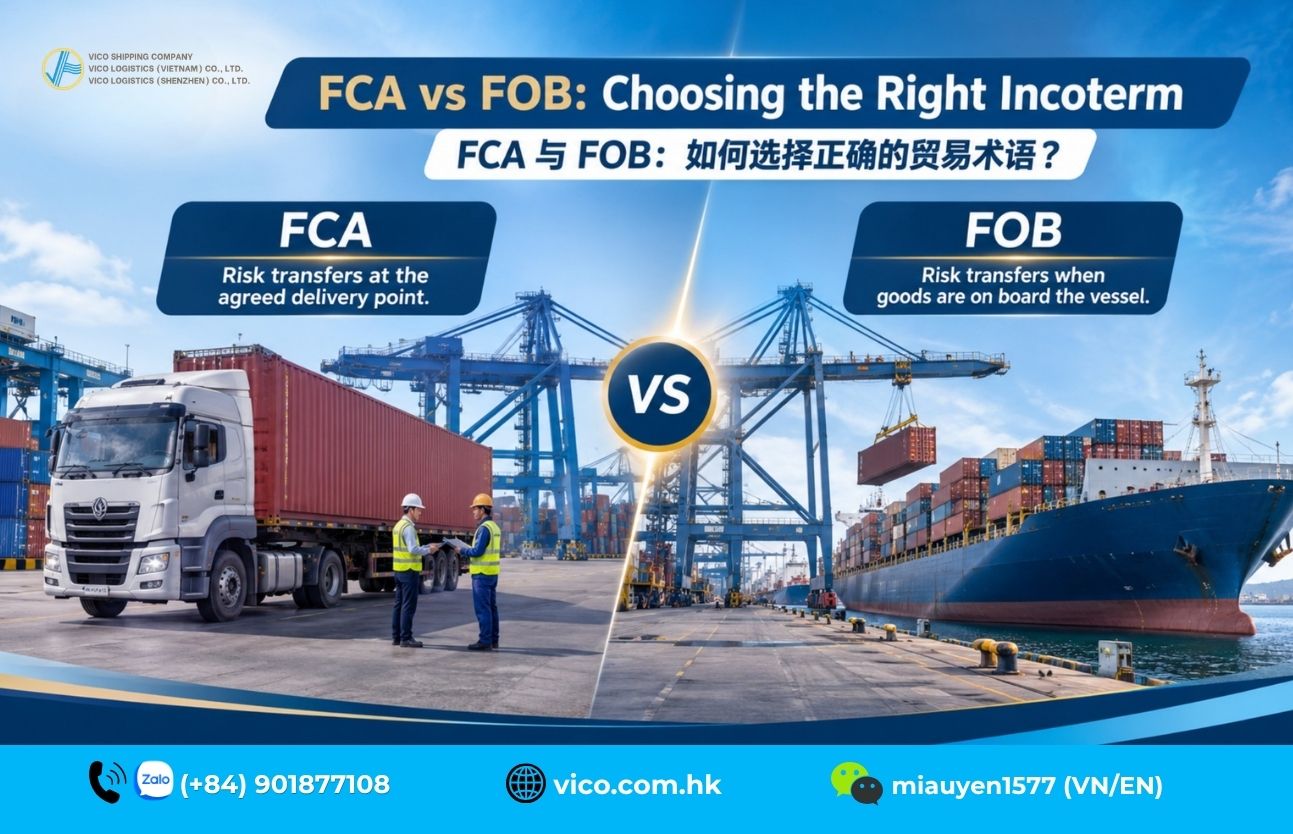
When arranging an international shipment, choosing the right Incoterms® rule is essential for managing transportation costs, delivery responsibilities, and potential risks. Two of the most frequently compared trade terms are FCA (Free Carrier) and FOB (Free On Board).
Although both terms require the seller to complete export customs clearance and generally leave the arrangement of main international transportation to the buyer, they differ significantly in terms of the delivery point, transfer of risk, and applicable modes of transport.
So, between FCA and FOB, which term should you choose for your shipment?
In general, FCA is suitable for containerized cargo, air freight, road transport, rail transport, and multimodal transportation. Meanwhile, FOB is designed exclusively for sea and inland waterway transport, where the seller delivers the goods on board the vessel nominated by the buyer.
Understanding these differences helps importers and exporters avoid unnecessary charges, minimize shipping disputes, and choose more efficient logistics solutions.
Let's explore the key differences between FCA and FOB under Incoterms® 2020.
1. What Are FCA and FOB Incoterms?
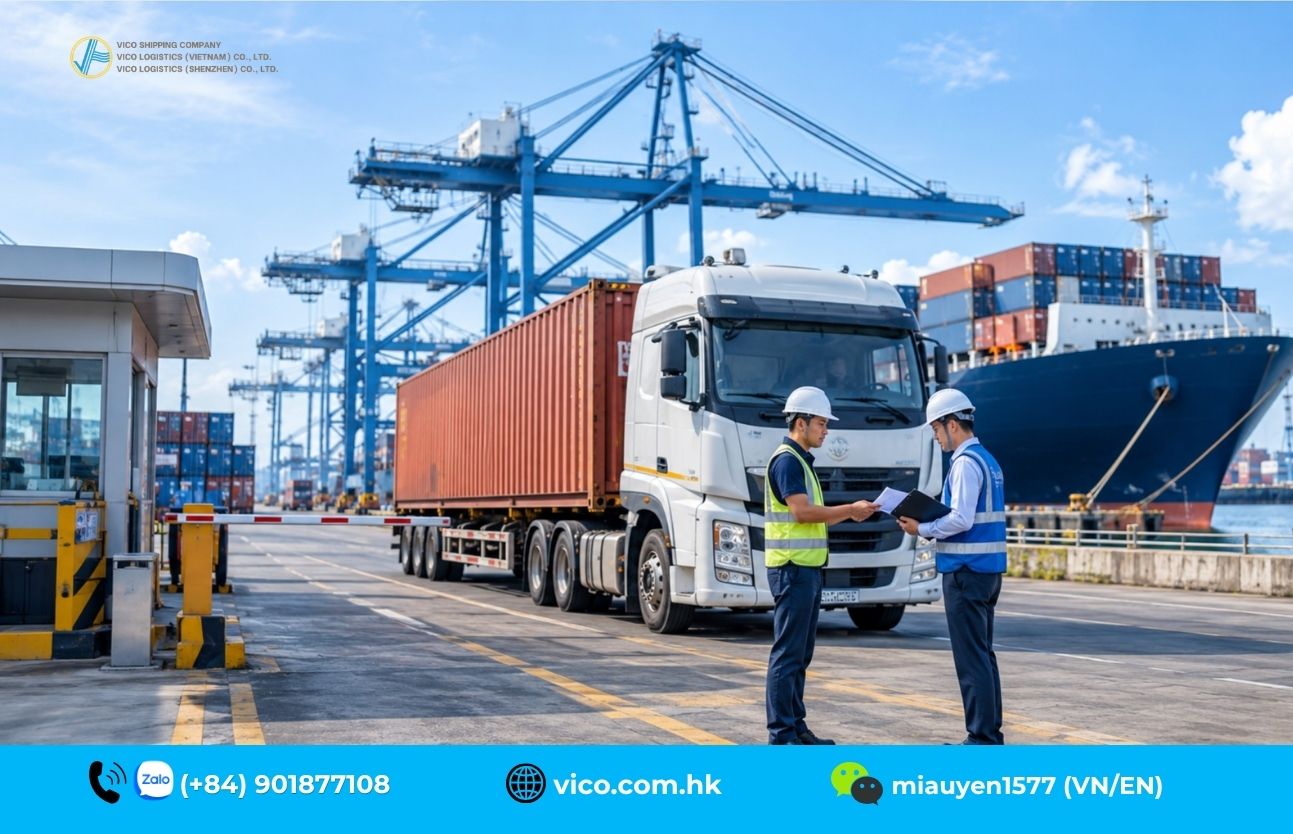
Before comparing FCA and FOB, it is important to understand what each term means and how responsibilities are divided between the seller and the buyer.
1.1. What Is FCA (Free Carrier)?
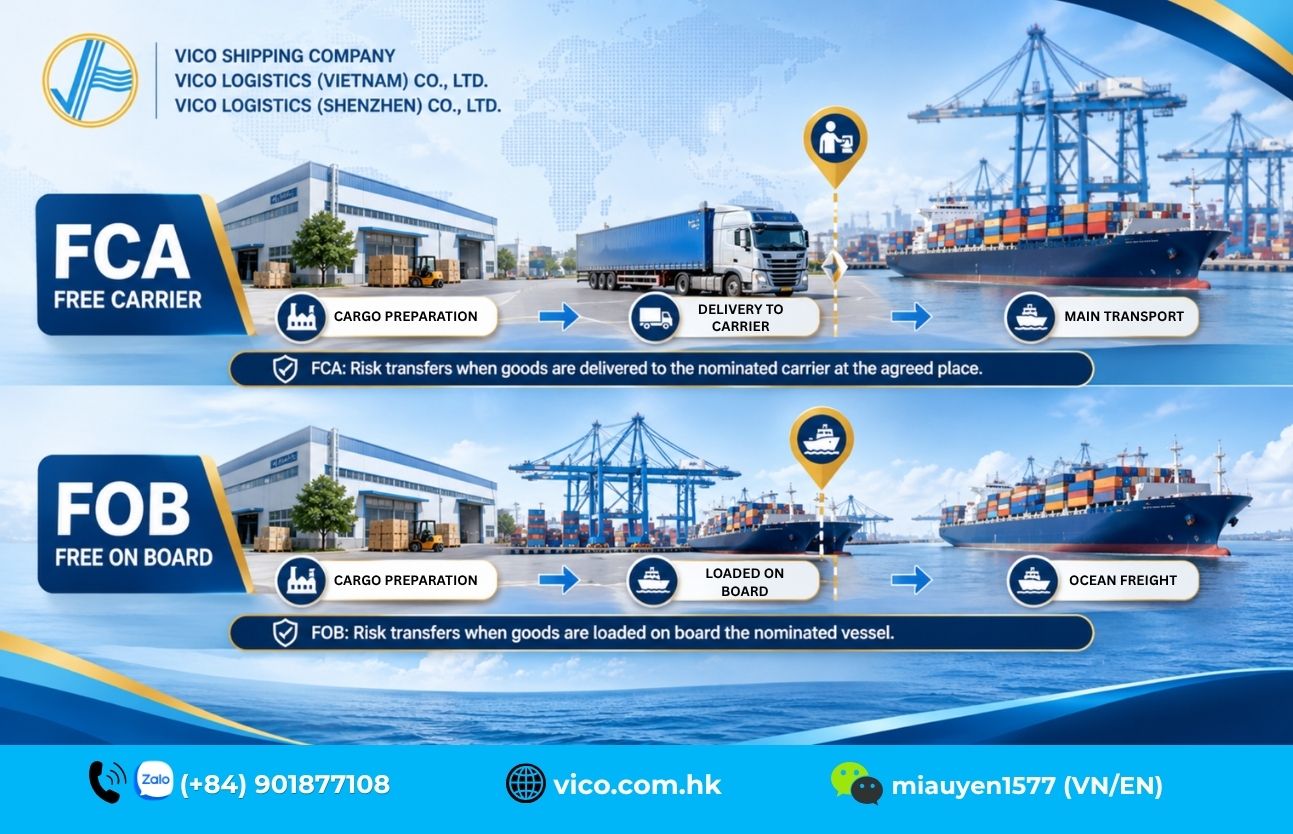
FCA is an Incoterms® rule under which the seller delivers the goods to the carrier or another party nominated by the buyer at an agreed location.
Under Incoterms® 2020, FCA involves the following responsibilities:
- The seller prepares and packages the goods in accordance with the sales contract.
- The seller completes export customs clearance.
- The seller delivers the goods to the carrier nominated by the buyer at the agreed delivery location.
- The buyer arranges and pays for the main transportation.
- Risk transfers from the seller to the buyer once delivery has been completed at the agreed location.
One of the key advantages of FCA is its flexibility. This term can be used for various modes of transport, including:
- Sea freight
- Air freight
- Road transport
- Rail transport
- Multimodal transportation
There are two delivery scenarios under FCA:
- Scenario 1: Delivery at the Seller's Factory or Warehouse
If the agreed delivery location is the seller's factory or warehouse, the seller fulfills the delivery obligation when the goods have been loaded onto the means of transport arranged by the buyer. - Scenario 2: Delivery at Another Agreed Location
If delivery takes place at another location, such as a container yard or warehouse, the seller fulfills the delivery obligation when the goods arrive at that location on the seller's means of transport, are ready for unloading, and are placed at the disposal of the carrier or another party nominated by the buyer.
This distinction is particularly important because it determines the exact point at which risk transfers to the buyer.
1.2. What Is FOB (Free On Board)?
FOB is an Incoterms® rule specifically designed for sea and inland waterway transport.
Under Incoterms® 2020, the seller fulfills the delivery obligation when the goods are loaded on board the vessel nominated by the buyer at the agreed port of shipment.
The seller's responsibilities generally include:
- Preparing and packaging the goods.
- Arranging inland transportation to the port of shipment.
- Completing export customs clearance.
- Bearing the costs and risks associated with delivering and loading the goods on board the nominated vessel.
Once the goods are on board the vessel, risk transfers from the seller to the buyer.
From that point onward, the buyer is responsible for:
- Main ocean freight charges.
- Transportation from the destination port.
- Import customs clearance.
- Import duties and other applicable taxes.
- Other costs allocated to the buyer under the agreed Incoterms® rule.
Practical Example:
A Vietnamese exporter sells furniture to a buyer in Germany under the following term:
FOB Cat Lai Port, Ho Chi Minh City, Vietnam – Incoterms® 2020
The Vietnamese seller is responsible for delivering and loading the furniture shipment on board the vessel nominated by the buyer at Cat Lai Port. Once the goods are on board, risk transfers to the German buyer, who becomes responsible for the subsequent ocean transportation and import procedures.
2. FCA vs FOB: A Quick Comparison of Key Differences
The table below highlights the most important differences between FCA and FOB under Incoterms® 2020.
|
Comparison Criteria
|
FCA (Free Carrier)
|
FOB (Free On Board)
|
|---|---|---|
|
Full Name
|
Free Carrier
|
Free On Board
|
|
Mode of Transport
|
All modes of transport
|
Sea and inland waterway transport only
|
|
Delivery Location
|
An agreed and named delivery location
|
On board the nominated vessel
|
|
Transfer of Risk
|
At the agreed delivery location
|
Once the goods are on board the vessel
|
|
Export Customs Clearance
|
Seller
|
Seller
|
|
Import Customs Clearance
|
Buyer
|
Buyer
|
|
Main Freight Charges
|
Buyer
|
Buyer
|
|
Pre-Carriage Transportation
|
Depends on the named delivery location
|
Seller
|
|
Suitable for Containerized Cargo
|
Yes
|
Generally not recommended
|
|
Suitable for Air Freight
|
Yes
|
No
|
|
Suitable for Multimodal Transportation
|
Yes
|
No
|
The fundamental difference between FCA and FOB lies in the delivery location and the point at which risk transfers from the seller to the buyer:
- Under FCA, delivery takes place when the goods are handed over to the carrier nominated by the buyer at the agreed location.
- Under FOB, delivery only takes place when the goods are physically loaded on board the nominated vessel.
This distinction becomes particularly important when transporting containerized cargo.
3. Detailed Comparison: FCA vs FOB
To choose the right Incoterms® rule, businesses need to understand how FCA and FOB allocate delivery responsibilities, transportation costs, and risks.
3.1. Delivery Location and Transfer of Risk
The delivery location is one of the most significant differences between FCA and FOB.
- Under FCA: The seller completes delivery when the goods are handed over to the carrier nominated by the buyer at the agreed location.
Example: If a Vietnamese exporter sells goods under the termFCA Seller's Warehouse, Binh Duong, Vietnam – Incoterms® 2020, the seller must prepare the goods, complete export customs clearance, and load the goods onto the collection vehicle arranged by the buyer. As soon as the goods have been loaded onto that vehicle, risk transfers to the buyer. - Under FOB: The seller completes delivery when the goods are loaded on board the vessel nominated by the buyer at the agreed port of shipment.
Example: Under the termFOB Cat Lai Port, Ho Chi Minh City, Vietnam – Incoterms® 2020, the Vietnamese seller remains responsible for the goods throughout the transportation to the port and the loading process. Risk only transfers once the goods are on board the vessel.
Key Difference in the Transfer of Risk:
Under FCA, the buyer generally assumes risk earlier than under FOB in typical scenarios where the goods are delivered at the seller's premises or at a container yard. However, the exact point of risk transfer still depends on the named delivery location and the specific delivery arrangements agreed upon by both parties.
3.2. Transportation Costs and Responsibilities
Another important difference when comparing FCA and FOB is how transportation costs are allocated.
- Under FCA, the seller's costs generally include:
- Export packaging and labeling.
- Transportation to the agreed delivery location, where required.
- Export customs clearance.
- Loading costs for the collection vehicle, if delivery takes place at the seller's warehouse or factory.
- The buyer pays for: Transportation beyond the FCA delivery point, main ocean freight, destination port handling charges, import customs clearance, duties, and onward transportation to the final destination.
- Under FOB, the seller's costs generally include:
- Export packaging and labeling.
- Inland transportation to the port of shipment.
- Export customs clearance.
- Origin port charges allocated to the seller.
- Costs and risks associated with loading the goods on board the vessel.
- The buyer pays for: Main ocean freight, costs incurred after delivery on board the vessel, destination port charges, import customs clearance, duties, and onward transportation.
3.3. Export and Import Customs Clearance
Regarding customs procedures, FCA and FOB have equivalent responsibilities:
- Seller: Responsible for export customs clearance and completing all relevant export formalities.
- Buyer: Responsible for import customs clearance and applicable import duties and taxes.
Example: When a Vietnamese exporter ships goods to the United States under FCA or FOB, the exporter is responsible for completing export procedures in Vietnam, while the US importer handles import customs clearance and pays the applicable import duties in the United States.
3.4. Bill of Lading (B/L) and Transport Documents
Transport documentation is another factor to consider:
- Under FOB, the buyer typically arranges the main ocean transportation and receives the relevant transport documents from the shipping line.
- Under FCA, although the buyer also arranges the main transportation, certain transactions may face documentation challenges if the seller requires an on-board bill of lading to satisfy Letter of Credit (L/C) requirements.
To address this issue, Incoterms® 2020 introduced an optional mechanism for FCA: The buyer and seller may agree that the buyer will instruct the carrier to issue an on-board bill of lading (on-board B/L) to the seller after the goods have been loaded on board the vessel. This helps meet documentary credit requirements without changing the fundamental nature of FCA.
4. FCA or FOB: Which Is More Suitable for Containerized Cargo?
One of the most important considerations when choosing between FCA and FOB is the type of cargo being transported.
For containerized cargo, FCA is generally more suitable than FOB under Incoterms® 2020.
Why Is FCA More Suitable for Containerized Cargo?
Containerized cargo is typically handed over to the carrier at a container yard (CY) before the container is physically loaded onto the vessel. This creates a time and location gap between the actual handover of the container and the delivery point required under FOB (on board the vessel).
- Under FCA: The seller completes the delivery obligation when the container is handed over to the carrier nominated by the buyer at the container yard, following export customs clearance. At that point, risk transfers to the buyer, reflecting the actual handling process for containerized cargo.
- Under FOB: The seller remains responsible for the goods until the container is loaded onto the vessel. This may lead to disputes over risk allocation and Terminal Handling Charges (THC) while the container is waiting in the yard to be loaded onto the vessel.
For this reason, the International Chamber of Commerce (ICC) has highlighted the incompatibility between traditional maritime terms such as FOB and modern container shipping practices, recommending FCA or CPT for containerized cargo delivered through ports.
Practical Example: Container Exports from Vietnam
A Vietnamese company exports two containers of furniture to Australia, using a trucking company or freight forwarder nominated by the buyer:
- Option 1: FCA Cat Lai Port
The seller prepares the goods, completes export customs clearance, and delivers the containers to the designated yard. Delivery is completed when the containers are placed at the disposal of the carrier nominated by the buyer. The buyer is responsible for the subsequent ocean freight.- Option 2: FOB Cat Lai Port
The seller is responsible for customs clearance, transporting the goods to the port, and bearing the risk until the containers are lifted onto the vessel.Assessment: For this container shipment, FCA is the more appropriate choice because its delivery point aligns with the actual handover of containers at the yard. FOB may still appear in commercial contracts due to established business practices, but its delivery point does not align with the actual container handover process at the port.
When Is FOB Still an Appropriate Choice?
FOB remains highly suitable for traditional bulk cargo or breakbulk cargo transported by sea, where the seller delivers the goods directly on board the vessel. Examples include:
- Bulk agricultural commodities (rice, corn, soybeans, etc.).
- Iron ore.
- Coal.
- Oversized and heavy-lift equipment loaded directly onto the vessel (breakbulk cargo).
5. When Should You Use FCA or FOB?
5.1. When Should You Choose FCA?
- When shipping containerized cargo.
- When transporting goods by air freight or road.
- When using multimodal transportation.
- When delivering goods to a freight forwarder's warehouse or a container yard.
- When the buyer wants full control over international freight arrangements.
5.2. When Should You Choose FOB?
- When shipping bulk or breakbulk cargo by sea.
- When the seller has the capability and wishes to directly handle the loading of goods on board the nominated vessel.
- When both parties clearly agree on the specific port of loading and vessel schedule.
5.3. Quick Decision-Making Guide
|
Shipping Scenario
|
Recommended Option
|
|---|---|
|
Containerized cargo
|
FCA
|
|
Air freight
|
FCA
|
|
Road or rail transportation
|
FCA
|
|
Multimodal transportation
|
FCA
|
|
Bulk cargo transported by sea
|
FOB may be suitable
|
|
Oversized and heavy-lift cargo loaded directly onto the vessel
|
FOB may be suitable
|
|
Delivery at a container yard before vessel loading
|
FCA is preferred
|
6. Common Mistakes When Choosing Between FCA and FOB
- Mistake 1: Automatically Using FOB for Every Sea Shipment. Many people assume that FOB must be used whenever goods are transported by sea. However, for containerized cargo, FCA is generally the more appropriate choice and can help reduce legal and risk-related complications.
- Mistake 2: Confusing the Delivery Point with the Final Destination. Neither FCA nor FOB means that the seller is required to transport the goods all the way to the buyer's warehouse overseas.
- Mistake 3: Assuming FOB Includes Ocean Freight. In reality, under FOB, the seller only covers costs up to the point when the goods are loaded on board the vessel. The buyer pays for the main ocean freight.
- Mistake 4: Failing to Specify the Delivery Location Clearly. Simply writing "FCA Vietnam" or "FOB Vietnam" is not sufficiently specific. The exact location must be stated, for example:
FCA Binh Duong Factory Warehouse, Vietnam – Incoterms® 2020orFOB Cat Lai Port, Ho Chi Minh City, Vietnam – Incoterms® 2020. - Mistake 5: Overlooking Local Charges and Terminal Handling Charges (THC). The parties should clearly determine who is responsible for port handling charges (THC), documentation fees, and customs-related charges to avoid potential disputes.
7. Checklist for Choosing the Right Incoterms Rule
Before finalizing FCA or FOB terms with your business partner, consider the following questions:
- Identify the type of cargo: containerized cargo, bulk cargo, or general cargo?
- Determine the mode of transport: sea, air, road, rail, or multimodal transportation?
- Identify the exact delivery location agreed upon by the seller and buyer.
- Who will nominate and contract the main carrier or transportation provider?
- Who is responsible for export customs clearance?
- Review origin charges, THC, and destination port charges.
- Determine the exact point at which risk transfers.
- Check whether there are any special requirements for the Bill of Lading (B/L) or Letter of Credit (L/C).
- Clearly state the Incoterms® rule, its version (Incoterms® 2020), and the named location in the sales contract.
8. Frequently Asked Questions (FAQ)
8.1. Is FCA Better Than FOB?
Neither term is universally better than the other. FCA is more suitable for containerized cargo, air freight, and multimodal transportation. FOB is more appropriate for bulk cargo and traditional sea shipments where the seller delivers the goods on board the vessel.
8.2. Can FCA Be Used for Sea Freight?
Absolutely. FCA is widely used for sea freight, particularly for containerized cargo delivered to a container yard (CY) before being loaded onto the vessel.
8.3. Who Pays for Freight Under FCA and FOB?
Under both terms, the buyer arranges and pays for the main international freight. The key differences relate to pre-delivery inland transportation costs and the point at which risk transfers.
8.4. Does FCA Include Export Customs Clearance?
Yes. Under Incoterms® 2020, the seller is responsible for completing export customs clearance under FCA.
9. Conclusion: Which Term Should You Choose for Your Shipment?
Understanding the differences between FCA and FOB provides businesses with a solid foundation for optimizing their international trade operations.
- Choose FCA for containerized cargo, air freight, road transport, rail transport, and multimodal transportation.
- Choose FOB for bulk cargo or traditional sea shipments where the seller is responsible for loading the goods on board the vessel.
If you need further guidance on international shipping solutions, customs clearance procedures, ocean and air freight rates, or supply chain optimization across the Indochina region, the expert team at VICO Logistics is always ready to support your business — from shipment planning to successful delivery!
- Factory Coffee: The Global Coffee Harvest Calendar
- What's So Good About Vietnam Manufacturers
- Electronics Shipping: Mastering The Logistics Of High-Value Technology
- Door To Door Cambodia Shipping: The Ultimate Logistics Solution For 2026
- Trucking Cambodia - Vietnam: Fast & Reliable Cross-Border Solutions 2026
- What Is MSDS/SDS? 16 Sections and Its Role in Import and Export
- What Is an Insurance Certificate? How to Verify and Use It
- What Is an Air Waybill (AWB)? How to Read & Track an AWB
- Who Is Responsible for Cargo Damage? Incoterms 2020
Get a Logistics Quote in just 5 minutes
Professional international transportation and supply chain solutions tailored for your business.
Get a quote now ↗Quick Contact
🇻🇳 Ms Uyen
Hotline / Zalo
(+84) 901 877 108WeChat (VN/EN)
miauyen1577Scan to Contact
Zalo
🇨🇳 Ms Schyler
Office Hotline
(+852) 3759 9300WeChat ID
Schyler_skylarScan to Contact
VICO International Logistics — Your Trusted Logistics Partner in Indochina
Senior member of international logistics and trade associations: Eurocham, JCtrans, VICOFA, VITAS, and more.