
When conducting international trade transactions, choosing the appropriate Incoterms rule is one of the most critical decisions for an importer. For the exact same product and supplier, selecting EXW, FCA, FOB, CIF, or DDP can result in significantly different transportation responsibilities, logistics costs, and risk levels for the buyer.
So, which Incoterm is best suited for the buyer? Should you choose FOB to take control of booking vessels, CIF to have the seller arrange transportation, or DAP/DDP to receive goods right at your facility in Vietnam?
In reality, no single Incoterm rule universally provides the best benefits for every importer. The right choice depends on your organization's transport management capacity, customs clearance capabilities, cargo characteristics, and the total cost from origin to the final delivery location.
In this article, VICO Logistics analyzes all 11 Incoterms 2020 rules from the buyer's perspective, helping businesses choose the most suitable option and minimize unnecessary expenses during the import process.
1. Which Incoterm is Right for the Buyer?
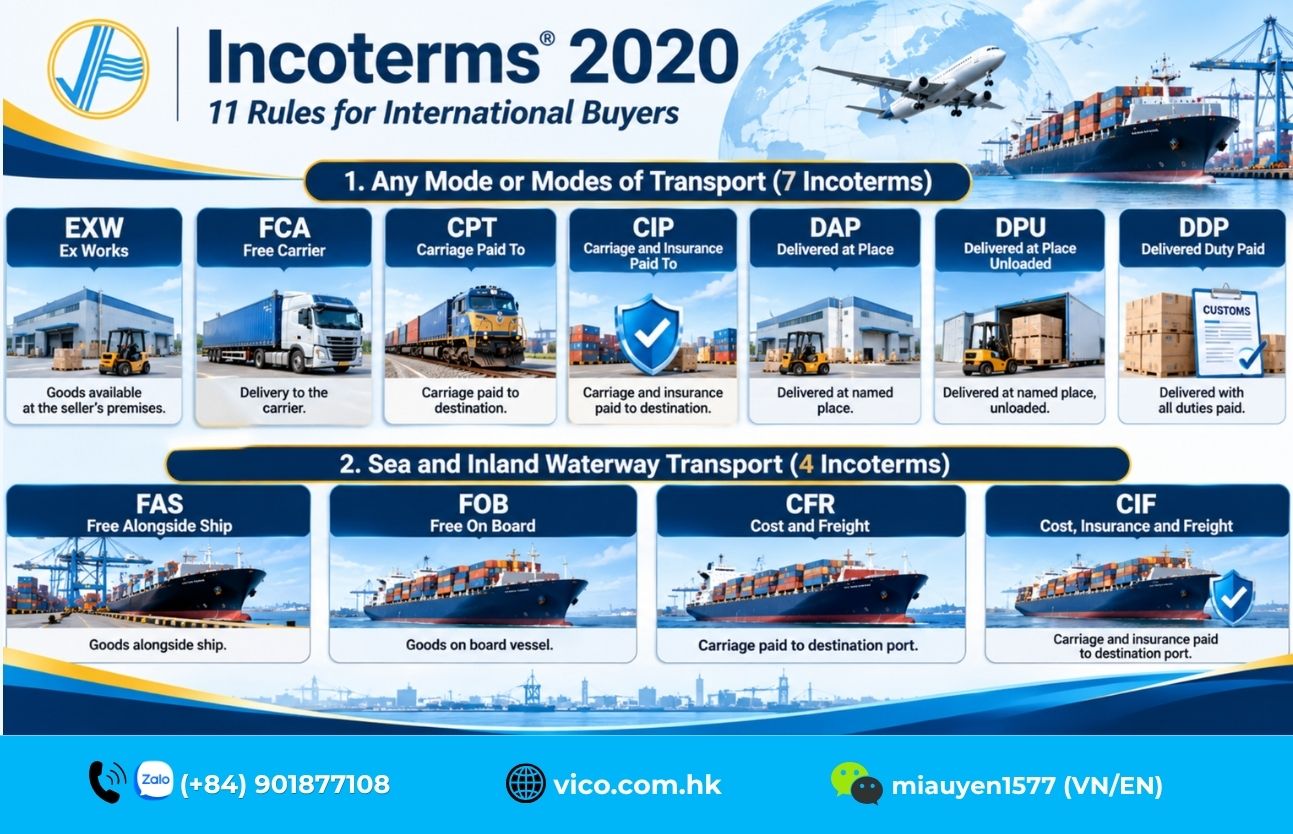
Based on practical business needs, buyers can consider the following rules:
- EXW: Suitable for buyers with the experience and capability to independently organize transport from the seller's premises.
- FCA: Suitable for containerized cargo, multimodal transport, and buyers who want to control the international transport leg.
- FOB: Suitable for traditional maritime transport when buyers want to proactively charter vessels and control ocean freight rates.
- CIF: Suitable for buyers who want the seller to arrange ocean freight and minimum required cargo insurance.
- DAP: Suitable for buyers who want delivery at a named destination while retaining control over import customs clearance themselves.
- DDP: Suitable for buyers who want the seller to handle both transportation and import clearance, provided the seller has the capability to fulfill these obligations in the destination country.
Therefore, buyers should not simply choose the condition with the lowest purchase price or the one where the seller covers the most costs.
The key is to determine your actual total landed cost, the precise point of risk transfer, and your capacity to control the entire transport process.
1.1. Key Factors Determining the Choice of Incoterms
Before negotiating with suppliers, buyers should evaluate these 5 factors:
First, Transport Organization Capability.
Does your business have a dedicated logistics team or trusted forwarding partners? If yes, choosing EXW, FCA, or FOB offers greater control over schedules and freight costs.
Conversely, if you are new to importing, consider CIF, DAP, or DDP based on your needs and the seller's execution capacity.
Second, Total Import Cost.
The product price does not reflect the full actual cost. Buyers must account for freight charges, port fees, documentation processing fees, insurance, import duties, VAT, and inland transportation.
Third, Risk Control Level.
You must determine exactly where the goods are delivered and at what point the risk of loss or damage transfers from the seller to the buyer.
Fourth, Customs Clearance Capacity.
Not every business has the resources to handle export clearance in the supplier's country or import clearance in Vietnam. This must be reviewed before selecting delivery terms.
Fifth, Cargo Characteristics and Transport Mode.
Containerized cargo, bulk cargo, refrigerated goods, oversized cargo, or cross-border shipments may require different Incoterms rules.
2. Comparing Incoterms 2020 Rules from the Buyer's Perspective
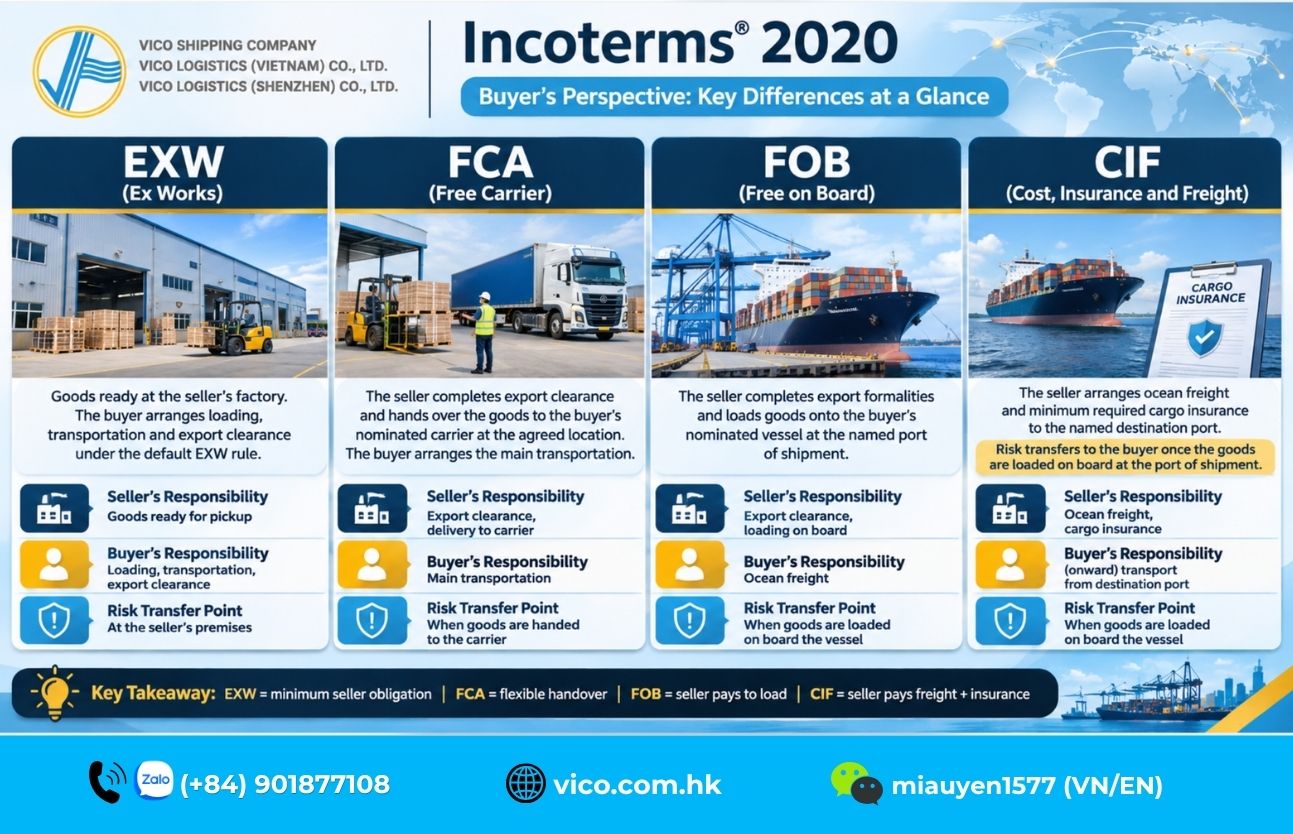
Incoterms 2020 consists of 11 rules, divided into two categories:
- 7 rules for any mode(s) of transport: EXW, FCA, CPT, CIP, DAP, DPU, and DDP.
- 4 rules for sea and inland waterway transport: FAS, FOB, CFR, and CIF.
Below is an analysis of each rule regarding the buyer's rights and responsibilities.
2.1. EXW (Ex Works) – Buyer Controls the Entire Transport Process
Under EXW, the seller fulfills their obligation to deliver when they place the goods at the buyer's disposal at their premises or another named place.
The buyer bears almost all responsibilities during transit, including:
- Arranging vehicles to collect the goods.
- Loading goods onto the collecting vehicle (by default rule).
- Handling export customs procedures.
- Booking international freight.
- Purchasing insurance if needed.
- Handling import customs clearance and transporting goods to the warehouse.
Buyer's Advantages:
- Complete autonomy in selecting carriers.
- Full control over the logistics chain.
- Opportunity to optimize costs with strong transport partner networks.
Disadvantages:
- Heavy operational workload for the buyer.
- Difficult to execute without local agents in the export country.
- Potential challenges handling export customs under the supplier's local regulations.
When to choose EXW?
EXW is suitable for experienced enterprises with established logistics agents in the exporting country, capable of handling pickup and export clearance.
However, for international exports, buyers should consider FCA if the seller is capable of managing export clearance.
2.2. FCA (Free Carrier) – Ideal for Containerized & Multimodal Transport
Under FCA, the seller delivers the goods to the carrier or another person nominated by the buyer at a named place. The seller handles export customs clearance and delivers the goods according to the agreed location.
The buyer is responsible for:
- Hiring the main carrier.
- Paying international freight.
- Purchasing insurance if needed.
- Handling import customs clearance.
- Bearing risks from the moment goods are delivered to the carrier.
Buyer's Advantages:
- Freedom to choose carriers.
- Control over international freight rates.
- Seller assists with export customs.
- Applicable to road, rail, air, and multimodal transport.
Disadvantages:
The buyer must still arrange main transport and assume risks post-delivery.
When to choose FCA?
Highly recommended for containerized shipments from China to Vietnam where the buyer wants to appoint a forwarder without managing export clearance formalities inside China.
Note: Under FCA Incoterms 2020, parties can agree that the buyer instructs the carrier to issue an on-board Bill of Lading to the seller when required by the commercial transaction.
2.3. FOB (Free On Board) – Buyer Controls the International Sea Leg
Under FOB, the seller fulfills their obligation to deliver when the goods are loaded on board the vessel nominated by the buyer at the named port of shipment.
Seller's Responsibilities: Preparing goods, delivering them to the export port, clearing export customs, bearing costs and risks until goods are loaded on board.
Buyer's Responsibilities: Nominating the vessel/carrier, paying international freight, buying insurance (if needed), bearing risks from the on-board point onwards, clearing import customs, and organizing inland transport from the destination port.
Buyer's Advantages:
- Proactive selection of shipping lines and forwarders.
- Better negotiation power for freight rates.
- Schedule visibility.
- Opportunity to combine shipments to optimize costs.
Disadvantages:
- Requires active booking and transport management.
- Risks transfer once goods are on board at origin.
- Destination port fees and non-freight charges must be monitored.
When to choose FOB?
FOB is ideal for experienced importers managing maritime container flows with reliable forwarding partners.
Important Note: FOB is strictly for maritime and inland waterway transport. For containerized cargo handed over at a terminal before loading, FCA is technically more appropriate.
2.4. CIF (Cost, Insurance and Freight) – Seller Pays Freight and Insurance
Under CIF, the seller contracts and pays for carriage and minimum cargo insurance to the named port of destination.
Seller Pays: Goods value, loading costs, international ocean freight, and minimum required cargo insurance.
Buyer Still Must: Clear import customs, pay import duties and taxes, receive goods at destination port, organize inland transport, and bear risks from the moment goods are loaded on board at origin.
Buyer's Advantages:
- No need to directly book vessels.
- No need to arrange default insurance independently.
- Suitable for businesses wanting the seller to organize international transit.
Disadvantages:
- Limited control over carriers and schedules without separate agreements.
- Freight costs may be bundled into product prices.
- Default insurance scope does not mean all-risk coverage.
- Buyer still bears maritime risks after loading.
When to choose CIF?
CIF is suitable when buyers want sellers to handle vessel booking and insurance, especially when lacking international transport networks.
However, buyers must carefully inspect insurance scope, insured value, documents, and destination port fees.
Remember: CIF does not mean the seller assumes risks all the way to destination. Risk transfers upon loading at origin.
Additionally, CIF defaults to minimum coverage under Institute Cargo Clauses (C) unless otherwise agreed.
2.5. CPT and CIP – Best for Multimodal Transport
These two rules are commonly used when goods are transported via multiple modes.
- CPT (Carriage Paid To): The seller contracts and pays for carriage to the named destination. However, risk transfers to the buyer when goods are handed over to the carrier at origin.
- CIP (Carriage and Insurance Paid To): Similar to CPT, but the seller must also purchase cargo insurance. Under Incoterms 2020, CIP mandates broader insurance coverage than CIF: defaulting to Institute Cargo Clauses (A) or equivalent, unless otherwise agreed.
When to choose?
- Choose CPT if you want the seller to arrange transport but prefer buying your own insurance.
- Choose CIP if you want the seller to handle both transport and comprehensive insurance coverage.
Note: Buyers must distinguish between the place where the seller pays freight and the place of risk transfer. These two locations do not necessarily match.
2.6. DAP (Delivered at Place) – Seller Delivers to Named Destination
Under DAP, the seller is responsible for delivering the goods to the named destination.
Seller Bears: Transport costs to destination, risks during transit, export customs, and necessary expenses to bring goods to delivery location.
Buyer Bears: Import customs clearance, import duties and related taxes, unloading costs at destination unless otherwise agreed.
Goods are delivered when placed at disposal on the arriving means of transport, ready for unloading.
Advantages: No need to organize international transport legs directly, reduced logistics coordination workload, convenient delivery at agreed location.
Disadvantages: Buyer must still be capable of handling import customs and paying related taxes.
When to choose DAP?
DAP is suitable when you want the seller to arrange transport to your warehouse/facility in Vietnam while you retain control over customs clearance.
2.7. DPU (Delivered at Place Unloaded) – Seller Unloads the Goods
DPU is similar to DAP with one key difference: the seller is responsible for bringing the goods to the named destination and unloading them.
The buyer remains responsible for import customs clearance and duties.
Advantages: Buyer does not need to organize unloading operations; ideal when you want the seller to handle more steps at destination.
Disadvantages: Seller must have the capacity to unload at the destination point; requires clear access conditions and unloading equipment at the warehouse.
When to choose DPU? When you want goods transported and unloaded at the agreed destination point.
2.8. DDP (Delivered Duty Paid) – Maximum Seller Responsibility
Under DDP, the seller assumes maximum responsibility to bring goods to the named destination, including export/import clearance and payment of taxes/fees.
Seller Bears: Transport costs, transit risks, export clearance, import clearance, and import duties/taxes.
Buyer: Responsible for receiving goods at the delivery location, ready for unloading.
Advantages: Drastically reduces logistics organization workload, eliminates direct import clearance duties, ideal for door-to-door delivery.
Disadvantages: Higher product prices due to bundled transport, customs, and taxes; lower buyer control over carriers; requires verifying the seller's legal and practical capacity to clear customs in Vietnam.
When to choose DDP?
DDP is suitable when simplifying import processes is desired and the seller has proven capabilities to fulfill obligations locally.
Do not assume DDP is always best. Verify import documents, importer of record status, tax liabilities, and handling procedures.
2.9. FAS and CFR – Sea Freight Rules to Understand
- FAS (Free Alongside Ship): Seller delivers alongside the vessel at the export port. From that point, the buyer bears risks and subsequent costs, including loading and international transit. FAS is typically suited for bulk or specialized cargo.
- CFR (Cost and Freight): Seller pays carriage to destination port, but risk transfers to the buyer upon loading at origin. CFR does not require mandatory insurance.
For buyers:
- FAS is suitable when capable of organizing vessel loading and international transit.
- CFR is suitable when wanting the seller to pay ocean freight while independently arranging insurance.
Both apply exclusively to sea and inland waterway transport.
3. Incoterms 2020 Quick Comparison Table for Buyers
This summary table helps importers quickly assess responsibilities and control levels.
|
Incoterm
|
Seller Arranges Transport To
|
Risk Transfers To Buyer
|
Import Customs Handled By
|
|---|---|---|---|
|
EXW
|
Seller's premises
|
When placed at buyer's disposal at pickup location
|
Buyer
|
|
FCA
|
Agreed delivery point
|
When handed over to carrier
|
Buyer
|
|
FAS
|
Alongside ship
|
When placed alongside ship
|
Buyer
|
|
FOB
|
On board at export port
|
When loaded on board
|
Buyer
|
|
CFR
|
Destination port (freight paid)
|
When loaded on board
|
Buyer
|
|
CIF
|
Destination port (freight & insurance paid)
|
When loaded on board
|
Buyer
|
|
CPT
|
Destination place (freight paid)
|
When handed over to carrier
|
Buyer
|
|
CIP
|
Destination place (freight & insurance paid)
|
When handed over to carrier
|
Buyer
|
|
DAP
|
Destination place (ready to unload)
|
Upon arrival at destination
|
Buyer
|
|
DPU
|
Destination place (unloaded)
|
After unloading at destination
|
Buyer
|
|
DDP
|
Destination place (cleared & ready to unload)
|
Upon arrival at destination
|
Seller
|
Recommended Buyer Options by Need:
- Full control over transport: EXW
- Control transport + seller handles export clearance: FCA
- Self-book vessels & control ocean freight: FOB
- Seller pays freight & insurance: CIF
- Seller pays freight, buyer chooses insurance: CPT
- Seller pays freight & broader insurance scope: CIP
- Delivery at named place, self-clear customs: DAP
- Delivery including unloading: DPU
- Seller handles import customs clearance: DDP
Conclusion: Experienced logistics buyers can consider FCA or FOB for greater transport control. Companies wanting less coordination workload can look at CIF or DAP. Meanwhile, DDP fits situations where the seller can genuinely execute all obligations in the destination country.
4. Should the Buyer Choose FOB or CIF?
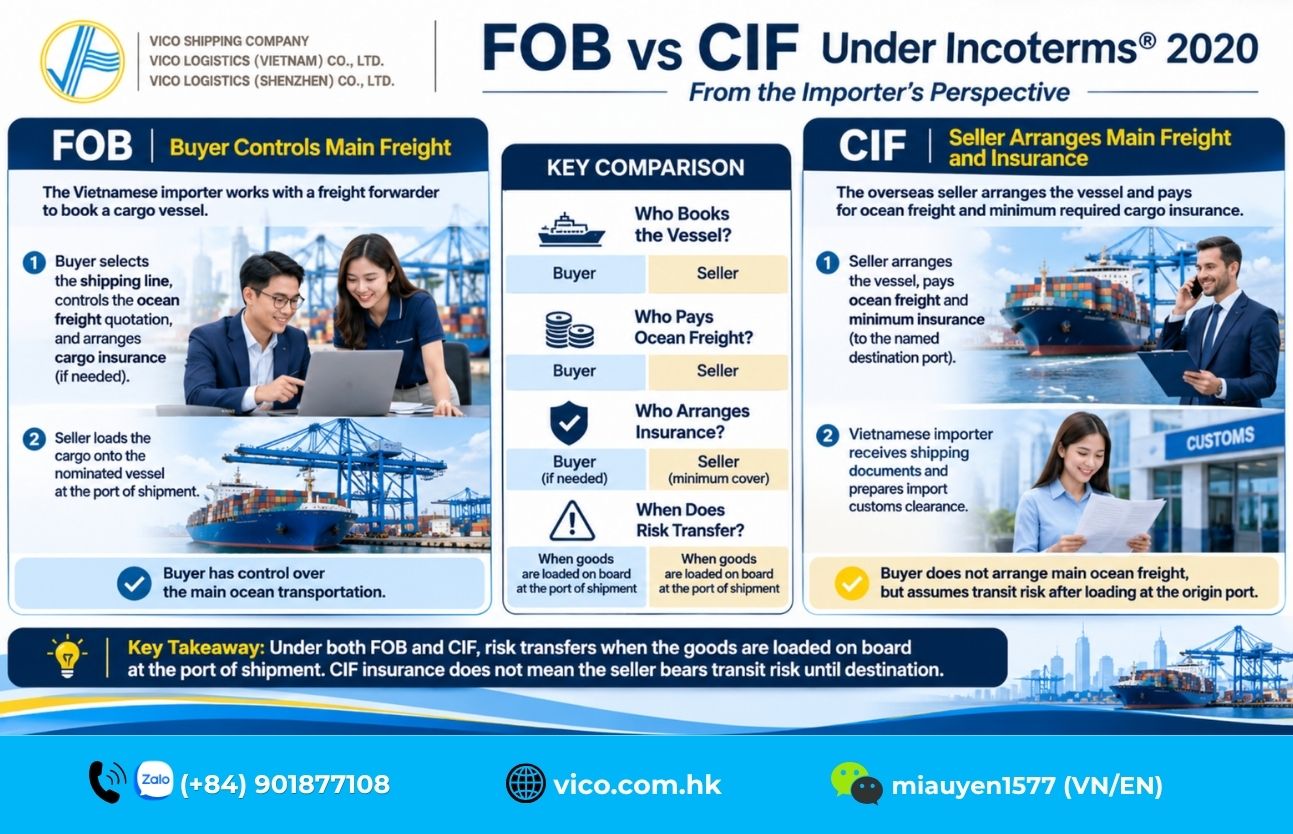
This is one of the most common questions when importing goods via ocean freight. Both FOB and CIF are widely used, but they differ significantly regarding transport organization, insurance, and risk transfer timing.
4.1. When to Choose FOB?
Buyers should consider FOB when:
- Having trusted international forwarders or transport partners.
- Wanting to select shipping lines independently.
- Wanting to control international freight rates.
- Having the capability to track schedules and manage transport documents.
- Wanting to combine multiple shipments for cost optimization.
Example: A Vietnamese company imports 5 containers of raw materials from China. The supplier quotes FOB Shanghai. The Vietnamese company hires a forwarder to book space, organize transit, and track shipments to Vietnam. Here, FOB grants greater control over transport partners and ocean freight.
4.2. When to Choose CIF?
Buyers should consider CIF when:
- Lacking international transport partners.
- Wanting the seller to arrange ocean shipping directly.
- Simplifying vessel booking.
- Wanting the seller to purchase default insurance required by CIF.
Example: A new importer brings goods from China to Cat Lai. The supplier quotes CIF Cat Lai (goods, freight, and insurance included). The buyer avoids direct vessel booking but must check destination port fees, insurance terms, transit time, and import taxes.
4.3. FOB vs. CIF Comparison
|
Criteria
|
FOB
|
CIF
|
|---|---|---|
|
Vessel Booking
|
Buyer
|
Seller
|
|
Ocean Freight Payment
|
Buyer
|
Seller
|
|
Default Insurance
|
Buyer's discretion
|
Seller must purchase
|
|
Carrier Control
|
Buyer-controlled
|
Seller-controlled
|
|
Risk Transfer Timing
|
On board vessel
|
On board vessel
|
|
Import Customs
|
Buyer
|
Buyer
|
Important Note: CIF does not mean the seller assumes risk until destination port. This is a common misconception for new importers.
Advice: Do not decide solely based on lower CIF quotes or seemingly cheap FOB terms. Request detailed breakdowns and calculate total landed costs to compare fairly.
5. Importing from China to Vietnam: Which Incoterm to Pick?
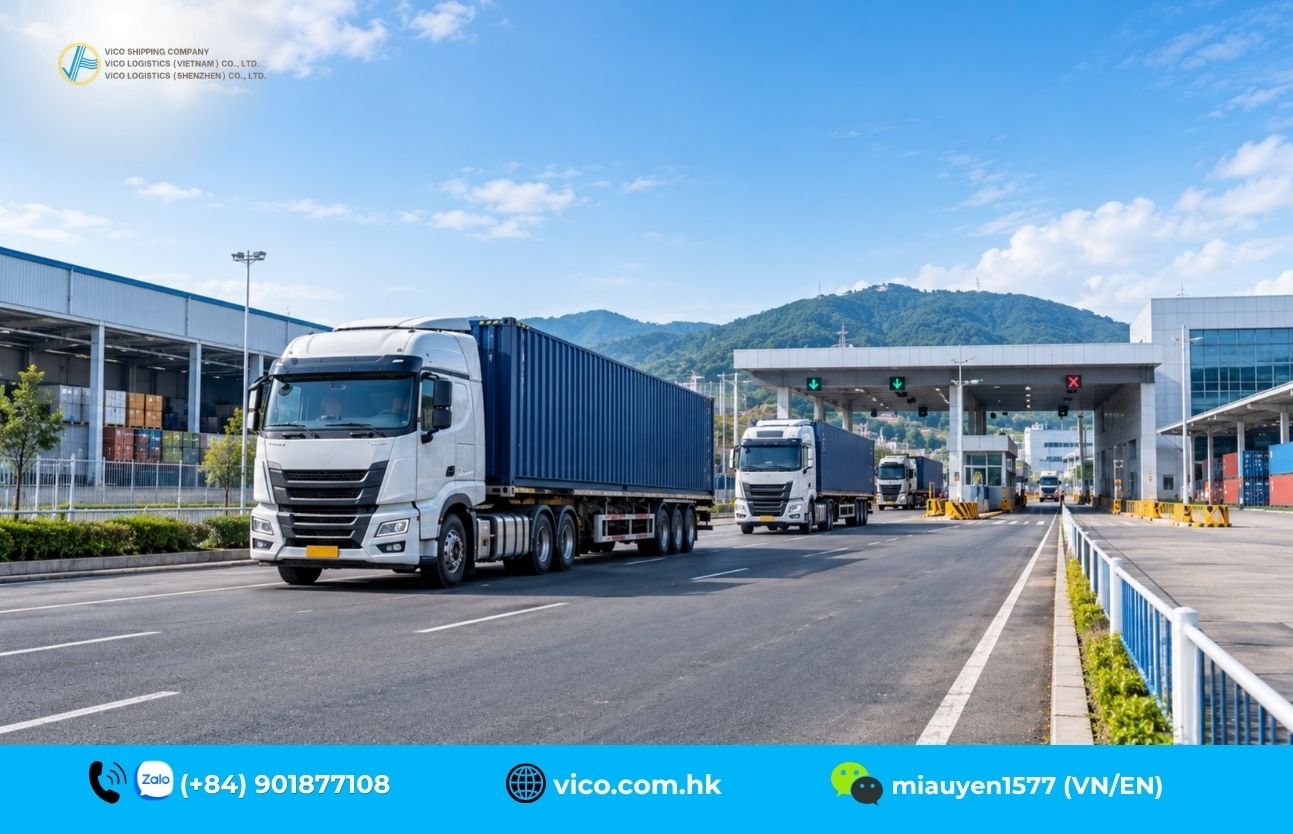
China is a vital supply market for Vietnamese enterprises. Depending on commodity types, transport methods, and logistics capacity, buyers can consider various rules.
5.1. Importing from Chinese Factories via EXW or FCA
If your business has logistics partners in China, EXW or FCA are worth considering.
- With EXW, the buyer organizes pickup and procedures from the seller's facility.
- With FCA, the seller handles export customs and hands goods over to the carrier at the agreed location.
Recommendation: For Vietnamese firms lacking local legal presence or export capability inside China, FCA is usually more practical than EXW if the supplier can handle export obligations.
5.2. Containerized Sea Freight via FOB or CIF
For container cargo, note a technical point: FCA is often more suitable than FOB when containers are handed over at a container yard or terminal before vessel loading.
If using FOB, ensure terms and risk points align with actual handling operations.
Buyers can consider:
- FCA to self-manage freight and hand over at terminal.
- CIF for supplier-managed shipping and insurance.
- FOB if actual handling strictly involves on-board loading at origin port.
5.3. Overland or Cross-Border Transport
For goods moving from China to Vietnam via road, consider FCA, CPT, CIP, DAP, or DDP based on responsibility splits.
Example: Importing materials from Guangdong to a factory in Bac Ninh. Under DAP, the seller organizes delivery to Bac Ninh while the buyer handles customs and taxes. Under FCA, the buyer can proactively hire cross-border carriers starting from the agreed handover point in China.
5.4. Advice for New Importers
Beginners should select terms based on procedural capabilities and cost control:
- CIF: If wanting the seller to arrange ocean transit and insurance.
- DAP: If wanting delivery to a designated site while managing customs independently.
- DDP: If wanting the seller to handle import clearance legally in Vietnam.
However, newcomers should avoid defaulting to DDP assuming all costs/risks vanish. Verify documentation, importer registration, taxes, and actual fulfillment workflows.
6. Top 5 Common Buyer Mistakes with Incoterms
Choosing incorrect delivery terms can trigger unexpected costs, customs clearance delays, or supplier disputes.
Mistake 1: Comparing Product Prices Without Total Import Costs
An EXW quote looks cheaper than CIF, but buyers absorb numerous extra transport and handling costs. Conversely, higher CIF prices do not automatically mean higher total costs.
Solution: Request full quotes and calculate total landed costs to warehouse.
Mistake 2: Confusing Freight Payers with Risk Bearers
A frequent error with Group C terms (CIF, CFR, CPT, CIP). Sellers pay freight to destination, but risks transfer to buyers much earlier at origin.
Solution: Separate freight cost allocation from risk transfer timing.
Mistake 3: Failing to Check Destination Port Fees
Maritime imports involve fees like THC, D/O, container cleaning, demurrage, storage, and documentation charges. Not all are bundled into CIF or FOB.
Solution: Request origin and destination fee tariffs from forwarders before confirming orders.
Mistake 4: Omitting Precise Delivery Locations
Writing "FOB China" or "DAP Vietnam" lacks specificity. Specify exact ports/addresses (e.g., FOB Shanghai Port, China, Incoterms 2020). Exact locations govern risk transfer and cost allocation.
Mistake 5: Overlooking Cargo Insurance Scope
Assuming CIF/CIP guarantees full coverage. Default levels differ; buyers must review insured values, policy conditions, exclusions, and claims procedures.
Solution: Require sellers to provide insurance certificates and confirm coverage terms before shipping.
7. How to Optimize Total Import Costs
To choose effective delivery terms, build comparison frameworks based on total costs and control levels instead of raw product tags.
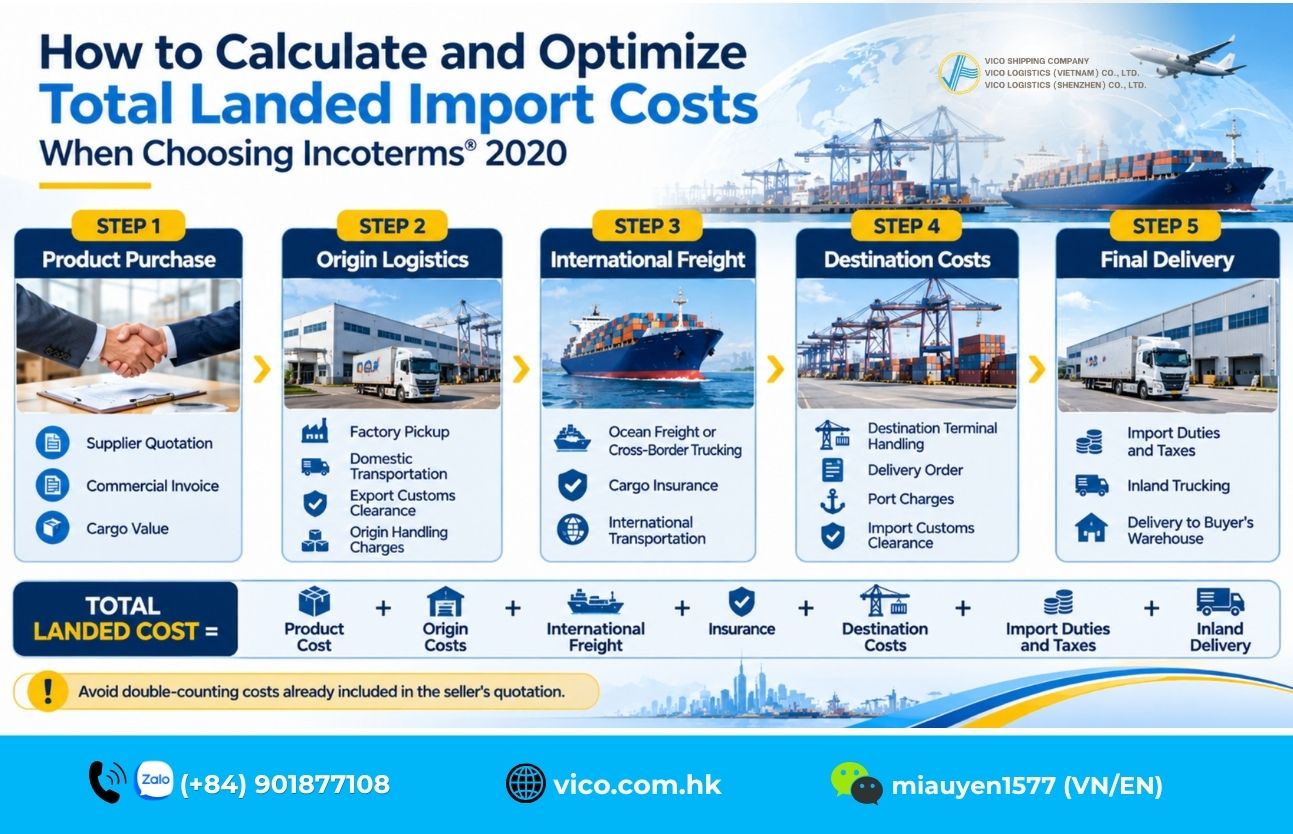
- Step 1: Assess internal logistics capabilities (overseas partners, booking capacity, documentation teams).
- Step 2: Request multi-term quotes from suppliers (EXW, FCA, FOB, CIF) to benchmark expenses.
- Step 3: Calculate total landed costs (Goods value + origin local fees + export clearance + international freight + insurance + destination port charges + duties/VAT + domestic trucking).
- Step 4: Weigh risks against control levels (transit velocity, tracking visibility, delay handling, claims capabilities).
- Step 5: Formalize contract conditions clearly (Incoterms code, exact port/address, 2020 version, special fee responsibilities, insurance/document stipulations).
8. VICO Logistics – Your Partner in Global Supply Chain Solutions
Choosing Incoterms involves more than splitting responsibilities; it directly dictates your logistics budget and operational efficiency. For shipments originating from China, Hong Kong, and Southeast Asia, correct delivery terms must align with reliable transport execution and smooth customs clearance.
VICO Logistics provides international freight and cross-border solutions, supporting businesses with:
- Consultation on shipping options tailored to cargo profiles and terms.
- Ocean, road, and multimodal transport execution.
- Import/export customs clearance and documentation support.
- Coordinated shipping across China, Vietnam, Hong Kong, and Indochina.
- Cost control and transit schedule optimization strategies.
9. Frequently Asked Questions (FAQs) for Buyers
9.1. Which Incoterm is most advantageous for the buyer?
No single universal best term exists. FCA and FOB suit those wanting transport control; CIF suits those wanting supplier-managed freight and insurance; DAP and DDP fit door-to-door destination delivery needs.
9.2. Should buyers choose FOB or CIF?
Choose FOB to self-book vessels, control ocean freight, and choose carriers. Choose CIF to have sellers pay freight and minimum required insurance.
9.3. Container imports: FOB or FCA?
FCA is generally better for containerized goods handed over at terminals prior to vessel loading. FOB applies when goods are genuinely loaded on board at origin ports.
9.4. Is DDP the best choice for new buyers?
DDP reduces transport and clearance workloads, but requires verifying if the supplier can legally execute import obligations and provide proper documentation in Vietnam.
9.5. Under CIF, does the seller bear risks until destination port?
No. Under CIF Incoterms 2020, risk shifts to the buyer once goods are loaded on board at origin, even though the seller pays freight and insurance to destination.
9.6. Do Incoterms regulate title transfer?
No. Incoterms govern duties, costs, and risks between buyers and sellers, but do not dictate ownership or title transfer. This must be addressed separately in sales contracts.
- What Is an HS Code? How to Find HS Codes, Calculate Duties, and Avoid Incorrect Declarations
- What Is a Sales Contract? 12 Key Details to Check Before Signing
- What Is MSDS/SDS? 16 Sections and Its Role in Import and Export
- What Is an Insurance Certificate? How to Verify and Use It
- What Is an Air Waybill (AWB)? How to Read & Track an AWB
- Who Is Responsible for Cargo Damage? Incoterms 2020
- FCA vs FOB: Key Differences, Costs, Risks & When to Use Each
Nhận Báo Giá Logistics chỉ trong 5 phút
Các giải pháp vận tải quốc tế và chuỗi cung ứng chuyên nghiệp được thiết kế riêng cho doanh nghiệp của bạn.
Nhận báo giá ngay ↗Liên Hệ Nhanh
🇻🇳 Ms Uyên
Hotline / Zalo
(+84) 901 877 108WeChat (VN/EN)
miauyen1577Quét để liên hệ
Zalo
🇨🇳 Ms Schyler
Hotline văn phòng
(+852) 3759 9300ID WeChat
Schyler_skylarQuét để liên hệ
VICO International Logistics — Đối tác Logistics Tin cậy của bạn tại Đông Dương
Thành viên cấp cao của các hiệp hội logistics và thương mại quốc tế: Eurocham, JCtrans, VICOFA, VITAS và nhiều hiệp hội khác.