


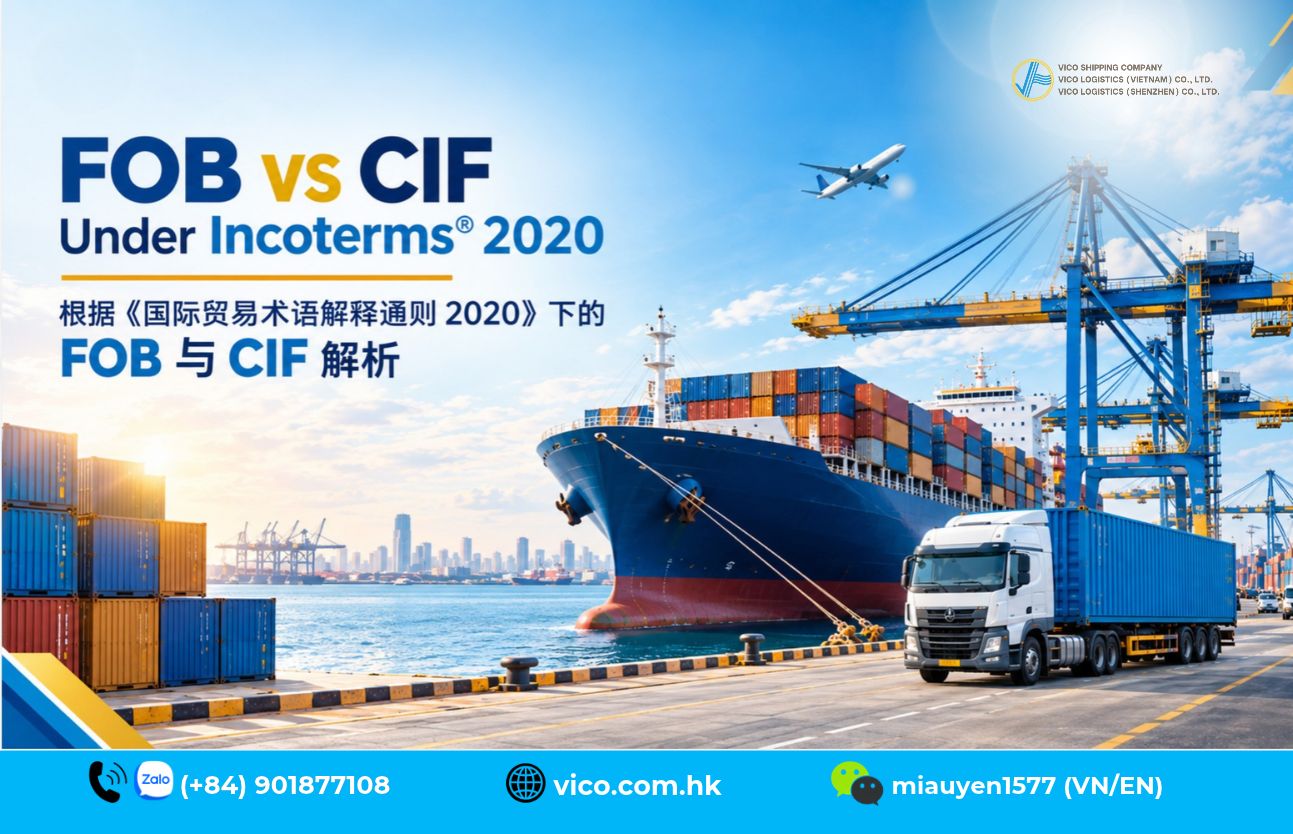
When importing goods by sea, FOB and CIF are two delivery terms that frequently appear in supplier quotations. However, the fact that a CIF price includes ocean freight and insurance does not mean the seller bears all risks until the cargo arrives at the destination port. Similarly, choosing FOB does not automatically mean higher costs.
So, how do FOB and CIF differ, which condition saves more money, and which option should businesses choose when importing goods?
The article below will help you clearly understand the responsibilities of buyers and sellers, how risks are transferred, the fees to check, and how to compare quotations under Incoterms® 2020.
1. What Are FOB and CIF?
FOB and CIF are two delivery terms under the International Chamber of Commerce's (ICC) Incoterms® 2020, used for sea and inland waterway transport. These two terms govern the responsibilities of buyers and sellers regarding delivery, transport arrangements, costs, and risk transfer.
1.1. What Is FOB?
FOB (Free On Board) is a delivery term specifying that delivery occurs on board the vessel at the named port of shipment.
Under FOB Incoterms® 2020, the seller is responsible for delivering the goods on board the vessel designated by the buyer at the agreed port of loading. The seller completes export clearance procedures and bears all costs within their scope of responsibility up to the point of delivery under the FOB rule.
Once the goods have been loaded on board the vessel, the risk of loss or damage to the goods transfers from the seller to the buyer. The buyer is responsible for arranging and paying for main ocean freight, as well as deciding whether to purchase cargo insurance if needed.
Example: A Vietnamese enterprise imports components from China under the terms FOB Shanghai, China, Incoterms® 2020. The seller is responsible for delivering the goods on board at Shanghai port and completing export procedures. The buyer arranges ocean freight from Shanghai to the destination port in Vietnam and handles their import obligations.
1.2. What Is CIF?
CIF (Cost, Insurance and Freight) is a delivery term that includes the cost of goods, ocean freight, and cargo insurance as part of the seller's obligations.
Under CIF Incoterms® 2020, the seller must deliver the goods on board the vessel at the port of departure, complete export clearance procedures, arrange and pay for freight to the named port of destination, and purchase cargo insurance meeting at least the minimum coverage required by the CIF rule.
A key point to note is that risk still transfers to the buyer when the goods are loaded on board the vessel at the port of departure, not when the goods arrive at the port of destination. The seller paying ocean freight and purchasing insurance to the destination port does not mean the seller bears transit risk until arrival.
Example: A Vietnamese enterprise buys components under CIF Cat Lai Port, Vietnam, Incoterms® 2020. The seller arranges and pays for ocean freight and insurance required by CIF to Cat Lai port. The buyer still bears the risk of the goods after the point of delivery under CIF and carries out import procedures, taxes, and related obligations in Vietnam.
2. FOB vs. CIF Comparison Table
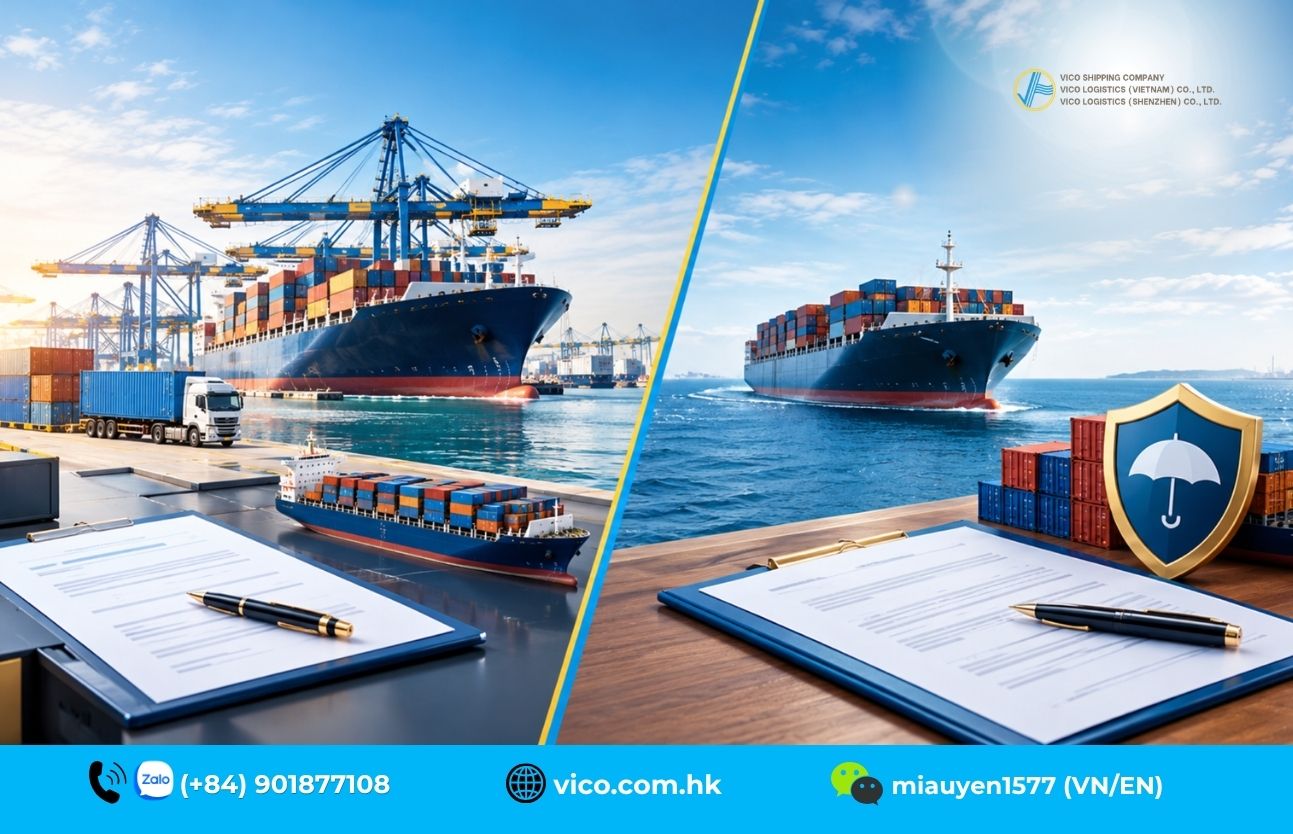
The table below summarizes the main differences between FOB and CIF under Incoterms® 2020.
|
Criteria
|
FOB
|
CIF
|
|
Full Name
|
Free On Board
|
Cost, Insurance and Freight
|
|
Transport Mode
|
Sea and inland waterway transport
|
Sea and inland waterway transport
|
|
Delivery Place
|
On board the vessel at the named port of departure
|
On board the vessel at the named port of departure
|
|
Point of Risk Transfer
|
When the goods are loaded on board the vessel at the port of departure
|
When the goods are loaded on board the vessel at the port of departure
|
|
Main Ocean Freight Arrangement
|
Buyer
|
Seller
|
|
Main Ocean Freight Payment
|
Buyer
|
Seller
|
|
Cargo Insurance
|
Not mandatory under FOB rules
|
Seller must purchase insurance at CIF minimum coverage
|
|
Export Clearance
|
Seller
|
Seller
|
|
Import Clearance
|
Buyer
|
Buyer
|
|
Import Duties & Related Taxes
|
Buyer
|
Buyer
|
|
Choice of Carrier
|
Usually arranged by the buyer
|
Usually arranged by the seller
|
|
Suitable When
|
Buyer wants to proactively control sea transport
|
Buyer wants seller to arrange ocean freight and minimum insurance
|
Note: The comparison table is based on the division of obligations in the ICC's FOB and CIF rules. Specific costs depend on contracts, scope of service, individual agreements, and actual incurred fees.
3. How Do FOB and CIF Differ in Cost and Risk?
3.1. Who Is Responsible for Paying Ocean Freight?
This is one of the most important differences when comparing FOB vs. CIF.
-
With FOB, the buyer typically works directly with shipping lines or freight forwarders to make bookings, negotiate ocean freight rates, and track shipping schedules. The buyer can choose service providers based on price, schedule, transit time, and support quality.
-
With CIF, the seller arranges and pays for ocean freight to the agreed port of destination. This can be convenient for buyers who do not yet have logistics partners or lack extensive experience in organizing international transport.
However, the CIF price provided by the supplier is not necessarily the option with the lowest total cost. The buyer still needs to check destination port charges, included scope of service, and related transport conditions.
3.2. At What Point Do FOB and CIF Transfer Risk?
A common misconception is that CIF makes the seller liable for all risks until the goods reach the destination port.
In reality, under both FOB and CIF, delivery and risk transfer occur when the goods have been loaded on board the vessel at the port of departure according to the respective rule.
The difference is that CIF requires the seller to arrange freight and insurance to the destination port, while FOB assigns main freight arrangement responsibility to the buyer.
If cargo is damaged or lost during transit after risk has transferred, determining rights and responsibilities will depend on the cause, contract of carriage, insurance terms, and relevant documentation. It cannot be concluded that a CIF seller is always liable for compensation simply because they paid the freight.
Therefore, businesses must distinguish between two separate concepts:
-
Transport Cost: Which party is obligated to arrange and pay according to delivery terms.
-
Cargo Risk: Which party bears the risk of loss or damage from the point specified in Incoterms.
These two concepts are related but not identical.
3.3. Is Cargo Insurance Under CIF Sufficient?
Under CIF Incoterms® 2020, the seller must purchase cargo insurance meeting the minimum coverage level required by CIF rules—typically corresponding to Institute Cargo Clauses (C) or equivalent clauses—unless otherwise agreed by the parties.
This minimum coverage level does not mean all types of losses are covered. Compensation scope depends on specific clauses, exclusions, deductibles, and claim procedures.
If the goods are high-value, fragile, perishable, or require special preservation, the buyer should verify:
-
Copy of policy or insurance certificate.
-
Sum insured and currency of insurance.
-
Scope of risks covered.
-
Exclusions and deductibles.
-
Loss notification and claim filing procedures.
-
Possibility of purchasing additional insurance if minimum coverage is insufficient.
With FOB, the buyer has no obligation to purchase insurance under FOB rules itself, but can proactively buy insurance to protect their interests during transit.
4. Which Is Cheaper: FOB or CIF?
There is no fixed answer that FOB is always cheaper than CIF or CIF is always more cost-effective than FOB. To determine which option is appropriate, businesses need to compare total expected costs on the same basis.
An FOB quote may have a lower goods price, but the buyer must pay additional freight and insurance. Conversely, a CIF quote includes freight and insurance under CIF conditions, but destination port charges, document handling fees, local transport, and other related expenses may still apply.
4.1. Fees to Check When Comparing
|
Expense Item
|
FOB
|
CIF
|
|
Contract Price of Goods
|
According to FOB quotation
|
According to CIF quotation
|
|
Origin Charges (Seller's Obligation)
|
Usually included in FOB price scope
|
Usually included in CIF price scope
|
|
Main Ocean Freight
|
Buyer arranges and pays
|
Seller arranges and pays
|
|
Insurance Under CIF Rules
|
Buyer considers independently
|
Seller must arrange minimum coverage
|
|
Destination Port Charges
|
Check quotation and contract
|
Check quotation and contract
|
|
Import Clearance & Duties
|
Buyer
|
Buyer
|
|
Transport from Destination Port to Warehouse
|
According to buyer's logistics plan
|
According to buyer's logistics plan (unless otherwise agreed)
|
Note: The table above illustrates a general division of responsibilities, not a definitive list that all fees are included in the price. Businesses should request quotations clearly showing which items are included, excluded, or potentially incurred.
4.2. Example Comparing FOB and CIF When Importing
Suppose a company imports a shipment from China to Vietnam and receives two quotations. The figures below are hypothetical assumptions for illustration purposes only, not market rates.
-
Option A – FOB
-
FOB Goods Price: $20,000
-
Ocean Freight arranged by buyer: $1,200
-
Insurance purchased by buyer: $100
-
Destination port charges & related fees: $450
-
Total cost of listed items: $21,750
-
-
Option B – CIF
-
CIF Goods Price: $21,000
-
Freight & Insurance under CIF obligations: Included in CIF price
-
Destination port charges & related fees: $450
-
Total cost of listed items: $21,450
-
In this example, CIF is $300 lower. However, if the ocean freight negotiated by the buyer under FOB is lower, or if the CIF quote contains unstated additional charges, the outcome may change.
To make an accurate comparison, bring quotations to the same baseline: same goods category, quantity, port of origin, port of destination, shipping window, fee scope, currency, and insurance coverage. Additionally, calculate duties, customs clearance costs, and inland transport if the goal is to determine the total landed cost to the warehouse.
5. When Should You Choose FOB, and When Should You Choose CIF?

5.1. When to Choose FOB?
FOB may be suitable when a business:
-
Has a freight forwarder or in-house logistics team to handle bookings and manage transport.
-
Wants to proactively select shipping lines, vessel schedules, and negotiate ocean freight rates.
-
Wants to compare multiple shipping options from various logistics providers.
-
Needs to tightly manage delivery schedules and shipment tracking information.
-
Plans to purchase cargo insurance tailored to the specific value and nature of the shipment.
Note: For containerized cargo, consider whether FCA is more appropriate. FOB is designed for sea and inland waterway transport where delivery occurs on board the vessel. If the seller hands over the container to the carrier at a container yard prior to loading on board, FCA usually aligns better with the actual delivery point.
5.2. When to Choose CIF?
CIF may be suitable when a business:
-
Prefers the seller to arrange ocean freight and minimum CIF-required insurance.
-
Lacks extensive experience in international vessel booking.
-
Wants a quote bundling product price, freight, and insurance for easier budgeting.
-
Has verified destination port charges and insurance coverage details.
-
Can coordinate effectively with the seller regarding document provision and resolving arising issues.
Even when choosing CIF, buyers should still review the transport service provider, insurance documents, and unincluded fees. The fact that the seller pays ocean freight does not eliminate the buyer's need to control costs and risks.
5.3. Quick Decision Guide
|
Business Need
|
Recommended Option
|
|
Want proactive control over shipping lines and freight negotiation
|
FOB
|
|
Want seller to handle ocean freight and minimum insurance
|
CIF
|
|
Want to compare total landed cost across multiple quotes
|
Request itemized quotes for both options
|
|
Importing containerized goods handed over at yards before loading
|
Consider FCA instead of defaulting to FOB
|
|
High-value cargo or specific cargo risks
|
Carefully review insurance and consider additional coverage
|
Do not select a delivery term based solely on the lowest price. Evaluate total cost, control level, obligations, documentation, and contingency handling capabilities.
6. Important Considerations When Importing Under FOB or CIF
6.1. Clearly Specify Departure Port, Destination Port, and Incoterms Version
In contracts, explicitly state named places or ports alongside the rules version, for example:
-
FOB Shanghai, China, Incoterms® 2020
-
CIF Cat Lai Port, Vietnam, Incoterms® 2020
Specifying exact places helps parties accurately identify delivery points, cost allocation, and risk transfer timing. ICC emphasizes the importance of naming specific places or ports when using Incoterms.
6.2. Do Not Confuse CIF Price with Landed Warehouse Cost
A CIF price usually covers product price, freight, and CIF-obligated insurance. However, businesses must still verify destination port charges, import procedures, taxes, and inland delivery.
To know your exact import budget, request quotations with a clear scope of service rather than comparing just the FOB or CIF figure on the commercial invoice.
6.3. Check Destination Port Charges Before Finalizing CIF
Upon receiving a CIF quote, buyers should verify:
-
Whether ocean freight covers all the way to the correct destination port.
-
Which party bears destination terminal handling charges (THC) and document fees.
-
Whether additional charges apply based on transport terms.
-
Free time for container detention/demurrage and applicable penalty rates after expiration.
-
Which entity issues documents and assists with problem resolution.
Specific charges depend on the shipping line, port, cargo type, and service agreements. Therefore, verify using actual shipment quotes.
6.4. Verify Insurance and Transport Documents
Under CIF, do not stop at "insurance included." Confirm insurance certificates, policy clauses, sum insured, and claim filing procedures.
Under FOB, buyers need to take note of when risk transfers and proactively arrange coverage if tailored protection is desired.
Additionally, verify consistency across the sales contract, commercial invoice, packing list, bill of lading, and related paperwork.
6.5. Correctly Understand the Role of Incoterms
Incoterms divide specific obligations, costs, and risks between buyers and sellers; they do not govern every aspect of a contract. For instance, transfer of title (ownership) and payment terms must be defined separately in the sales contract.
Businesses should view FOB or CIF conditions as one part of transaction management, not a replacement for a full contract review.
7. Frequently Asked Questions About FOB vs. CIF
Does FOB include ocean freight?
No. Under FOB Incoterms® 2020, the buyer is responsible for arranging and paying main ocean freight. The seller bears obligations and costs within their scope until goods are delivered on board at the departure port.
Does CIF include import duties?
No. CIF does not automatically include import duties or complete customs clearance costs in the destination country. The buyer is typically responsible for clearing imports and settling associated tax obligations.
Does CIF mean the seller bears risk until cargo arrives at the port?
No. Under CIF Incoterms® 2020, risk transfers from seller to buyer when goods are loaded on board the vessel at the port of departure. The seller pays freight and arranges insurance to the destination port under CIF rules, but this does not alter the risk transfer point.
Does CIF cover full insurance for all cargo loss?
Not necessarily. CIF requires the seller to procure insurance at minimum coverage levels under CIF rules, unless otherwise agreed. Buyers should inspect insurance clauses and consider purchasing supplementary coverage if needed.
Are FOB and CIF used for containerized cargo?
FOB and CIF are intended for sea and inland waterway transport. However, when containerized cargo is handed over to a carrier at a container yard before loading on board, FCA is often better suited to the actual point of delivery. Choose conditions based on actual handover methods, not just trade habits.
Should I choose FOB or CIF when importing from China to Vietnam?
This depends on goods pricing, ocean freight, destination port fees, insurance scope, and your capacity to manage transport. It is advisable to request itemized quotes for both FOB and CIF, then compare total costs on an identical scope of service before deciding.
8. VICO Logistics Assists in Reviewing FOB and CIF Costs

When importing goods, choosing between FOB and CIF is only the first step. To control your budget and prevent unexpected expenses, businesses must simultaneously evaluate ocean freight, origin/destination port charges, documentation, customs clearance, and inland transport.
VICO Logistics can support your business in evaluating shipping options, reviewing quotation scopes, and identifying cost items that need clarification before finalizing shipments.
When requesting a quote, prepare:
-
Commodity name and cargo specifications.
-
Quantity, weight, and dimensions.
-
Pickup/departure address or port, and destination port.
-
Supplier's quoted delivery terms: FOB or CIF.
-
Estimated time of shipment (ETS).
-
Special requirements regarding insurance, handling, or delivery.
Have an FOB or CIF quote and unsure which option is optimal? Contact VICO Logistics to discuss shipping routes, service scopes, and fee items requiring verification before making a decision.
Properly selecting delivery terms helps businesses gain proactive control over budgets, risks, and import planning.
- What Is Customs Inspection of Goods? Process & Costs
- How Is Ocean Freight Calculated? FCL, LCL & Surcharges
- VICO Logistics Named a Top 5 Finalist at the Search Engine Land Awards 2026
- How to Calculate Import Duty in Vietnam (2026 Guide)
- What Are Green, Yellow, and Red Customs Channels? Differences & Handling Guide
- What Is a Customs Declaration? A Complete A–Z Guide for Businesses
- What Is an HS Code? How to Find HS Codes, Calculate Duties, and Avoid Incorrect Declarations
Get a Logistics Quote in just 5 minutes
Professional international transportation and supply chain solutions tailored for your business.
Get a quote now ↗Quick Contact
🇻🇳 Ms Uyen
Hotline / Zalo
(+84) 901 877 108WeChat (VN/EN)
miauyen1577Scan to Contact
Zalo
🇨🇳 Ms Schyler
Office Hotline
(+852) 3759 9300WeChat ID
Schyler_skylarScan to Contact
VICO International Logistics — Your Trusted Logistics Partner in Indochina
Senior member of international logistics and trade associations: Eurocham, JCtrans, VICOFA, VITAS, and more.